
What AOC Wants For The World
The overwhelming majority of her critics are vapid; but there is one potential vulnerability in her vision of a better future.

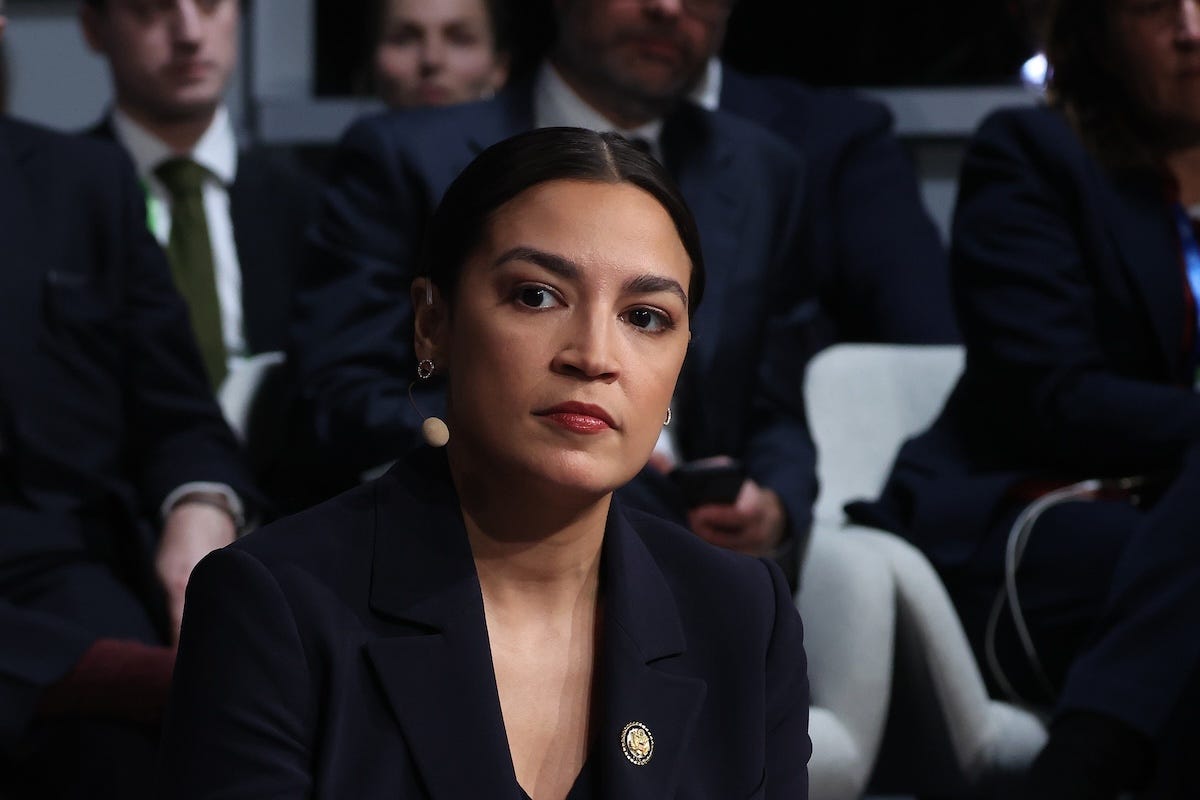
If you’ve been on the fence about breaking up with mainstream political news to support independent journalism, do me a quick favor and Google AOC + Munich. Open a new tab and do it right now. No leading words, just enter AOC + Munich and scroll the headlines.
You’ll likely notice a slight bias. We live in the Trump era, yet for some reason Democrats must meet a very high standard of gaffe-avoidance. You’ll see that establishment media (Google included) still enjoys the power to define politicians, and is simply selective about who’s subject to this kind of treatment. Alexandria Ocasio-Cortez fell short of an arbitrary bar, freeing political journalists to depict a topsy-turvy world in which one of the Democratic Party’s most articulate leaders is an incoherent amateur. Their imputation that clarity and polish are essential political skills is left unstated, because that might raise some questions about double standards.
Essentially all substantive criticism of AOC has come from the left. Her progressive critics detected a dissonance between her appeals to economic egalitarianism and her participation in a security conference of, by, and for the global elite—with all of its assumptions about the international trading system, and the defense alliances that undergird it.
“[F]or a politician that has built a progressive platform on criticism of US military interventionism and domestic policies aimed at benefitting the working class,” tut-tutted The Nation, “her presence at [the Munich security conference], widely considered to be the biggest international annual security event in the West and a major hub for hawkish military elites, seemed at first glance out of line with her values.”
In AOC’s defense, I believe these critics misapprehend the ambitious vision she drew in her remarks. But it’s important to probe the limits of that vision.
What AOC wants to see in the world, apparently, is U.S. moral leadership stripped of contradictions, and sustained by global, pro-democratic class solidarity. When we fail to live up to enlightened values, we breed contempt; when democracy doesn’t deliver people a decent standard of living, they will be tempted by the false promises of strongmen. Those vulnerabilities imperil both freedom and prosperity.
It’s a highly ambitious, idealistic vision of a better future. And there’s nothing in it for most progressives to dislike. To be a little flip, it’s a two step process of, first, global class war.
“We are moving in this direction of increased recognition that we have to have a working class centered politics if we are going to succeed, and also if we are going to stave off the scourges of authoritarianism,” which she defined as “political siren calls to allure people into finding scapegoats to blame for rising economic inequality, both domestically and globally.”
…and, second, benevolent U.S. participation in the new class-conscious community of democracies.
[W]e are in a new day and in a new time. But that does not mean that the majority of Americans are ready to walk away from a rules based order, and that we're ready to walk away from our commitment to democracy. I think what we identify is that in a rules based order, hypocrisy is vulnerability, and so I think what we are seeking is a return to a rules based order that eliminates the hypocrisies around when, too often in the West, we look the other way for inconvenient populations to act out these paradoxes, whether it is kidnapping a foreign head of state, whether it is threatening our allies to colonize Greenland, whether it is looking the other way in a genocide. Hypocrisies are vulnerabilities, and they threaten democracies globally. And so I think many of us are here to say, we are here and we are ready for the next chapter, not to have the world turn to isolation, but to deepen our partnership on greater and increased commitment to integrity to our values….
When you have a rules based order where you carve out exceptions to our values, exceptions to our rules, eventually the exceptions become the rules. And I think that to your original point, over the last five years, we've seen such a breaking and such a fraying of these alleged western values that people wonder if it ever existed in the first place. So I don't know if it's necessarily that we are in a post-rules based order, I think it's possible that we were in a pre-rules based order, and we have an opportunity to explore what a world would look like if we upheld democracy, human rights, trade that actually centers working class people, instead of accruing overwhelmingly the benefits of trade to the wealthiest. But if we reoriented a new era that could actually help people and show how foreign policy and healthy foreign policy can show up and help them in their lives.
There is no tension, in this view, between an international liberal order and social democracy. She has not aligned with dread globalists at the expense of workers. She wants to forge an international popular alliance of workers and their progressive allies, to counter the bourgeoning alliance of nationalists and kleptocrats—and for the resulting governments to helm more honorable, humane alliances.
You may think this is all pie in the sky. Moving the world in this direction is the undertaking of lifetimes. But it is a good vision, and perfectly defensible.
My main question is to what extent she presents this idea in this manner because she thinks it can be fashioned into a strong domestic and international political appeal, and to what extent she actually believes the underlying analysis—that fascism is an outgrowth of working class economic disaffection, and thus that economic policy is our best weapon in the fight against authoritarianism.
To my mind, it’s a strong, high-brow appeal, and a good guide star for the people who will build the future. It does not, however, strike me as an accurate assessment of the social underpinnings of authoritarianism, and would thus be a poor guide star for the more immediate challenge of defeating fascism.
This is a tricky dance for left-leaning politicians, because the politics of rules, norms, and democracy have become viewed with suspicion and contempt, particularly on the left. In shorthand, leftists want to wage class war, but get thwarted by sell-out centrists who appeal to norms and rules as a crutch, because they can’t admit that their governing ideas are too milquetoast to appeal widely. The reality is a bit different. Leftists and centrists alike believe anti-Trump politics have failed, and should be jettisoned, in favor of economic appeals. Leftists believe this for Marxist reasons; centrists believe it because they spend the most time listening to pollsters. But as a tactical matter, they agree.
In between and all around these two factions are idealists and optimists (myself included) who think democracy must be protected—first and on its own terms—because democracy is prior to everything else, and humans clearly form politics on the basis of more than just their bank accounts. It’s an argument about sequencing and priorities, and the power of abstract appeals, rather than the substance of any policy.
AOC’s left-wing critics have little interest in U.S.-led global anything and wish she would stick to domestic egalitarianism. Our view is that beating fascists and holding them accountable is a predicate to everything, and that this is now a global challenge: What work does left-populist economic rhetoric or policymaking do in societies where rightists control all the levers of power and won’t give them up without a fight? Donald Trump has been effectively disciplined by bond traders, and, in his most fascist adventure, the community of freedom-loving people in Minneapolis. Not by increasing class consciousness. It’s true that Trump has quickly squandered the cross-racial working-class support he built in 2024, but there’s good reason to believe these voters have defected not simply because he broke his economic promises. They walked away because his whole schtick is an affront to liberty and decency, without any upside.
In our view, authoritarianism must be crushed using every available means, if we are to make the world safe again for egalitarian policymaking. I think AOC is trying to signal solidarity with us, but not agreement. In her telling, economic egalitarianism must come first, and it will usher people away from authoritarianism on its own.
To see things that way, you have to believe MAGA and the rise of far right parties throughout the democratic world are principally economic phenomena, and that defeating them is a matter of fixing what’s broken about economic policies—at which point the allure of conspiracy theories and hatreds will ebb.
It is a commonly held view. There is much, much less evidence for it than I’d like there to be:
We’ve lived through worse economies that did not prefigure the rise of global fascism.
We just experienced Biden’s economy, which did more to compress inequality than most people realize, faster than almost anyone thought possible, and it did not create cross-racial class solidarity. Indeed, it prefigured a swing of working-class people of color toward the GOP.
The appeal of far-right politics has grown even in social democracies, notwithstanding their robust safety nets and benefit systems.
The one variable that changed everywhere all at once is the proliferation of disruptive new information technology.
Convincing people that the future can and will be better actually is an essential component of politics, much more so than clarity and polish in extemporaneous speaking. Trump probably couldn’t muster the phrase “strategic ambiguity” from memory, let alone explain its importance, but he promises a return to greatness in just about every public appearance.
In that sense, an optimistic vision can help political talents like AOC draw popular support. But to succeed—to stem the tide of authoritarianism—they will need to increase mass consciousness of the poisonous effects of algorithmic media, including of A.I. technologies that proliferate fabrications and incitement at industrial scale. At the very least, we need people around the world to become better at compartmentalizing internet and non-internet, and to be clear that only the latter should serve as a guide to politics.
More likely, we’ll need these companies to flounder and fail or respect constraints, as they become viewed with greater contempt. Through boycott we can harm them. Through taxes we can limit their power and gain some restitution. If their greed crashes the economy, populist anger can be marshaled against them. But the politics will be tricky because while awareness of social-media ills is widespread, so is its use. Biden waged hostilities against tech platforms, and it did not endear him to anyone. It took much more than mass awareness of the dangers of smoking cigarettes to really put the screws to tobacco companies. Most people surely know that drinking alcohol is unhealthy, but neo-prohibitionism, or even just support for a hefty alcohol tax, would be an extremely dicey political proposition.
The point, though, is that various kinds of direct confrontation with the forces fanning authoritarianism will be necessary. Criminals will need to go to jail; collaborators will need to be exposed; their best tools will need to be confiscated. We can’t count on fiscal and regulatory policy—from the left, center, or parts in between—to do that work for us, because our luck will eventually run out. We’ll have a recession, or stumble a bit as we build out imperfect new systems of income and wealth distribution. And evil will be ready to pounce.
The very fact that the AOC pile-on happened at all is a testament to her power and voice. And her (and others') ascendency. The jeering men-children are at least smart enough to recognize a threat when they see one.
Yes, 100%, all of this.
And a few additional points:
1.) AOC joined Bernie after the 2024 election in repeating the old canard that Democrats lost to Trump because they "abandoned the working class". But both of them were fully behind Biden--and in fact opposed him leaving the race--because they thought he had been the "best president for the working class in decades".
Try as their supporters might to deny it, there is a logical disconnect there.
2.) Toby Buckle has done God's work exposing and debunking the old "Voters are turning to fascism because they are economically deprived" bullshit--he best encapsulated that debunking here:
https://www.liberalcurrents.com/a-disease-of-affluence/
3.) AOC, much as I like her, is going to have to be an FDR-like figure if she gains the presidency--and not in terms of "fighting for the working class". But in terms of leading the free world against tyranny.
I do not think that is a job she is prepared for, interested in, or planning for.
If she becomes president, or even gains real power in America, she had damn well be ready to have that mantle thrust upon her. Because it's coming.