
Obamacare Was Not Universal Health Insurance
It was much better than the status quo ante, but the point of a starter home is to move on to something better, not to continually rebuild as time and vandalism damage its foundation.

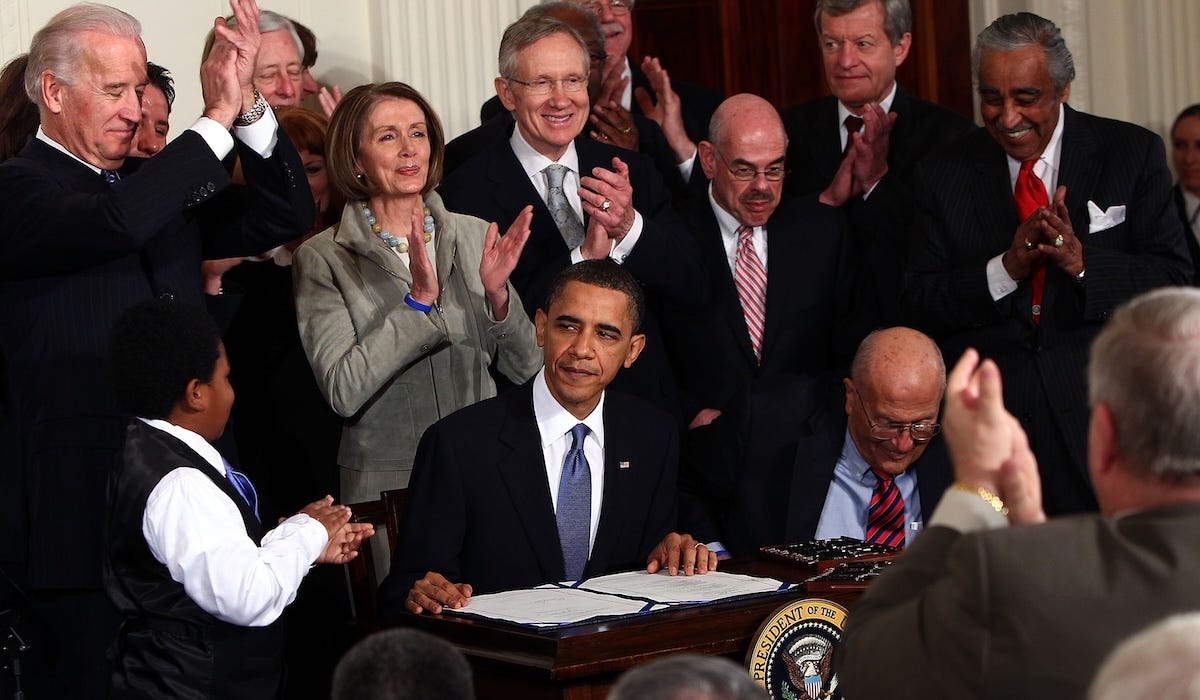
When I wrote last week’s newsletter about Medicare for All, and seeking detente in the Democratic Party’s factional wars, I didn’t know the Searchlight Institute—a new, moderate-branded think tank—was about to release what authors David Bowen and Tré Easton describe as a “comprehensive plan to achieve universal health care.”
Searchlight proposes building on the foundation of the Affordable Care Act by fixing what Republicans have broken, then going further: more generous subsidies for private insurance; fewer obstacles to enrolling in Medicaid; then, over time, a public option that would bring Medicare Advantage plans (privately administered but federally powered) into marketplaces for people who don’t get affordable insurance through their employers.
Searchlight would also create a novel inducement to impel holdout states like Florida and Texas to expand their Medicaid programs: No augmented private-market subsidies for states that continue boycotting the expansion. But the way the provision is structured might actually limit the overall coverage expansion (why wouldn’t Republicans just say no to both?) and would be vulnerable to sabotage by an unreformed Supreme Court.
Even still, these reforms would bring coverage rates much higher than they’ll be at the end of Donald Trump’s term, possibly even higher than they were when the ACA was functioning at its best under Joe Biden. Their plan would improve public welfare significantly. Millions of Americans would be better off.
But would coverage be universal, as the authors describe it?
They use that phrasing, at least in part, to emphasize a conceptual distinction between multipayer systems that, in sum, cover every citizen, and plans that aim to pool all (or the overwhelming majority) of citizens into a single government-administered insurance program. Call the latter “Medicare for All.” The unspoken implication is that there’s a way to accomplish the goal of universality by sealing up all the cracks in the system that leave millions uninsured, without taking steps as radical as Medicare for All—which would either eliminate the private insurance industry, or shrink it dramatically.
This distinction is important to mainstream Democrats. If it is actionable in the real world, then the moral divide between the left and the center closes, and little is lost by embracing incremental reforms: We all support universal health care, we just have different ideas about how to achieve the goal.
The writer Jonathan Chait recently emphasized this point in an article called “You Don’t Need to Vote for Socialists to Get Universal Health Care.” In it, he asserts, “Nobody in the Democratic Party opposes universal coverage.”
Teeing off the same theme, Easton himself claimed that the plan I support—open up Medicare, and let it outcompete private health insurance—“isn't actually capitulating on Medicare for All. It's doubling down on a commitment to universal health care, which Democrats of every ideological stripe support.”
Are these claims true, though? Is there a way to make insurance coverage a basic, permanent fact of citizenship by incrementally reforming the current system rather than changing it radically? A lot hinges on the answer. If it’s “yes,” mainstream Democrats can protect the public from Republican sabotage without conceding much if anything to the left. We won’t, as I argued, “always be one election away from Republicans throwing 30 million people off their health plans.”
After covering national health care debates for about 20 years, though, I think the answer is no. Probably not on paper, and definitely not in our political reality, where all the different insurance systems comprise constituencies with different levels of political clout, and the right places bullseyes on the weakest.
The claim that Democrats of every stripe support universal health care is true abstractly but not programmatically. Many Democrats blanch at the steps that would be required to build out the last mile of coverage. Even under various manifestations of “Clintoncare,” which contemplated a much more aggressive approach to reform, it was widely understood that some millions of people would remain uninsured. Eight percent of the population, according to one 1994 report from the Congressional Budget Office. As President Clinton said at the time, “no one has yet found a way to do that without a law that says ‘universal coverage.’… [W]e have universal Social Security, but about two percent somehow don’t get covered. We have universal school attendance laws in every state in the country, but there are always a couple of percent of the people that fall through the cracks.”
The cracks in Obamacare were larger. Where Clintoncare would have opened job-based health insurance to tens of millions, growing out our biggest private system, the ACA created new, smallish systems at the margins for the self-employed, small-business employees, and near-indigent. These have proven attractive targets for Republicans.
What made Obamacare radical, in the American context, was its coverage guarantee. But even excluding those who’d choose to remain uninsured (like children who skip school, or seniors who don’t claim Social Security benefits) this did not make coverage universal. It just meant insurance companies could no longer legally discriminate against sick people by denying them coverage or overpricing it.
But the ACA wasn’t of much use to uninsured people (sick or healthy) who couldn’t afford private market premiums, even with subsidies, nor to people who were eligible, but too detached from social services to enroll.
And these shortcomings of the plan increased the number of people who chose to opt out: The law originally required them to pay a small penalty for going uninsured; Republicans eliminated the coverage-requirement penalty altogether after a few years, making free-riding literally free. Obviously no one anywhere is required to consume the health care services they’re entitled to, but in all societies, these defectors will eventually get sick or injured. In other societies, those people show up at hospitals or clinics, or get wheeled into emergency rooms, and providers treat them without sweating their patients’ ability to pay. There may still be de minimis out-of-pocket costs or paperwork at the point of care, but it’s understood that everyone’s covered.
The ACA design made it so that, for many abstainers, having a change of heart on the gurney wouldn’t really work. The public will cover (some) emergency care (through the mechanism of higher costs) but from there, options vary and thin out. If you’re poor and meet the criteria, you might end up on Medicaid. But if you aren’t insured, and one day you collapse due to an undiagnosed chronic condition, you can’t just count on being able to walk out of the hospital insured, with no huge unpaid bills, and embark on a course of coordinated care.
To accomplish that, you really do need a law that, per Bill Clinton, says “universal.” Or “all,” if you prefer.
Nevertheless, it is true that regulated private health insurance, along with expanded public programs, can get you very close. Had Republicans cooperated in the establishment of the ACA as a compromise, tolerating a system that leaves, say, five to 10 percent of the population uncovered might have been worth the upside of long-run stability. And over time, with enhancements and wraparound services, we could have brought that number down. Ultimately my main problem with the incrementalist approach isn’t the cracks people fall through. It’s that the current system is highly vulnerable to partisan vandalism, which makes repeatedly sealing the biggest cracks a sucker’s game.
As enacted, the ACA was projected to leave a bit over 20 million Americans uninsured.
The first attack struck before the law had been implemented, when the Supreme Court rewrote it to make its Medicaid expansion optional for states rather than mandatory. Its coverage potential dropped by millions in an instant.
Then (as noted above) Republicans eliminated the coverage “requirement” (which was itself more like a parking ticket than a real inducement to buy coverage). Democrats countered under Biden by temporarily increasing the value of market subsidies. But those enhanced tax credits expired. Republicans didn’t and won’t renew them1. And they certainly don’t go out of their way to make the law function well, or to draw eligible beneficiaries out of the woodwork.
Their goal upon passage of the ACA was to get the law off the books altogether. They never accomplished it. But the Supreme Court got them, say, a quarter of the way there. They got another quarter of the way there through malign neglect and outright sabotage. By the end of Trump’s term, the ACA will likely still exist as a matter of law. But it will be in terrible shape.
This is why, apart from the goal of fostering intraparty cohesion, Democratic wonks should place a higher priority on establishing a truly universal system that’s insulated from GOP sabotage, than on fixing the visible damage Republicans have done to the current system. I suspect they’d quickly arrive at the conclusion that to protect beneficiaries, particularly lower-income ones, we need to consolidate them. Republicans would still be able to siphon money out of the system to finance tax cuts, but they wouldn’t be able to do it by removing poor people from the rolls.
In other words, I think it’s time to move on. Bowen recalls that Obama described the ACA as a starter home. He writes, “we don’t need to tear down the ACA ‘starter home’ and build a new one.”
But nobody tears down their “starter home” to build and move into a new starter home. The metaphor contemplates a better quality of life over time. People buy starter homes with the goal of moving on to something bigger and better. Some people do sink lifetimes into maintaining their starter homes, or even tearing down walls to build out new rooms. But it usually makes more sense, when the opportunity arises, to trade up.
That’s my case against reattempting incrementalism. But I admit, I’m a cheap date.
I thought it was a bad idea for Obama to negotiate away the public option he campaigned on, and a worse idea for him to hide the ball about that choice. I thought it was a bad idea for Democrats in Congress to negotiate the zombie public option down from one with Medicare’s purchasing power to one with a trivial market advantage over private plans, before abandoning the idea altogether. But I did not think these disappointments merited killing what was left of the bill. That version of Obamacare, the one that became law, ended up providing insurance to tens of millions of people. This is why every progressive in Congress at the time, including Bernie Sanders, voted for it, resisting calls from the left to hold out for the public option. Even if it meant dooming the legislation. It’s hard to imagine a more cavalier example of making the perfect the enemy of the good, with so many lives in the balance.
If Democrats come back to power in 2029, and their main policy accomplishment is a tinkering that reinsures those who lost coverage under Trump, and then some, it would strike me similarly: a big missed opportunity, much better than nothing.
But my thought at this point is that we should aim for universality of the kind that moots the question “is this person insured?” with a system that’s “too big to sabotage.” When someone arrives at the hospital gravely ill or injured, nobody should have to fear that admitting him will ruin his finances, or that he won’t be able to afford days, months, years, or a lifetime of outpatient care. And Republicans should have to be willing to upset hundreds of millions of people, not just tens, if they want to attack the system.
Our balkanized approach is a recipe for endless legislative and administrative complexity, along with painful swings between near-universality and giant uninsured populations. If we’re going to sign up for chaos and fighting, I’d rather do something reckless but irreversible, than something cautious and fragile.
My preference would be something considered, like carefully written Open Medicare legislation. But after living through the past decade, I’d rather see Democrats embrace a “move fast and break things” mentality than re-embark on a strategic approach to reform that’s vulnerable to huge reversals. Stop playing patsy to Republicans and make them regret their conduct over the past 16 years. Better to (in essence) cross out the number 65 everywhere in the Social Security Act’s Medicare title and replace it with the number zero than leave the fate of millions up to 20,000 swing voters in Wisconsin every four years. Plant the stake and it’s done. Deal with the messy consequences as they arise.
Democrats would face fierce blowback—as a technocratic matter this would be a terrible way to establish Medicare for All—but good luck to anyone who, four years later, would try to raise that number back to 65 and leave hundreds of millions of Americans with nothing.
That kind of approach obviously won’t be everyone’s cup of tea. It’s not really mine! But I can’t conjure a faithful opposition. And I wonder why, after all we’ve been through, we don’t see more ambition to move out of the straw starter home into one the big bad wolf can’t blow down.
If Democrats make them permanent in the future, Republicans can claw them back to finance tax cuts, just as they cut Medicaid to finance tax cuts last year.
As a senior who has sometimes worked in healthcare as a consultant and operations manager, I favor the approach that you recommend here. Will it cause dislocations that will need to be addressed? Absolutely! But our current “dislocations” are worse and extremely cruel.
Aim high, move forward fast and fix things along the way.