
Using FOIA To Expose Trump's Biggest Coverup
His administration is still concealing Epstein files that incriminate him.

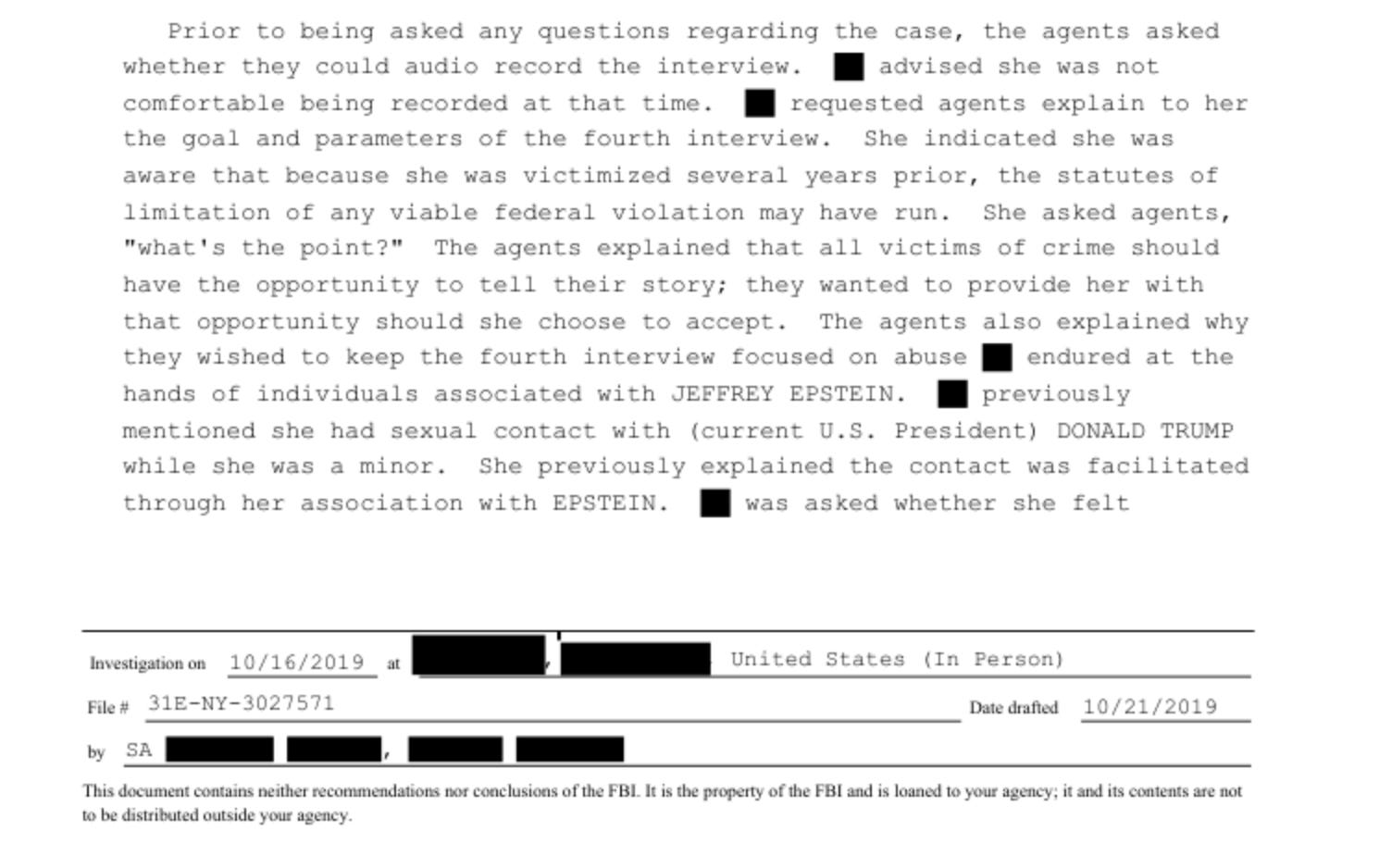
I have submitted a Freedom of Information Act request to the Federal Bureau of Investigation in an effort to unravel an ongoing Trump administration coverup—specifically, of evidence that Donald Trump battered and sexually assaulted a teenager in the 1980s.
In both the interest of transparency—and because multiple sources tell me Trump administration political appointees have compromised what should be an independent, routine FOIA process—I have reproduced the request here, as submitted, with only my office address and the accuser’s name redacted.

This reduces the likelihood that the improperly withheld documents will be provided exclusively to Off Message. But it better advances the public interest: first, by drawing further attention to the existence of these documents; second, by alerting the public to the administration’s actionable legal obligation to release them under the combined authorities of FOIA and the Epstein Files Transparency Act—so that the government can’t violate the law quietly. I am unaware of any duplicative effort to force disclosure of these documents to the media, though it’s certainly possible that other outlets have submitted similar requests without announcing it.
The investigative journalist Roger Sollenberger was first to report the existence of the allegation, along with the fact that the FBI had deemed the accuser credible, and that nearly all documentation stemming from her allegation had been withheld or removed from the Epstein files.
In response to Sollenberger’s reporting, public pressure from members of Congress, and the efforts of other journalists, the administration ultimately released many of these materials. Specifically, notes from the interviews FBI agents conducted with this accuser, over the course of three months, beginning in July 2019.
In those interviews, she alleged that she became a victim of Jeffrey Epstein in the 1980s and, through Epstein, a victim of Donald Trump’s as well. She claims Epstein introduced her to Trump when she was between 13 and 15 years of age, and that Trump “subsequently forced her head down to his exposed penis which she subsequently bit. In response, Trump punched her in the head and kicked her out.”
Administration officials have attempted to undermine this accuser’s credibility, citing her unrelated criminal history later in life, without categorically denying her allegation. White House Press Secretary Karoline Leavitt recently dismissed the accuser’s claims as “completely baseless accusations, backed by zero credible evidence, from a sadly disturbed woman who has an extensive criminal history.” (Her criminal history is not extensive, and does not suggest a track record of making false or defamatory accusations.)
What they have not done is release all responsive records from her case file, which should be covered in full, or nearly in full, by the EFTA.
As Sollenberger explained earlier this week, the Justice Department and FBI are still withholding:
-Field notes associated with interviews 1, 2, and 3 (these are contemporaneous agent notes and are separate from the official 302 writeups; they total 37 pages, and none of them have been released publicly)
-A driver’s license report
-The FBI’s 2019 background check on the accuser…
-Field notes for interview 4 (this 302 was drafted 5 days after the interview; the 302 quotes her directly; she also declined to be recorded; there are almost certainly field notes affiliated with this final interview)
- Any memorialization of the FBI’s final disposition closing her case…also exist somewhere, but we don’t have it
-All versions of the FBI’s “updated case index” spreadsheet…
-Additional internal communications about her case, including any FBI emails at the time as well as any discussion of procedural hurdles — most specifically the OLC guidance that DOJ cannot consider a charging decision against a sitting president
The purpose of this FOIA is to secure the release of all or nearly all of these documents, many of which are in the possession of Ghislaine Maxwell’s attorneys, as they pressure Trump for clemency.
Requesting a living individual’s FBI file under the Freedom of Information Act would normally be a fruitless endeavor. Any responsive documents would be properly and heavily redacted in accordance with privacy law.
But the Epstein Files Transparency Act supersedes the exemptions that would normally compel the government to withhold this information—save, in this case, for the accuser’s name and other personally identifying information.
That is a claim I am prepared to litigate if necessary.
Given the unusual scrutiny surrounding their absence from DOJ’s existing Epstein Files disclosures, it is possible that the administration will release these files in a timely manner—to me or other journalists, or to Congress or the general public.
If so, it would moot the legal question here, of whether the Epstein Files Transparency Act supersedes privacy exemptions that would normally apply to accusers, witnesses, or investigative subjects under FOIA.
But there are reasons to be concerned. As I was preparing this article, Sen. Sheldon Whitehouse (D-RI) sent the below letter to FBI Director Kash Patel and Attorney General Pam Bondi asking them to preserve many of these same files, and reminding them that destroying federal records is a crime.
Notably, FOIA requests are themselves public documents. The request I submitted to the FBI contains the accuser’s name. I have not made contact with the accuser, and do not intend to disclose her identity without permission, so I have implored the FBI to redact her name if the letter is later released as part of any FOIA response, request log production, or other public disclosure by the agency.
Isn't it a bit of a waste of time and effort? I don't think median voter will care much about things Trump did 40 years ago. He was a good looking NY real estate multimillionaire douchebag in his 40s. Sexually assaulting women, even underage (but generally from lower class) was somewhat a norm at the time for people in his station. To make this news one would need help from media, democrats and social media wizards.
Doing God's work.