
27 Thoughts On A Tough Primary Season
There's more to come, but the worst is over, and now it's time for some perspective.

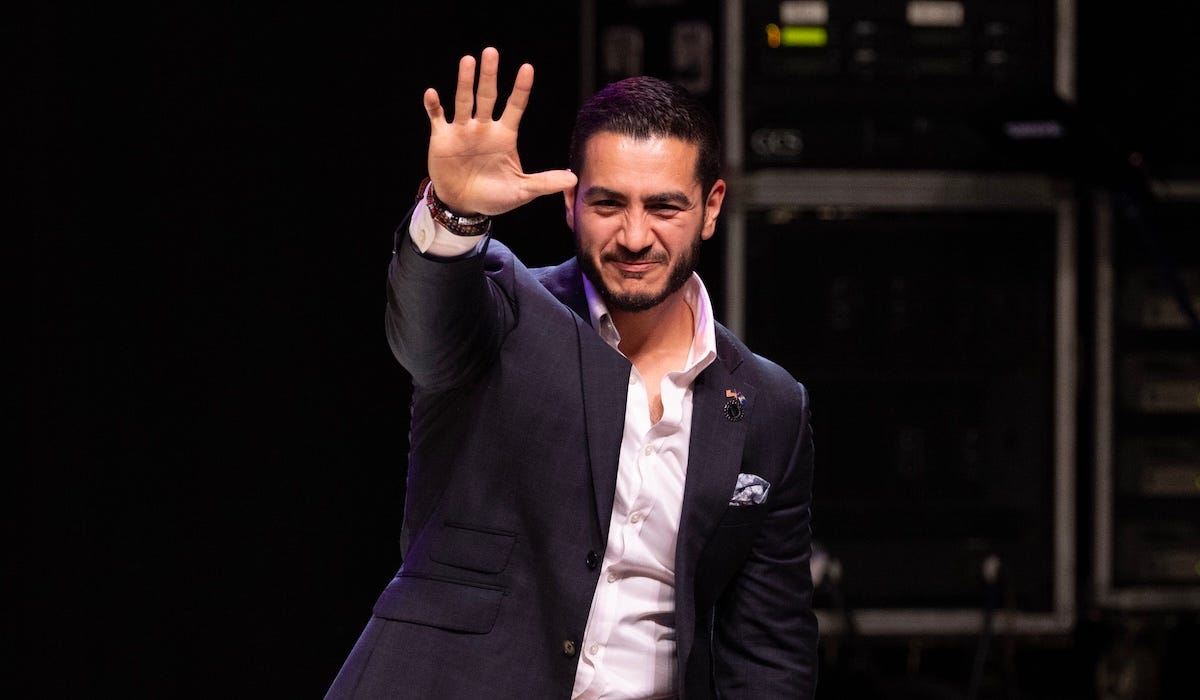
NBC News and Decision Desk HQ have called the Michigan Senate Democratic primary for Abdul el-Sayed.
Primary season isn’t over. But with the Michigan Senate primary now behind us, I think we’re over the hump, effectively in general election season, much like how we downshift for summer in May, weeks before the solstice.
In one sense this all worked out fine for me, personally—and what’s more important than that?—because if I were a Michigan voter, I would have voted for Abdul el-Sayed over Haley Stevens. But I’m not sanguine about it. If Michigan were a D+5-10 state in presidential years, I would be. But it’s not. Exultant progressives are, generally, pretty cavalier about the electoral track records of mainline Democrats vs. progressive Democrats in close-run states and districts.
Ceteris paribus (politicians of basically equal talent running in ordinary times, etc.) in a tight race you’d rather be the candidate viewed as moderate than the candidate viewed as ideologically strident. The political class abuses math both opportunistically and innumerately, but that finding is pretty robust.
But ceteris isn’t paribus. These aren’t ordinary times—the electorate suddenly seems less hostile to high-salience progressive ideas (cutting off aid to Israel, Medicare for All, data-center moratoria, money out of politics). And these are not politicians of equal talent: El-Sayed is unusually charismatic and he opposes the current leadership of the toxically unpopular Democratic Party; Stevens is an unimpressive electoral performer (despite being moderate), an Israel supporter, and Chuck Schumer ally whose primary campaign depended on enormous outside expenditures.
More speculatively, while el-Sayed’s candidacy might carry a bit more downside risk than Stevens, he also runs with a lot of upside risk, too. He’s benchmarked a seven-percent margin of victory for himself, predicting that he’d beat Republican Mike Rogers by slightly more than the state’s current generic-ballot margin. That’s definitely possible. If things shake out well, he could even exceed it.
All of that upside potential lies in the fact that he’s a nimble, energetic, gloves off campaigner—a kind of Democratic swing-state opponent Republicans have basically no experience running against. Someone who, like Republicans, is willing to win by defining his opponent in the minds of voters as weak and pathetic, and winning on the strength of voter revulsion. I’m excited, if admittedly a bit nervous, to see how that plays out.
It isn’t the beginning or the end of anything, but I ironically take heart that this is where the GOP stooped.
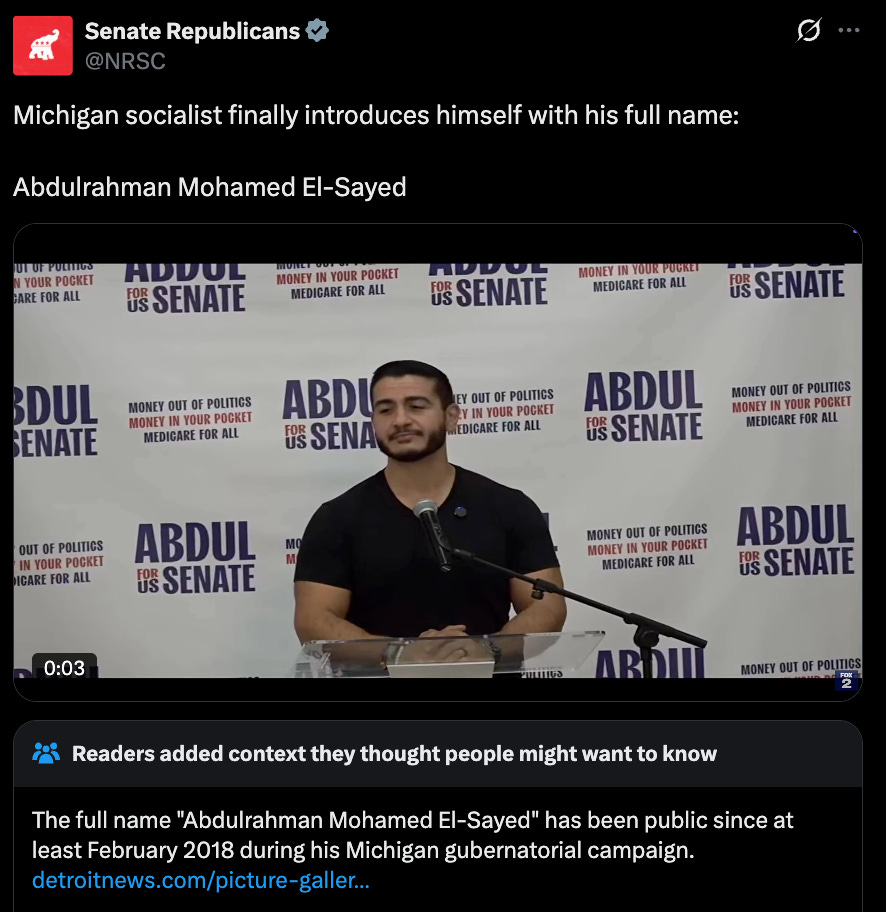
For starters, el-Sayed is not a socialist. So Republicans begin with a lie. But the racist part is a perfect echo of their attempt to beat Barack Obama by referring to him everywhere and always as “Barack Hussein Obama.” How’d that work out for them? Is Obama still popular? Did he serve two terms? Did he win Michigan? Someone remind me…
I understand and share the concern that this primary was unusually brutal and unfortunately late in the cycle. It was also much closer run than the final tranche of polls suggested it would be. There will be a lot of hard feelings and little time to mend them. So el-Sayed has his work cut out for him. Stevens would have, too, if she’d won.
At the same time, brutal primaries aren’t fatal. Many Democratic partisans feel snake-bit by the long and brutal 2016 Democratic presidential primary, prefiguring Donald Trump’s first election. And fair enough! It was a close general election. If things had been more chill on the left, during the primary, maybe Hillary Clinton would’ve won.
But Trump also won a brutal primary! He mounted a hostile takeover of the entire GOP. Maybe more aptly, after that primary, weeks before the general election, he endured a scandal (the Access Hollywood tape) that drove basically everyone in the party he’d taken over to withdraw support from him, then re-endorse him. And he won anyhow.
If you take little comfort from that (Trump won in 2016 with a minority of the popular vote, which doesn’t happen in Senate races) remember that the 2008 Democratic presidential primary was also very bitter, Democrats nominated someone with a name almost as Muslim-sounding as “Abdulrahman Mohamed el-Sayed,” and won handily.
The 2008 and 2016 elections had little in common thematically, and the winners are antitheses of one another. But I believe those races turned out the way they did because the winning electorates (Democrats in 2008, Republicans in 2016) were convinced that the stakes of the election were existential. It helped them overlook misgivings and get over primary-season hard-feelings.
These midterms are a lot like that. El-Sayed will have to put in the effort, but he’ll be pushing on an open door.
That being said, I hope he pushes on it by bringing the fire he just used to burn the Democratic establishment and AIPAC to bear against Rogers and Trump.
What I would really like to have heard this primary season from insurgent candidates is a pitch like this (though delivered in political oratory rather than written polemic):
In 2009, Republicans invented an unconstitutional veto over all legislation, and Democrats did not respond. As a result, Democrats delivered worse health care and fewer jobs than they would have if they’d been more willing to stand up for themselves—and for you. Many analysts believe that the slow recovery from the Great Recession created the public discontent that allowed Donald Trump to consolidate power and unravel democracy.
In 2016, Republicans asserted the unconstitutional power to steal a Supreme Court seat. The Constitution instructs the Senate to advise and consent, Republicans wiped their ass with it. Democrats did not respond; they did not try anything creative to force Republican hands, effectively acceding to the theft. They lost the court for a generation.
In 2021, Democrats quickly abandoned efforts to hold Donald Trump accountable for attempting a coup and inciting an insurrection; as before, they also continued to allow Republicans to veto legislation, making democracy reform impossible.
In 2022, the Supreme Court overturned Roe v. Wade and, for all of the above reasons, Democrats were unable to respond—not by codifying the right to abortion, certainly not by stripping the court of its power, which it went on to abuse: sabotaging prosecutions of Donald Trump, granting him immunity from criminal law.
This is what has to change about the Democratic Party. It has to be willing to unrig the system so that government can function at a rudimentary level. If we don’t do that, we won’t be able to deliver you better health care, or cleaner air, or a viable immigration system. We won’t be able to get money out of politics or make corrupt officials answer for their crimes.
Instead, we got a lot of recriminations pertaining to Israel and AIPAC. And so it remains a sadly open question: What will the new progressive House members and el-Sayed and Troy Jackson do differently in Congress than the people they defeated, vis a vis fighting Trump?
In el-Sayed’s case (and in some others, too) there was at least some logic to running against AIPAC. There’s a big Arab community in Michigan, and AIPAC heavily underwrote the whole pro-Stevens operation. Tens of millions of dollars. Primary candidates are trying to defeat their opponents, and if their main opponent is financed by lobbyists, they will attack the lobbyists, the out-of-state interests, etc.
But now he’s won! AIPAC will almost surely continue to spend heavily against him, but it’s no longer a race about which kind of Democrat should represent Michigan, it’s about whether Michigan’s junior senator should be a rubber stamp for Trump or a real check on his government.
Foreign policy is certainly a part of that equation. But it’s not the whole thing. And the truth is, senators have much less power to check Trump’s foreign policy than to check his domestic corruption.
There may be lessons here for the next cycle. Two years is a long time. Long enough for a party’s national leadership to turn over, or for a party to rehabilitate its tattered image. But if I’m, say, Chuck Schumer, and I’m concerned about the viability and intentions of Bernie Sanders-aligned insurgents, I’m thinking one lesson from 2026 is that if a non-radical, qualified, charismatic outsider enters a competitive race promising to oppose the current leadership, it might be wise to clear the field for that candidate behind the scenes. This is a take about Mallory McMorrow and (to a lesser extent) Dan Kleban in Maine.
More generally, there’s a Greens/Lib-Dems/Labor dynamic recurring in Democratic politics right now: An organized left challenging a muddle of insiders and non-radical outsiders, such that two or three mainstream candidates will frequently split the primary vote and create a path for a single radical to win by plurality. If the left underperforms in general elections, but the party leadership can’t drain the insurgency of enthusiasm, these mainstream candidates will have to do a better job coordinating. Given how discredited the leadership is, I’d “coordinate” by ceding power to these non-leftist outsiders.
The bitterest primary is behind us, but the most fateful may not be. I’m referring here to the Wisconsin gubernatorial primary. Where I would’ve voted for el-Sayed in Michigan, I would not vote for Francesca Hong in Wisconsin.
We shouldn’t take anything for granted. It would be a big own goal to lose the Michigan Senate seat. But in the race for Senate control there’s room for error. If el-Sayed flames out, Democrats will still have credible paths to 51, even 52 Senate seats. If Trump implodes, maybe more. There’s no room for error in Wisconsin. Either the Democratic or the Republican nominee will become governor, and if Democrats lose, they’ll squander their hard-earned opportunity, 16 years in the making, to win a trifecta and unrig Wisconsin’s democracy.
That said, I’m not totally bearish on Hong’s odds, if she wins the nomination next week. Pretty bearish, but not totally.
We should expect Hong to be an electoral underperformer. But we should expect the likely Republican nominee, Tom Tiffany—an election denier running without Trump on the ballot to give him coattails—to be an electoral underperformer as well.
But whereas Tiffany will underperform in a horrible environment for Republicans, without a huge grassroots army behind him, Hong will underperform with the wind at her back, and a huge, committed base of activists and resistance Dems working tirelessly on her behalf.
The worst should be behind us. There are three months until the election. Now it’s time for everyone—left and center—who’s ever admonished “vote blue no matter who” to show their cards. It’s never been more important. That guide star should be easier to follow this cycle than in the past. Anyone who reneges has only ever been a fair-weather friend of democracy.
The GOP cannot run on their agenda because it is hugely unpopular so all they have is overt racism, misogyny, propaganda, name calling and outright lies.
It remains depressing and terrifying that tens of millions of people know this and vote for them anyway.
Anyway, it’s time the party goes to work to help elect El-Sayed.
The kneejerk racism from the Republicans--the Senate Republicans, no less--is as predictable as it is tiresome and (obviously) outrageous. It IS who they are, however, so they can't help themselves. AND they are under the until-very-recently reasonable assumption that the zeitgeist is still Trumpy Nasty™️. It isn't; that wave has crested (for now). Hopefully, they will continue to misread the room like the drunk at the party who doesn't realize or care the music has stopped and the lights have come on.