
You Are Actors In History
A humble reminder for our decadent elites.

As a younger person, I struggled to absorb and process history, and thus didn’t appreciate it—not as a student, not as a sightseer. At least not for the reasons people devote their lives to history as a vocation1. My preferences ran to puzzles with correct solutions, and history, in those days, struck me as a discipline that mostly required students to commit factoids to memory.
College classmates flipping through flashcards all seemed to be studying for organic chemistry or history exams, and I wanted no part of that kind of learning. When I’d travel, my goal was to hoover up experiences and check famous places off lists in my mind, but without necessarily learning why those things mattered, or what systems and people produced them.
In part I was just a stereotypically arrogant STEM-type, but I also want to plead to a kind of perspective blindness.
I couldn’t really situate myself in bygone circumstances—at least, not the kinds that we memorialize in books and engravings. Asking me to inhabit distant lives, to feel what it must have been like to experience madness and danger all the time—you might as well have taken me to a natural history museum, then quizzed me on the interior lives of dinosaurs. These were artifacts from a world that didn’t exist anymore, from back when History still happened. The age of dinosaurs ended with an asteroid impact. History ended with…the surrender of the Axis powers? Globalization? My own birth? In any event, it doesn’t happen anymore, so why take more than cursory interest?
I of course had many peers who weren’t nearly this shallow, who became intellectually mature much faster than I did. But my story isn’t so unusual. It’s what happens to people who are born or raised in stable circumstances in stable places, in the world’s only superpower, where it’s easy to take permanence for granted. Particularly if you look and act a certain way.
Working as a reporter covering news of historical significance shook me out of all that. It exposed me to aspects of human nature that helped me grasp why powerful people do seemingly inexplicable things. Why regular people react the way they do. How an uneasy truce or fragile consensus, of necessity in a given moment, can burden future generations.
Age and self-knowledge helped, too.
But the scales really fell when the illusion of certainty went poof. That’s mostly a story about Donald Trump.
I was seven when the Berlin wall came down, and for the next 30 years, shocks and traumas and atrocities seemed to simply wash over the United States. It isn’t that 9/11 or the wars it inspired or the great financial crisis or even COVID-19 were insignificant. But the country’s wealth and power and relative enlightenment gave it immense margin for error. We could endure traumas that’d cripple smaller nations and be back on trend within months or maybe a few years at most.
At an individual level, life could be cruel, but the social scaffolding seemed durable in ways that people who lived through world war or civil war or famine or plague couldn’t have fathomed. People in circumstances like those would give anything for the kind of stability people like me took for granted. Which is why so many of them put themselves through hell to live here.
The kind of myopia I confessed above is endemic among people who come of age in an empire, and a perverse consequence of such immense privilege is it leaves the population unprepared to snap into survival mode. Good times, weak men.
Taking prosperity for granted, believing history had ended because that’s how it felt in our blasé hearts—this attitude didn’t just afflict bourgeois nobodies like me, but people with real power and influence. Their critics have derided them as managers of imperial decline. But I think they feel or felt more like superintendents, tasked with being on site in case shit happened. To patch and paint over holes, knowing most systems would chug along on their own, in perpetuity. The bones are good, and it’s mostly up to responsible people like us not to fuck things up too much.
Legislators, civil society leaders, journalists—their jobs became routine. They slotted themselves into their roles, hit autopilot, and left it on long after it began to malfunction.
I write this as an appeal to the egos of these same ambitious people.
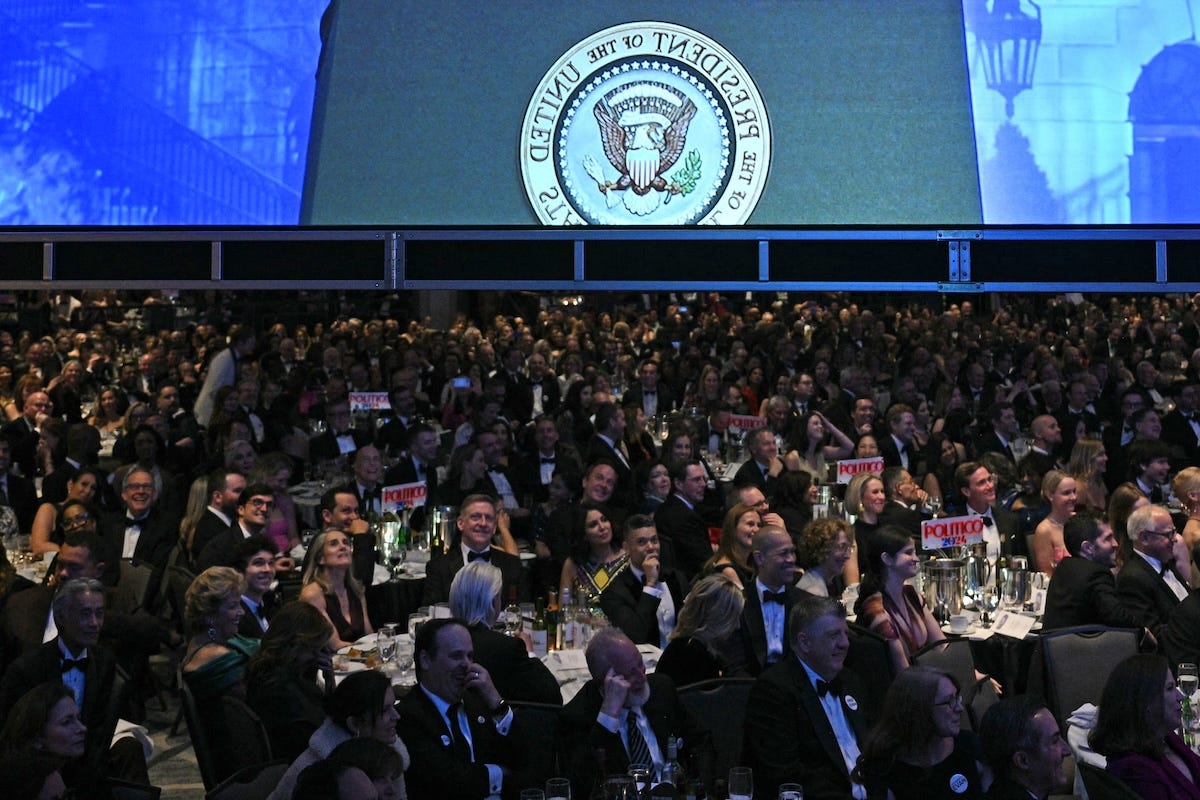
There’s no particular occasion, though the sentiments here were animated by the fact that, this weekend, many of those people will attend the White House Correspondents’ Dinner, alongside authoritarian censors like Brendan Carr, and enemies of press freedom like Kash Patel, in order to sit silently and absorb abuse from Trump himself.
They’re still carrying on as though history ended.
The politicians and journalists—particularly marquee writers, editors, and television news hosts—who’ve chosen to attend the dinner probably won’t be receptive to the argument that they’ve disgraced themselves and done a disservice to others. But they might well ruminate on the way this will all be written about and taught if the good guys win again. Some of your faces will be filmed and photographed; some of those images will circulate for centuries.
But this is much bigger than the dinner and pre-parties and afterparties. The assumptions undergirding the dinner infect the entire U.S. establishment. Journalists, in the way they cover news; donors, in the causes they fund; lobbyists, in how they advocate for client interests; and politicians, in their approach to spiraling crises. Nero’s fiddle turns out to be a metaphor for horserace punditry, access, and rent seeking, all discussed over an under-seasoned meal.
I suspect few Democrats will attend Saturday’s dinner. But their party isn’t immune to the same kind of thinking. They may be overcoming it. They made Trump and his Republican allies regret their attempt to rig election maps. But we can detect outmoded ways when they tiptoe around questions of impeachment, or court packing. When they oppose fascism on the basis of what pollsters tell them about how to win elections—under conditions no American pollster has any experience navigating.
There is a reasonable chance that Trump will die in office, and a similar chance that, if he does, Democrats will unilaterally suspend hostilities in the battle for historical memory. An American president has died, we must at least pretend to be mournful. Certainly we can’t deny him the usual honors.
I’m getting ahead of myself obviously, but the point is that everything short of determined opposition will be understood by students and disbelieving documentarians as a choice, no less than Chamberlain’s appeasement or in northerners’ indulgence of Lost Cause mythology. And to be clear: those choices were not crazy. They had internal logic, in the prevailing contexts, just as there’s a logic to going through the motions of dead customs—two-handed journalism, the correspondents’ dinner, running everything by focus groups.
Trump is self-immolating at the moment, which is better than the alternative, but if nobody will force him out, there’s also nowhere for him to go, and he has more than 30 months left to wreck spitefully. Long-shot efforts to contain or dethrone him might fail, but they will be noted and remembered reverently. Choosing to behave as though it’ll all blow over, like everything else, will be remembered a different way.
This category includes my brilliant older sister, which makes publishing this admission a little mortifying.
This weekends event should be re-named, ‘The Whitehouse Deplorables and half-truth correspondents dinner’.
All the while 4 million kids in this country will go hungry tonight and most nights, while we jack the taxpayers up to support an unnecessary oil war.
Someone explain why the most sensitive negotiations are being conducted by Kushner and a real-estate maven.
Thanks Brian for what you do 👏🏻 Your energy and your writing help me feel connected and give me hope.