
Woke One Happened Because American Government Is Broken
And it'll happen again if Democrats don't return to power and fix it.

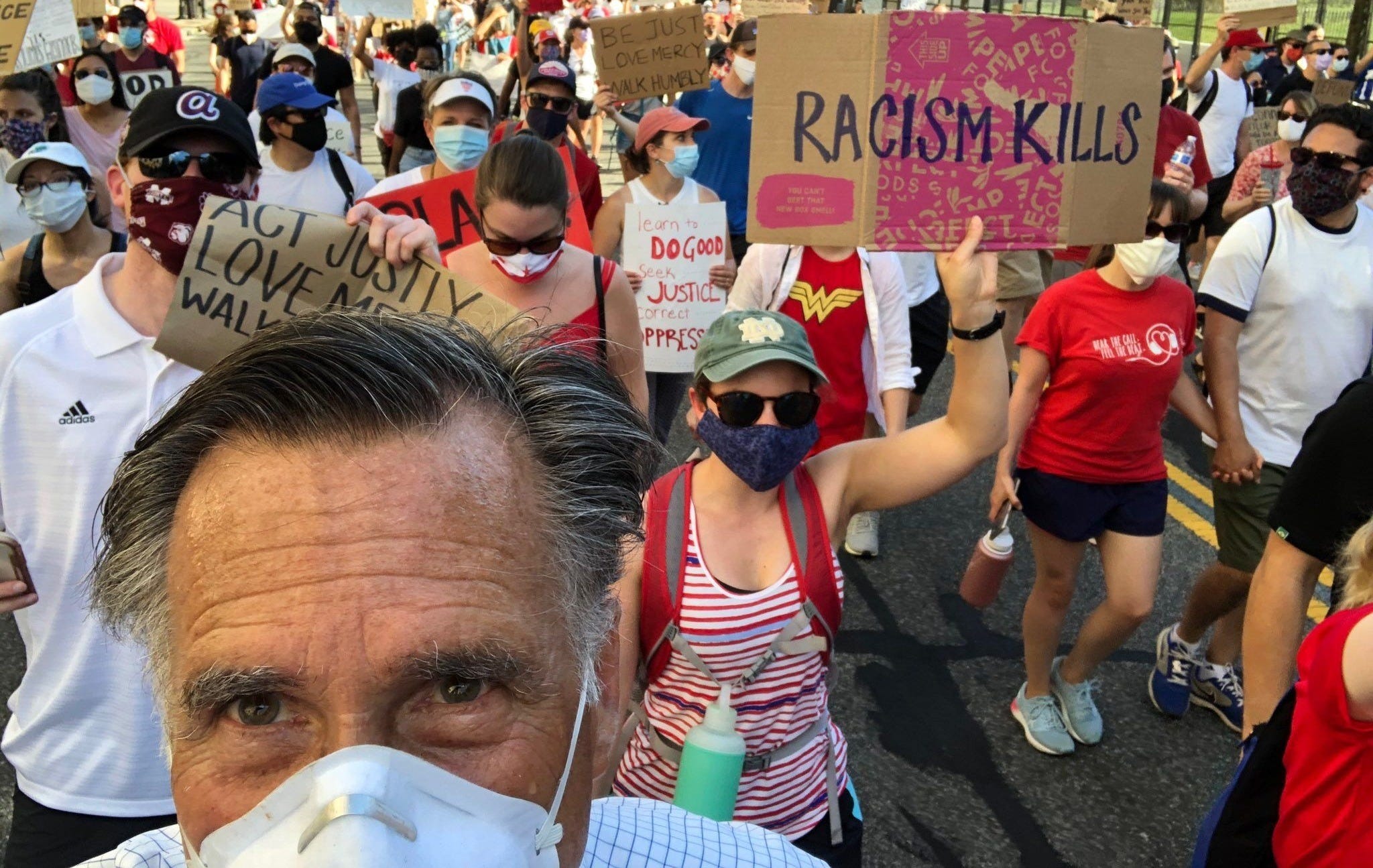
Alexandria Ocasio-Cortez wants voters to be open-minded about progressive candidates. Even those (like Francesca Hong) who played radical leapfrog with other online activists in the latter part of the last decade (cancel Thanksgiving?) and now regret the positions they took at the height of progressive cultural power.
“I have a local city councilman that has this saying that ‘Woke One was crazy,’” she told Jonathan Karl of ABC News. “And I think that what’s important is that we have to assess what a candidate is saying now.”
She has a good case to make. Zohran Mamdani isn’t governing New York like a 2020-era police abolitionist. She, herself, is an accomplished legislator. If people ask for a mulligan in good faith, they should get one.
But her detractors first want to know where they can go to get their apologies: What exactly are you disavowing, and why did you avow it in the first place?
There’s something to the idea that progressives should offer voters more here than a shaking of the Etch-a-Sketch. But it has nothing to do with I told you sos. Over years of backlash, Republicans have deemed just about everything liberal about America “woke.” To say “Woke One was crazy,” without a fuller picture, will invite false right-wing triumphalism: If even AOC is disavowing Woke One, isn’t she admitting that Republicans were right about everything?
No, obviously they were not. Specificity helps clarify just what baggage progressives want to shake loose ahead of this and future elections.
AOC did go on to explain what she believes drove the lurch to the left. “[D]uring this time and during—especially during COVID, there was a huge opening of the Overton window. We were shut down. There was some of the highest unemployment rates that we have seen because of those shutdowns. And I think that the doors were really open in trying to entertain any and every policy that was going to get us to a better place. And I actually think that the discussions that were had in that time were quite fruitful.”
Bernie Sanders was more specific about what exactly he’d like progressive candidates to walk back. “No serious person that I know who is running for office, believes in quote unquote defunding the police [or] doing away with prisons,” he said recently, “Open borders? No. Most of us believe in comprehensive immigration reform, not opening up all the borders.”
Unlike AOC, Sanders also didn’t articulate a theory to explain why some of the candidates he supports took position he now describes as unserious.
Maybe that’s to come. Or maybe he doesn’t know the answer. If he and other progressives dwell on the question and decide to tell a story about what gave rise to Woke One, I hope they consider the origin story as I understand it. Whatever you think about Woke One, wherever you landed six or seven years ago, the root causes are structural, and smarter future politics will thus require structural reform.
Woke One was a bunch of stuff wrapped into a cultural bundle:
“Cancellations.” Essentially viral pile-ons designed to pressure organizations to remove people, or change their operations, where the mechanism was something like a blacklist: Don’t do it, and your reputation in the progressive world will be ruined. When people Google you or your outfit, our allegations will be among the top hits. Sometimes, this was appropriate! The method isn’t illegitimate per se. But it is uncontrolled, and in the hothouse environment of the late 2010s, into 2020, a subset of exaggerators and liars and overzealous activists did whip up storms of outrage against people who didn’t really deserve it. Woke One came to be defined by that overreach.
Corporate partnership. This worked on a similar set of incentives, but to different ends. It was a form of political resistance, in which organized progressives (often loosely organized) wielded their economic clout to pressure big corporate actors like Disney to take positions on matters of public policy, usually to oppose discriminatory, state-level GOP legislation. When southern states enacted anti-abortion laws, companies like Disney would come under pressure to stop making movies and TV shows in those states.
Policy positions. This is the stuff that prompted AOC’s comments. It’s the one that dogs Democrats the most, because some of the people who were active in the online movement publicly lodged support for ideas like defunding the police and prison abolition, only to run for Congress many years later and see it thrown in their faces.
Performative discourse norms: This is DEI trainings; land acknowledgements; privilege scolding; riot apologetics etc, along with the shaming of people who didn’t partake.
I think that basically covers it. To be generous to antiwoke critics, the most open-minded of them would say their main concern pertains to excesses, not fighting for justice per se. Not “Me Too,” but “Believe Women”—the idea that men accused of sexual misconduct should be presumed guilty by their communities and in the court of public opinion. Not “Black Lives Matter” but defund and abolish. These ideas were bad on the merits and politically harmful.
The big woke rethink AOC kicked off concedes both points, but politics is doing most of the work. Whatever’s in their hearts, Democrats want to win elections; progressives want to be viable in more places. But it should probably be the other way around.
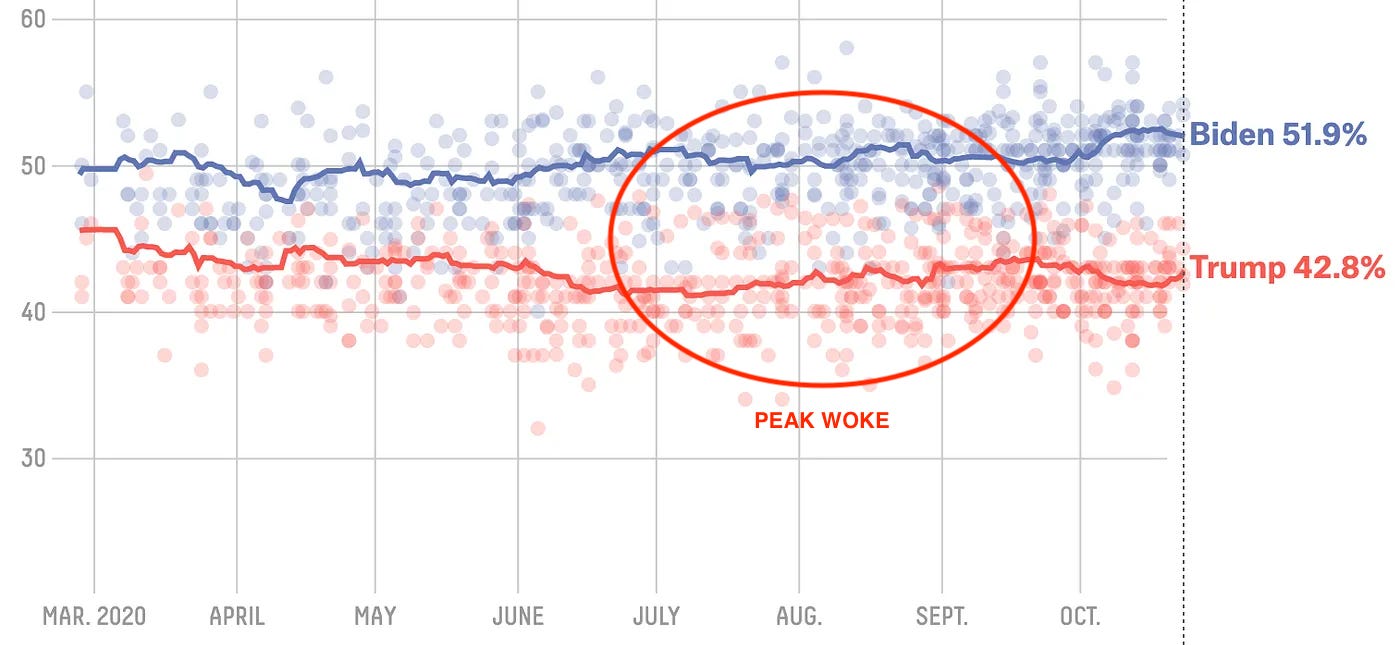
As conventional as the new wisdom has become, it’s very hard to detect the political cost of Woke One in election results. Democrats actually did pretty well during Peak Woke! They won the 2018 midterms in a landslide. During the 2020 campaign, liberals were certain that the George Floyd protests would hurt Joe Biden, and maybe even get Trump re-elected, but there’s just no evidence that they had any impact on the race.
I think we’ve been mind-tricked by the fact that social-media companies and their algorithms were fairly bought-in to Woke One, then swung hard against it, making it feel like there was a huge, organic backlash that hurt Democrats. But Democratic officials in general, and Biden in particular, were not terribly woke. And the tenor of social media is a vibe, not a scientifically valid survey result. Meanwhile, the Republican backlash was and remains weird, obsessive, dishonest, and frequently racist. Whatever spoils they might have reaped by offering a sensible critique of political correctness, they likely squandered them by deriding everything they hated (from normal liberal policy ideas to the very existence of black professionals) as “woke” or DEI, and then unleashing a campaign of political terror against pluralism.
But even if the politics were a wash, the woke milieu is not a good environment for nurturing political liberalism. It is not defensible as an abstract approach to ordering society. It gets Democrats twisted up in knots. It ensnares people who did nothing wrong, or who at least didn’t deserve to lose jobs and opportunities, or suffer reputational damage. It presents an unwelcoming face to people without strong political commitments. A decent read of modern politics is that the cooler-seeming coalition tends to attract the most swing voters, which means everyone invested in blocking fascists from power has a responsibility to foster a chill vibe. Woke was many things, but it was not chill.
But that’s all descriptive and normative stuff: What was it, and was it good or bad?
It doesn’t tell us why Woke One happened.
AOC’s instinct here—that woke excess corrected itself as people learned from experience—is reasonable. But I think it’s probably wrong. Woke One didn’t spring up from nowhere, at random, nor was it a conscious strategy to enforce mass compliance with some ever-changing justice agenda. It was an iterative response to incentives. And, my concern is that the incentives that gave rise to Woke One seem, for the most part, to still be in place.
People will peg the rise and growth of woke to discrete events. The killing of Michael Brown in Ferguson, MO. The exposure of Harvey Weinstein’s reign of abuse.
These were catalysts, no doubt. But woke doesn’t really make sense as a reasoned response to these kinds of developments. It makes sense as a means of creating change when known injustices persist against the will of public majorities.
There was a larger backdrop. It was, e.g., the profusion of mass shootings and the scourge of police abuse—often caught on camera—alongside the evident sclerosis of the political system. Reforms with 80 or 90 percent mass support could not become law. But Republican states could pass and enforce laws like Stand Your Ground, or give right-wing fanatics legal permission to mete out violence against protesters. George Zimmerman could stalk and kill Trayvon Martin and get away with it. Republicans could block comprehensive immigration reform, then freely unleash the state to separate immigrant children from their parents. There was no way to check police abuse or shrink the carceral state by law—but it was straightforward enough to build public support for shrinking the remit of law enforcement.
People could turn out in numbers to defeat a known sex pest, but he could win with a minority of the votes. Trump couldn’t be dislodged short of impeachment, but other powerful men could be exposed and driven from the public sphere.
But then, there was no hierarchy of authority figures to serve as guardrails; the enforcement tools were in the hands of anyone who wanted to take them up.
My read is that Woke One was the seepage of power into realms where it could have some effect, but didn’t really belong. Power belonged in democratic systems, but those had failed. And so people who understood themselves (correctly) to be the vanguard of a political majority innovated new ways to write rules of the road.
People will say they want accountability for Woke One, but what would that even mean? It’s not like MAGA, where we can point to significant crimes and abuses, with specific perpetrators, who can be charged, tried, convicted, disbarred, or whatever else.
Who’s “responsible” for woke? Who could’ve stopped it? Is the idea to identify bad social-media actors and essentially cancel them? Is it to somehow insulate corporations from boycotts? Is it to force candidates who tweeted silly things to partake in reverse struggle sessions?
I don’t think anything like that is in the offing. What we could do is reform our political systems to give people hope that if majorities are behind them, laws and norms will change.
The 2024 election was widely interpreted as antiwoke backlash. The results were close enough to lend this reading some credence. Overdetermined elections are like that. But then Republicans redefined antiwoke as repulsive fascism, and did enormous damage to the country.
That leaves us back at square one. If the cure is worse than the disease—if every incentive that drove woke politics still exists, and there’s no appealing alternative— why wouldn’t they just come roaring back? If nothing else changes, a Democrat will come to power in 2029 with congressional majorities and quickly run headlong into the same procedural obstacles that make it impossible to respond appropriately to societal outrages.
If Democrats don’t want Woke Two to diffuse to unaccountable actors, they will need to embrace democratic reforms. They will need to be able to legislate when the country is blindsided by horrible tragedy, and be confident that their laws can be enacted and implemented quickly—without illegitimate judicial interference. American political elites often marvel at how countries like Australia and New Zealand responded to mass shootings: with swift and sweeping legislative action to ban assault rifles, mandate national gun buyback programs, and impose strict licensing rules. We’re so stricken with Stockholm Syndrome, we’ve come to find the very concept of responsive government hard to fathom.
But it is not unusual for democracies to react quickly and forcefully to new circumstances; it is our inability that drives people to become “crazy,” as AOC put it. Restore their democratic power and they’ll do something decidedly not crazy: petition their government for change, confident that, if the numbers are there, things will go their way.
Nothing about Woke One was a mistake. Cancellations? It’s not our fault there are so many rapists and racists in positions of public power. Is it really preferable to just shrug and say it’s fine for a rapist to be president?
Corporate entities were never allies in social justice, but it’s good that they felt pressure to increase diversity.
Performative statements that are pro-democracy, pro-justice are good things, regardless of the mixed intentions behind them.
As for defunding police and prison abolition? The case for those has never been stronger, as police are partnering with ICE and using flock cameras to destroy privacy, among other things. It’s also historical myopia to view these as merely Woke One when they have been part of radical political activism for a long, long time.
The telling -- and not surprising -- thing about the current accountability movement here is that it's being directed squarely at one group. The media never focused on accountability for the Iraq war or the Great Recession or any number of other things that happened and had specific persons or organizations you could target in the way they have suddenly rallied around trying to take down this largely amorphous vibe shift.