
Why Are Democrats Suddenly Obsessed With Crippling Tax Cuts?
Inside the mailbag: Filibuster abolition ... Chris Van Hollen ... Oscars

Griffin Tennent: I’m wondering what you think about opening a portal to the chaos realm on the filibuster and letting republicans kill it. This article by Ryan Cooper makes what I think is a compelling case-- not that we should pass the SAVE election theft act, but that if republicans start to change the filibuster we should just totally demolish it….
I find this interesting, because I also agree with YOU that Democrats being totally Machiavellian could in reality be Democrats trying and failing to be as scheming and clever as republicans can be. Are you SURE you’ve predicted what they will do, etc. etc. etc...
I think Ryan may be right-- ultimately we need to stand up and gut check the republicans on their theory of “we can truly not give a single flying fuck about doing right by our people and still win” by ourselves trying to revive the idea of the system being capable of delivering results. I think the big mistake of 2024 was us not being willing to admit how far into structural failure we have fallen. It’s almost hard for me to pitch a coherent worldview and vision for the future that involves keeping the filibuster, and that might actually be something we should attach to the brand itself of the New Democrat.
Anyway, to get back to my point, I think that if there were EVER a time where you’d make the calculated gamble of “My opponent will be allowed to cheat, but in return I will have more power”, now would be that time, but it’s also at risk of being comically stupid in hindsight. What do you think about all this?
We should be clear that there’s only a real dilemma here if we think Democrats are likely to have a trifecta in 2029, but will once again lack the votes or gumption to abolish the filibuster.
This is obviously possible. But I don’t think it’s the likeliest scenario, and I also don’t think it’d be great practice to make concessions to Republicans now in exchange (maybe!) for a 50-vote threshold in the future. Particularly if one of those concessions will allow them to cheat in forthcoming elections and, thus, deny Democrats the trifecta they’re hoping to win. We should expend that energy reforming the Democratic Party, so that a replay of 2021 doesn’t happen.
To that end, I think the optimal play is for Dems to block as much bad shit as they can now, then get rid of the filibuster in three years. And if Republicans get frustrated and eliminate the filibuster themselves, so be it. I even think it’d be fine for Democrats to bait Republicans a bit: You’re getting no help from us, so if the SAVE Act means that much to you, get rid of the filibuster and pass it yourself.
There’s one scenario where the dilemma becomes pronounced, though. It will arise if Republicans a) decide one of their priorities (SAVE, or a war supplemental, I’d imagine) is important enough to merit abolishing the filibuster; b) invoke the nuclear option, but; c) can only round up, e.g., 49 votes. Would it be wise, in that moment, for a lone Democrat to provide the decisive vote, effectively eliminating the filibuster for all time, but at the expense of helping Republicans pass these two immoral bills?
I think the answer is no, particularly vis-a-vis war funding. I’m pretty sure I’d vote no and then redouble my internal party reform efforts. But the temptation would be real, and I wouldn’t enjoy being in the position of having to make that judgment call.
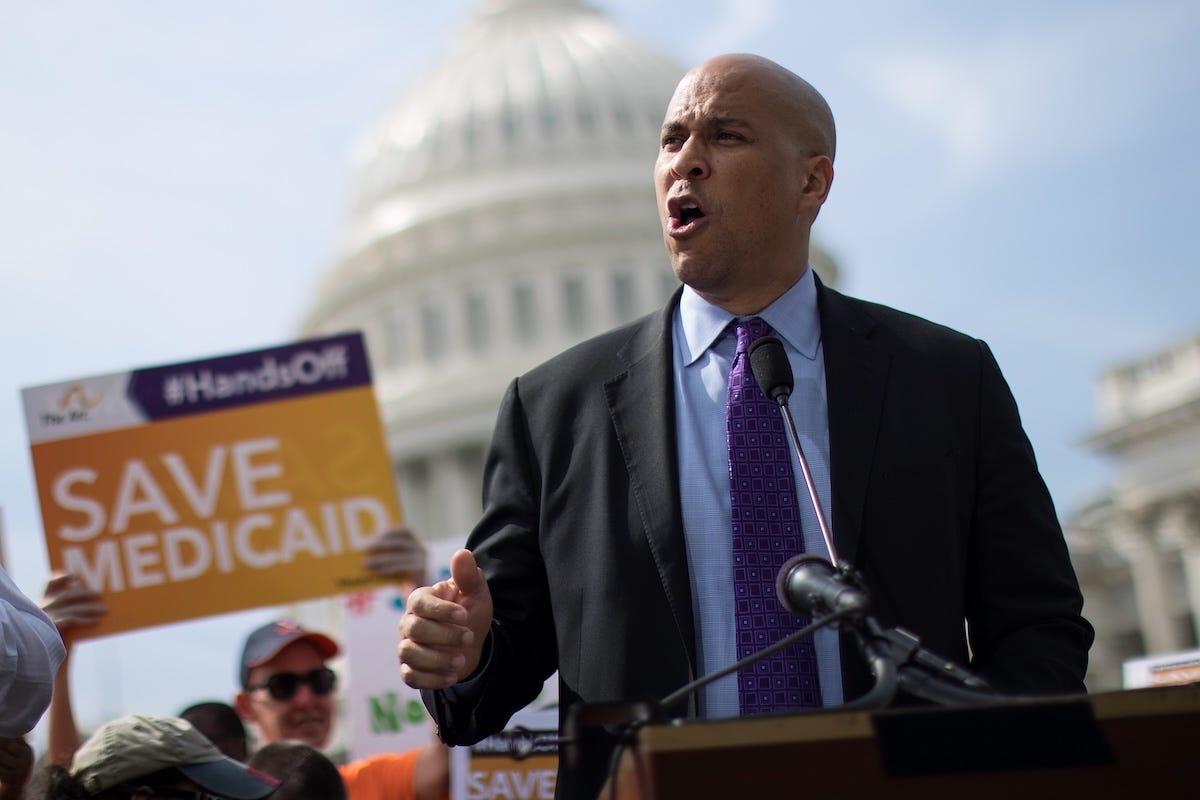
Colin Chaudhuri: Your podcast colleague had a post today dissecting the Chris Van Hollen, Cory Booker and Katie Porter tax cut plans. I actually think he wasn’t harsh enough in his criticism of these plans. I know talking about deficits is “boring” and also one of topics weaponized by the GOP to try to block any meaningful expansion of health care and indeed justify plans that slash Medicaid and cut social security. But that shouldn’t distract us from the fact that “The deficit” really is an issue again in a way that it hasn’t been since the early/mid 90s. Which is one of the reasons these plans are dumb from my perspective (I have other issues as well) given how much the exacerbate the debt and what this would do to medium/long term interest rates. However, your podcast colleague than pivoted to arguing that these plans were put out because Democrats are now the party of upper middle class white collar workers and this is all about appealing to their new “core” voters. I found this argument undercooked; if nothing else because I don’t think there is much polling indicating upper middle class Dems are clamoring for tax cuts as some big priority. I argued that this is perhaps related to the SALT deduction debate; namely it’s not a mistake these are all figures who represent constituents disproportionately affected by changes to SALT. And this is a “bone to throw” to those voters. But this still seems undercooked as explanation to me. To be frank, I’m in the camp of “where is this coming from?” Do you have any insights?
Matt and I actually discussed this at length in the (free) first half of the podcast this week, so I’d point you there for fuller thoughts.
For the purposes of the mailbag, let’s stipulate that the Booker and Porter plans are indefensible, and focus on the Van Hollen plan, which actually appeals to me in some ways.
To your ultimate question: I’m in the same camp. It’s a bit of a mystery where all of this is coming from—as in, who’s bringing these plans to these politicians, and why, and why now? I have sussing it out on my list of chores. I believe Matt’s argument—that the existence of these plans reflect growing professional-managerial class consciousness—stems from the fact that, e.g., teachers unions support the tax cuts. And I agree, it’s a bit of an undercooked take.
It is certainly true that there’s a (mostly Democratic) stratum of the electorate that’s been largely cut out of benefits half of the big churn in taxes and spending over the past 10 or 15 years. I know, because I fall into it! Trump raised my taxes in his first term; I did not qualify for any COVID relief, etc. So in theory, you could imagine a situation where a subset of people in the middle and upper-middle classes look around and say, THIS SUCKS! Democrats help the poor and pander to unions, Republicans service the rich… where are my goodies? Who’s looking out for me? And I don’t want to pretend as though nobody feels this way. But I also suspect that the PMC and the universe of well-informed, engaged voters with coherent ideologies overlaps a lot. Yes, we’re the ones who stand to “benefit” from these tax cut plans; we’re also the ones likeliest to think, “this is stupid and potentially quite harmful to more important goals.”
My hunch is that these plans were cobbled together because they reside at the intersection of affordability discourse, anti-billionaire discourse, and Things That Poll Well. And if that’s right, it’s no surprise they’re a bit sloppy.
But I think there’s something to what Van Hollen has proposed, if you make a few favorable assumptions. Let me explain: