
What Happened To Consumer Sentiment?
The vibecession came for Donald Trump—then he started a war.

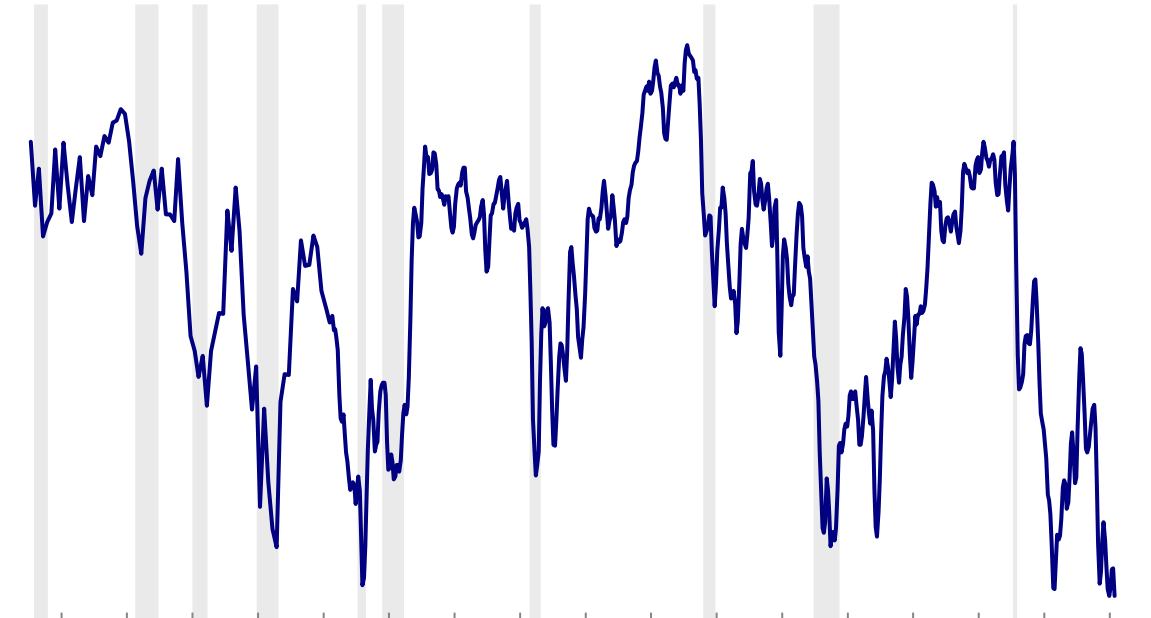
It’s instructive to imagine yourself (or a composite, fake person) living life severed from media and rhetoric and marketing. Or as insulated from those things as it’s possible to be in modern times.
No TV, no radio, no streaming, no social media (text or video), no newspapers, no magazines, few friends. A misanthrope who reads old books, but refuses to engage with headlines at the checkout counter, or chyrons in places like airports and gyms where televisions are forced upon the public.
We hear all the time, online and in politics, about how people must be met where they are, their “lived experience” respected. But how would a person like this ever draw correct inferences about the world as it exists beyond the horizon?
How would an ascetic recluse ever come to know, say, that immigration and border security had become unusually salient issues in national politics? Maybe if they lived in Eagle Pass, TX, they’d have seen the challenges up close. But in most of the country, they’d have no way of knowing. Not without the benefit of some kind of media, first or second-hand.
Same is true, most years, with respect to crime. Crime goes up, crime goes down. The national trend has been down for decades, notwithstanding a brief COVID-era reversal. But to know that, you have to be unusually well informed—enough to check ambient signals against official statistics. A normally mediated person must be forgiven for believing that crime is and has always been at crisis levels. That’s what our local news broadcasts imply, what social media wants us to believe, and what right-wing politicians need us to believe.
But our loner friend Ted1 ? Years and years could go by without him encountering anything to suggest that the orderliness of society at large had changed in either direction. A rash of neighborhood break-ins could be part of a trend, or it could be happenstance. Things in the narrow confines of his personal experience would have to get quite bad before he could intuit that the country had fallen into crisis. Even in a violent country like ours, most people seldom experience crime directly. And even when they do, it’s foolhardy to draw huge inferences. Did Ted get robbed because America’s going to hell in a handbasket? Or was he just unlucky?
The answer is almost always going to be “unlucky.” Which is why it’s uncontroversial, at least in progressive circles, to note that public misperceptions about the state of crime and immigration in America are driven almost entirely by media, and social interactions about what’s happening in the news or online.
Controversy only arises when you suggest that these same dynamics drive economic sentiment, too.
Back to Ted, our weird shut in.
How would he ever know anything certain about the American macroeconomy? He has a house. He has a job. His neighbors have houses, and most of them have jobs, too. Prices at the grocery store fluctuate. Sometimes they go up, sometimes, they’re flat. Sometimes the prices of certain goods rise, while other stuff gets cheaper.
Then Ted gets laid off, and we’re back to the question above. Did he lose his job because America’s going to hell in a handbasket? Or was he just unlucky?
Without mediation of some kind, it’s going to be hard to tell. Does the human resources officer provide any meaningful context? Is the entire workplace shutting down? And without an informational world curated by faithful journalists, even a better-adjusted person would have a hard time gleaning much with certainty.
Almost 30 years ago—when I was a teenager with a job, but no make-or-break expenses and no positions in any market—I would catch headline economic news on the radio in the car going to and from school. But I could’ve been a nerd who read the Financial Times or a cable-news junkie and the story would’ve been the same. That is how I knew the national economy was booming, and the country was optimistic about the future. If I’d lost my job anyhow, I would’ve felt sad, but it wouldn’t have given me any meaningful information per se about the national economy.
If identical economic conditions were to materialize in 2026, today’s teenagers would get a murkier picture. Yes, they’d know the president had gone to war and set an energy shortage into motion. They’d also scroll past doomer memes and conspiracy theories and pictures of homeless encampments and advertisements for apocalypse scams, and they’d be hard pressed not to conclude that the economy sucks (which makes sense in this hellhole country with all the immigrants and violent crime).
Ted, on the other hand, isn’t getting news from gate-kept sources or the digital commons. He loses his job, and he’s left to wonder what it means. Maybe he finds a new job quickly, and it sets his mind at ease. Or maybe he has a rough go of it, but none of his neighbors lose their jobs. What to infer? The answer is almost always nothing—unless more hardship ensues. Multiple neighbors sacked. Houses in foreclosure. Gas station lines stretching around the block. Signals this large would be tipoffs that the region or the country was experiencing an economic shock. But Ted’s lived experience, taken in isolation, tells us little.
There’s a separate question of whether there’s a correct way to feel about anything. I could tell someone who’s anxious about crime that crime is at or near historic lows, and she could respond, reasonably, “compared to what?” She’s from Munich, Germany. Her lived experience tells her America remains intolerably violent.
Who’s right?
It is empirically true that past generations of Americans were much happier with far worse economies than this one. But maybe they were naifs, or masochists. Maybe their consent had been manufactured by elites who never told them about life in more equal or prosperous societies. Maybe they were in denial about how much better things could be.
The point is not to scold people who claim to feel distressed. It’s to solve the mystery about what’s changed.
And the purpose of this tedious thought experiment is to remind everyone that one, big thing has changed: How we all know what we think we know about the world. We’ve lived through an epistemological revolution, and on this side of it there’s much more information, much more sorting into ideologically conformed social networks, and many more incentives to produce information that is either wrong or negative or both.
It’s not that Americans who believed it was morning in America under Ronald Reagan had it “right,” but that they were more easily able to experience the feeling of optimism because they weren’t surrounded by concerted, conflicting information.
Another thing has changed since then, as well: The parties have finished sorting ideologically. Reagan, unlike Barack Obama, Donald Trump, and Joe Biden, could credibly strive for approval ratings in the high 60s. That’s hard to imagine today, except under unusual circumstances, likely bleak ones.
This sorting has had a big and obvious effect on economic sentiment. When the presidency switches hands, the out party becomes more pessimistic, the in party becomes more optimistic, like clockwork—though the phenomenon is asymmetric: Republicans are more reactionary, more prone to larger swings. But Democrats aren’t immune. And it’s worth saying that in some cases, negative polarization is a good heuristic. I think I’m pretty well justified in losing economic confidence under Trump, who is erratic and corrupt in ways that tend to both destroy demand and increase prices. We may not yet be in a recession, but we are endangered! Plus, we have a clear and theoretically well-grounded track record: the economy performs better under Democrats than Republicans.
By contrast, right-wing doomerism under Democratic presidents mostly reflects tribal hatred and disinformation. Republican media is much more propagandistic than mainstream or progressive media.
But if polarization alone explained the change in the relationship between the economy and consumer sentiment, Democrats would be sitting pretty. Biden’s economic approval would’ve held steady, even if people still believed he was too old to be president. His co-partisans would’ve felt good about the economy, offsetting Republican despair. Kamala Harris would’ve won.
Likewise, if polarization told the whole story, Trump would’ve been sitting pretty in 2025. Polarization should create a low ceiling on economic sentiment, but also a high floor underneath it. Instead, Americans feel no better about the economy today than our ancestors did in October 1929.
Even a loner like Ted could detect the dissonance.

Short for “unmedia-Ted”
“No TV, no radio, no streaming, no social media (text or video), no newspapers, no magazines, few friends. A misanthrope who reads old books, but refuses to engage with headlines at the checkout counter, or chyrons in places like airports and gyms where televisions are forced upon the public.”
Where do I sign up?
"Short for 'unmedia-Ted'"
Until I saw the footnote I was expecting a Ted Kaczynski reference.