
Speed Chess, Poor Sportsmanship, And The Trump Opposition
He's losing; and only he and his enablers are responsible for the collateral damage of his volatility.

We are not right back where we were a year ago.
It might feel that way. Donald Trump and the people who issue orders in his name surely want to create that impression. That’s why they returned so conspicuously to the frenetic pace of his first weeks in office.
But to mistake today’s madness on all fronts for the madness of last year requires pretending that everything in between never happened. And it’s a lot. It’s overreach and economic deterioration and No Kings and corruption scandals and an approval rating that’s inverted from +12 to -16.
Demoralized and exhausted? I get it. So am I. It’s only human. But the fact that Trump’s actions now are as aggressive as they were before he squandered his good will doesn’t mean he’s reset the game board and started over.
This is what I was trying to convey in Tuesday’s newsletter: It’s an error to confuse flailing for forward momentum, but it’s also an error to grow complacent, simply because at this point in the game he’s closer to defeat. He’s also creating big problems that will be hard to fix in the future, when he’s gone.
But there’s one important caveat I didn’t address: the interim risk that he overturns the game board. That may be what he’s working himself up to do.
I love games and mind puzzles. The more challenging the better. I’ll even layer rules of my own creation on to whichever game I’m playing to augment the challenge. They’re a great Trump-era diversion. They’ve also become an essential part of my work flow. Ideally I’d have an editor. But as I must edit myself, I do my best to mimic the benefit of fresh eyes. I write in the afternoon, close up shop, then edit myself early in the morning, when I’ve built critical distance from whatever I drafted the day before. Games are a tool I use to clear my brain of morning fog, like warming up before exercise or revving an idle engine.
The only common game that really breaks my heart is chess, because I can never become good at it. I’ve been playing from a young age, and I’m fine as friendly chess playing goes. But I lack two critical skills everyone needs to play well: patience (which I can force upon myself if I really try) and visual search efficiency.
Show me a crowded bathroom countertop, ask me to grab the toothpaste, and I’ll scan for a good 30 seconds before finally locating it right in front of my nose. It’s very frustrating! For myself, as you might imagine, and for my wife, who has to help me find basically everything I didn’t place somewhere intentionally.
Drop me off at a grocery store I’ve never been to with a list of 10 common items, and (between wandering the aisles and scanning shelves) it’ll take me an hour to finish shopping.
This makes chess-playing—good chess-playing—almost impossible. I’m prone to dumb fuckups, particularly early in the game, because for all practical purposes, when the board is crowded, I can’t see the periphery. My playing is OK if I slow way down. I can recognize patterns and anticipate moves well enough. But in a normal-paced game, someone with similar skills will likely catch me in some obvious error, and put victory out of reach.
Ironically, I’ve found I can neutralize this debility by speeding things way up. In a game of speed chess, I’m still blinded by clutter, but a regular chess player is likelier to become flustered and screw up in their own right. The game becomes less about strategy and attention to detail than blunderbussing and mind tricks.
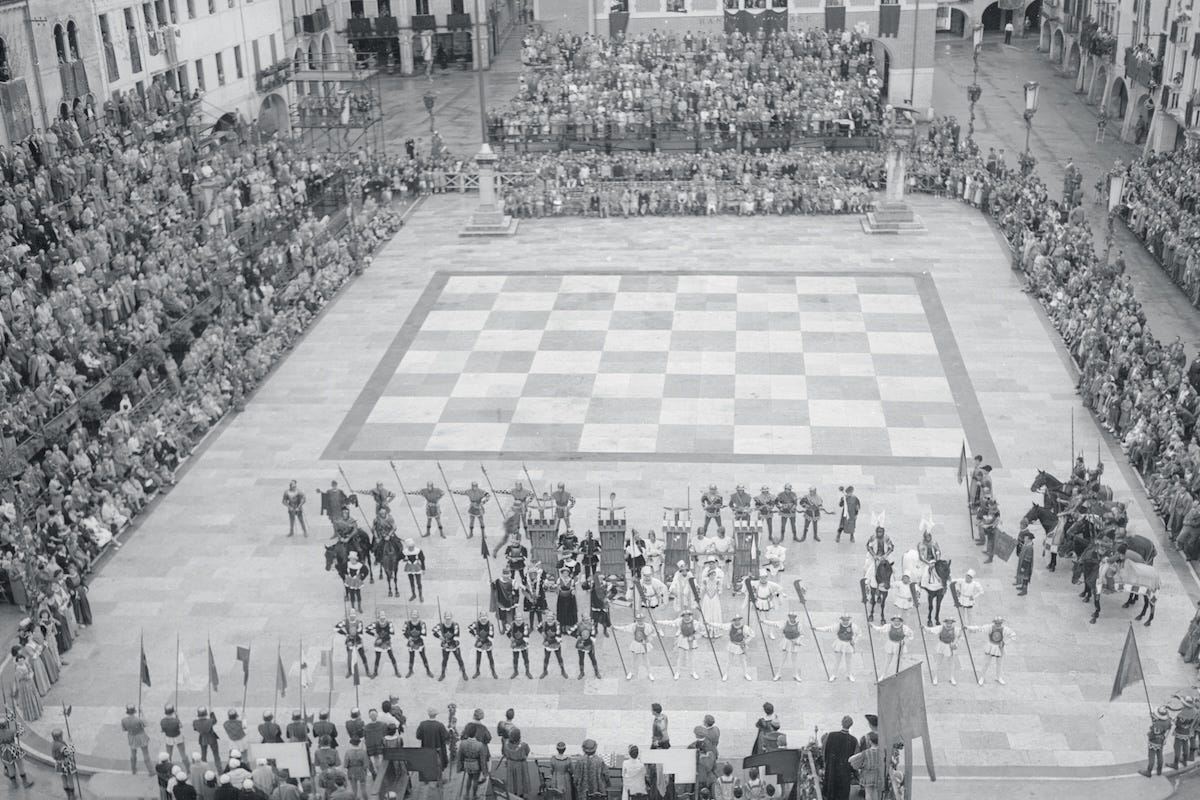
The arc of Trump’s second presidency so far resembles speed chess. Him, up against opponents who’d only ever played the game in competition, on a regular clock. First, shock and awe, then adaptation, then a reversal of fortune as his gambits fail. Suddenly he’s desperate.
Typically, in a friendly park-side table game, a player like that would lose with good sportsmanship and try again. The political equivalent would be to shake things up internally. Fire people. Extend a hand of friendship across the aisle. Whatever.
Trump is incapable of that kind of thing. He’d rather cheat, or sweep the pieces to the ground, than tip his king or admit to checkmate. It’s good that he’s losing. It’s not so good that he’d rather commit murder-suicide than accept defeat.
In a parallel universe, Trump plays normal chess, and thus consolidates power more durably. He slows down. He thinks ahead. He shelves self-destructive ideas like tariffs and mass firings and deportation snuff films. He coasts on the strong economy he inherited, until he can safely claim credit for it. Then, with approval ratings intact, he starts doing some of the lower-key things that he actually did in this universe—targeting a friendless man like John Bolton for prosecution on arguable grounds. No red-faced demands to fire various late-night comedians, just the quiet extortion of media executives desperate for merger approval.
Instead, he played speed chess. Multiple games at once. He didn’t sweat browbeating big institutions publicly, because they weren’t expecting him to do that; they didn’t respond optimally, because they had no time to think and much to lose in short order. They were intimidated, stupefied. This worked quite well for a time, but invariably some of these games went sideways. People got the hang of it. He made a bunch of errors. Some of his opponents were better than he’d anticipated.
By the end of last year, his tactics had worn thin, and he was out of smart moves. Everything that’s gone down since January 1 looks, to me, like a player who thinks he can regain the initiative by moving his remaining pieces with false bravado, pantomiming the early moves of the game, in the hope of psyching out his opponents.
Let’s resolve not to fall back into the same stupor.
We can’t fall for it, because we learned over many hard months that placating him doesn’t work.
In speed chess, the solution to an opponent like Trump would be to kick him out of the club or find a new game. Unfortunately we’re stuck with him. Republicans won’t impeach him, and we can’t split the union in two.
We can do two things, though:
Resist him on every front.
Brace ourselves to lose things we once took for granted.
This is the closest thing we have to a proven formula, and the only approach that has ever forced Trump and his congressional allies to relent.
Trump wants to subdue resistance to ICE by threatening to invoke the Insurrection Act. Keep resisting. Let him invoke it. It isn’t January 2025 anymore. He’ll be replacing one quagmire with another.
Trump wants to seize Greenland. Seizing Greenland polls just above zero percent. If he were to really try, that number would tick up (his cult following is real) but remain toxically low. A year ago, when Trump would advance on multiple fronts, Democrats would resort to the same response over and over again. “What’s that got to do with the price of eggs.”
By late 2025, they had settled, somewhat reluctantly, into a more confrontational posture. Under immense pressure, they shut down the government. They prosecuted the shutdown in a somewhat strange, ad hoc way. But, as a political matter, they won.
Where are we now?
We’re regressing. War powers resolutions are useful and welcome. But what kind of multi-pronged approach would actually slow Trump, disorient him, expose his weakness?
For starters, refusing to fund his government, particularly the Departments of Defense, Justice, and Homeland Security, until lawful governing is restored. That could entail legislative provisions that:
Prohibit the expenditure of funds for military operations against Greenland;
Require all federal law enforcement officers to wear badges, and show their faces, and de-escalate tactics in Minneapolis;
Require cooperation between DOJ and Minnesota to investigate the killing of Renee Good;
Full compliance with the Epstein transparency act.
They could supplement these demands with:
Unified, public Democratic communication to the governments of Denmark and Greenland assuring them that Congress will not permit Greenland’s annexation;
Further communication vowing that any illegally seized Greenlandic territory or resources will be returned by the next U.S. administration;
Per Paul Krugman, refusing to work with Trump on substantive issues unless he offers deliverable concessions;
A robust antiwar movement;
If that doesn’t work, escalate to:
A Democratic-governor led federal tax protest.
This list isn’t intended to be authoritative or comprehensive. It’s meant to cast a harsh eye on the quiescent opposition, and start a discussion about a better approach.
Of course in chess, the rules of the game bind both players. Here, there’s no such symmetry. Trump is a crook who wields hugely destructive forces. If his aggression doesn’t win him support or adulation he’s liable to escalate until he invites disaster and everyone loses.
Unfortunately I think we just have to accept that this may be where we’re headed. For a mix of desperate rashness and vandalism for vandalism’s sake. Hopefully playing back at him will create deterrence. But we can’t buy him off with appeasement or ransoms or outright surrender. I thought we learned all of this last year?
As you point out, now is the time for Democrats in Congress to leverage the need to fund the government to curtail some of Trump’s most egregious behavior. ICE, Greenland, and withholding of funds from blue states are at the top of my (long) list.
On a more personal note, I share your assessed shortcomings… perhaps there is a common cause here.
Congressional Dems should refuse to fund the government until the demands Brian listed, ant a minimum, are met.
They should start messaging why this is necessary now. Connect funds going to murderous thugs instead of healthcare. Connect ‘running’ Venezuela with affordability at home. Connect every bad act by the admin to every elected republican who, at best, sit on their hands.
Democrats need to meet the moment and stand strong for a change. If they can’t get concessions they should force republicans to end the filibuster. If republicans want to continue to gut healthcare, fund illegal invasions, murder & the occupation of American cities Dems should make sure the public knows they refused be complicit.
I’m not gonna hold my breath.