
They're Only As Repressive As Their Constraints Allow
Dictatorial ambition resides in their hearts, not just their deeds. The difference is what stops them—and no one from outside is coming to stop Donald Trump.

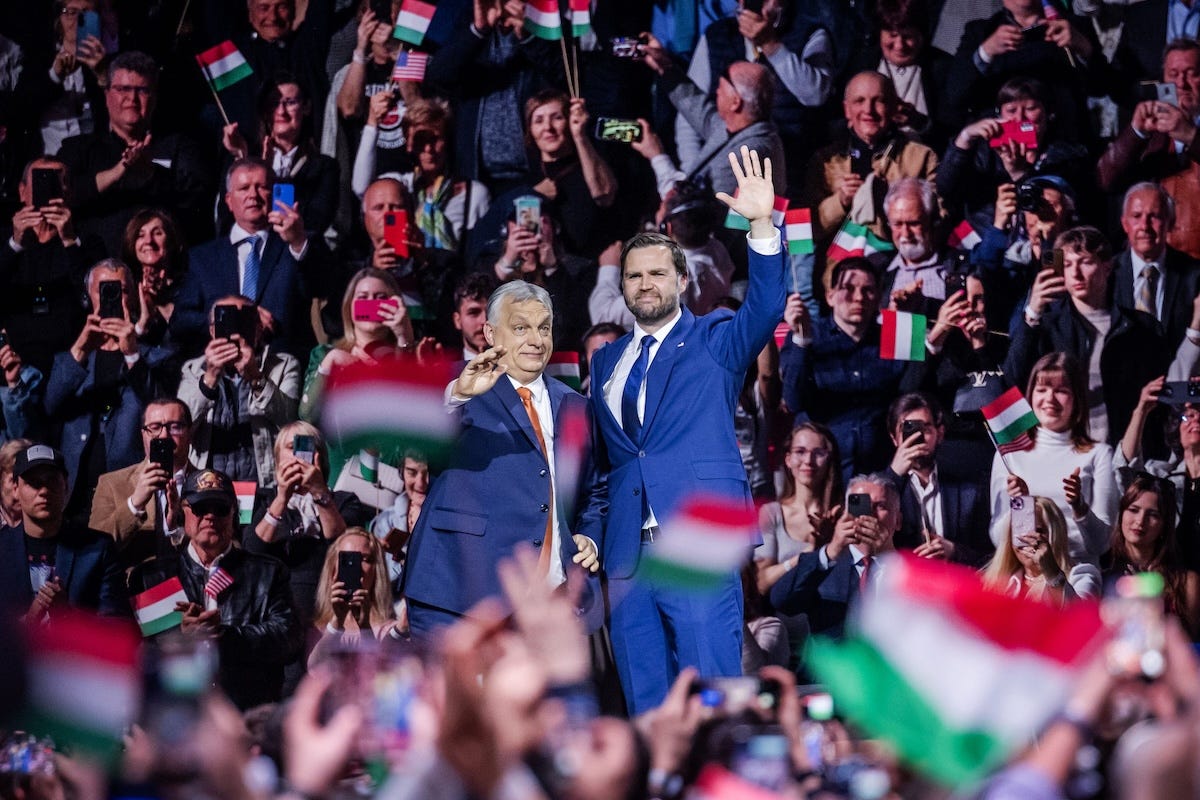
Everyone’s looking to Hungary for lessons. What does it mean that Viktor Orban conceded defeat? What does it mean that Hungarians ousted him in the first place? What does either fact mean for the United States, insofar as Orban was an inspiration figure for the MAGA elite? These are fair questions, so long as we resist the temptation to reason backward from the premises—to observe the many vestiges of freedom in Hungary and the U.S., and mistake them for the character of their heads of state.
Hungary held an election, and Orban conceded defeat, ergo, how bad could he be? How endangered was Hungary’s democracy, really?
This is an analytic error we’d recognize in almost any other context. Outside of truly totalitarian societies, when would we ever view governing outcomes as perfect proxies for the ideologies, personalities, or methods of political leaders?
The similarities between civic life in America and Hungary; the fact that Trump and his movement looked to Orban rather than some other autocrat for inspiration—these things matter less than we think. What we need more than anything is a clear sense of how repressive they’d be if left to their own devices.
Dictators tend to possess similar personality traits, but they are not interchangeable. Some are insane and some are rational, some are genocidal maniacs, and some are not. But they don’t typically disclaim power when an opportunity to grab it arises. Indeed, most dictators don’t govern quite as tyrannically as they’d like, because they face real external and psychological constraints.
Trump’s motives and his lust for power are unusually vain. He suffers from mental illness. He’s a self-aggrandizer who’s desperate for glory, but also to avoid ego injury. It is this quality, more than anything real, that impels him to deny the results of the 2020 election, even though he knows he lost. Or to incite an insurrection, then call it off when the risk of permanent disgrace becomes intolerable.
This stands in contrast to Orban or Vladimir Putin, who are both greedy crooks like Trump, but were each, in their own ways, forged in ideological and nationalist crucibles.
There’s small comfort here, in that Trump’s ineligible for another term, diminishing the stakes of future elections in his mind. If that piece of the Constitution holds, it’ll remove a crucial ingredient from the stew that produced the January 6 insurrection. Trump surely wants Republicans to remain in power and build monuments to him across the country; but if they lose coming elections, he won’t feel personal shame; indeed, he’ll happily blame them for their own defeats.
This may spare us another insurrection. But it won’t spare us efforts to rig elections in the manner of Orban or worse. None of these guys want to lose elections. They go to great lengths not to. And here is where the differences between them start to matter less than the forces that constrain them.
I got a small amount of unconvincing pushback this week for making a correct observation: Orban’s decision to concede defeat proves nothing about the regime he oversaw. Many dictatorships have fallen in response to election results, including ones much more repressive than his.
Call Their Bluff

If Viktor Orban’s willingness to acknowledge defeat helps underscore Donald Trump’s aberrance, it also provides refuge to right-wing authoritarians in America. They can now unctuously cite Orban’s concession and (so far) peaceful hand-off of power as proof that their political project is harmless. Normal. All in the game.
Orban did everything he could to make his elections impossible to lose, but that is not the same as saying he did everything he would’ve liked to do.
As others have observed, when incoming Prime Minister Peter Magyar addressed the people of Hungary after the election, it marked his first time doing so on television, because under Orban’s rule, he’d been banned from campaigning on Hungarian airwaves. That’s quite enough to confirm Orban’s Hungary was authoritarian in nature. It does not tell us whether Orban would’ve jailed or murdered Magyar if he could have.
If we mean to assess the depths of a dictator’s depravity, we can’t just tally up their abuses or size up their role models. We have to look at the constraints they face as well.
To circle back to the example I used earlier this week, Augusto Pinochet’s Chile was much more repressive than Orban’s Hungary, though both regimes lasted 16 years, and voters ended both dictatorships at the ballot box. But that doesn’t tell us Pinochet had a darker heart than Orban. We can’t determine who has the most evil intent by counting bodies and lost liberties.
This is important, because I think people are over-reading. They know Trump and Orban supported one another; they know MAGA viewed Orban’s Hungary as a model for establishing semi-permanent control over the U.S. government. The common inference seems to be that the MAGA movement wants only as much control as Fidesz was able to establish, no more no less.
But this is bad thinking. Trump does not have Orban’s heart. And he and Orban don’t face the same constraints.
Orban, unlike Pinochet, didn’t murder Hungarians by the tens of thousands, or throw dissidents from helicopters. But is that because he’s a less sadistic person than Pinochet was? Or is it because the particular constraints he faced limited his repressive capacity?
I think the latter quite obviously played a larger role: these are different people with different tolerances for brutality, which can in turn be hard to gauge. But we should generally assume they will attempt as much as they think they can get away with.
Orban was in cahoots with Putin. He called himself a mouse to Putin’s lion‚ an allusion to Aesop’s fable about how the strong and weak can be of mutual use to one another. But because Hungary is in the E.U. and NATO, and is a tiny, weak country, Orban could not subdue the population with the same forms of brutality available to Putin or Pinochet or other villains. His economy depended on Europe and so he had to follow some of its rules.
Pinochet wasn’t surrounded by aligned, integrated democracies. Quite the contrary! And his coup d’etat and dictatorship had U.S. backing, further freeing him to brutalize dissidents.
But even with U.S. backing, Chile was a small country subject to international pressures. Pinochet allowed the plebiscite that ended his dictatorship for many of the same reasons Orban held elections and Putin still holds “elections.” He thought he had enough control over the society that he could never lose, and that if he tried suspending elections altogether, he’d face real consequences. His own constitution (like Hungary’s) required the plebiscite. Military leaders had a legitimating interest in overseeing some kind of election. And his years of oppressive rule had rendered Chile a pariah state throughout much of the free world. Allowing a plebiscite that seemed credible, complete with opposition figures and international observers, was a strategic play to earn good will abroad, while maintaining a viselike grip on power domestically. He just happened to miscalculate.
Would Orban have governed like Pinochet or Putin if he could have? I suspect he would have. At the very least, we have little reason to believe he wouldn’t have.
And that’s why I can’t take much solace in the fact that the U.S. authoritarian right embraced Orban more openly than other thugs.
They didn’t turn to him because they believed he’d found an ideological sweet spot—just authoritarian enough, without all the messiness of broken windows and missing persons. They turned to him because his approach seemed more likely to consolidate lasting power on their side than something more aggressive, like a criminal declaration of martial law.
Happily, Trump’s authoritarian breakthrough attempt has been shambolic. He’s undisciplined and strategically impaired and more unpopular than Orban was in his early years. U.S. institutions are compromised, though sturdier than Hungary’s, and our people are raised to be jealous guardians of their own freedom. Trump's failures stem from being stupider than Orban, and from facing tougher internal obstacles 16 months into his presidency than Orban did 16 years into his premiership.
But Trump is comparably unconstrained on the global scene. What does Trump care whether Brussels thinks American elections are adequately free and fair?
Trump has not successfully imprisoned his dissident enemies. But does anyone doubt he’d do it if he could? He insists they be arrested and prosecuted, publicly and privately, all the time. But he hasn’t established enough control of the judiciary. He can’t crack the grand jury system in any straightforward way. And his appointees can not or will not simply sweep up Trump critics and throw them in dungeons. Is that because Trump is magnanimous at heart? Does he fear a bad international reputation? Or is this actually just a work in progress?
Likewise, if Trump’s FCC director could force Democrats off the air, the same way Orban censored his opponents, he would1. Trump could never shoot anyone on Fifth Avenue by his own hand, but if he were given the opportunity to helm a dictatorship in which people took care of all his dirty work for him, he’d accept it happily.
He’s done something quite like this vis-a-vis immigrants, people mistaken for immigrants, and people resisting his secret immigration police: Indefinite detentions, torture prisons, two dissidents murdered in the street. That’s all real life under Trump, courtesy of his henchmen.
It’s a big part of why we can’t take for granted that a darker turn isn’t coming. I do not believe any attempt to Orbanize or Putinize our elections would succeed, at least not in the near term. But the only deterrents are internal: Among other things, they include Trump’s ego, the character of his loyalists, the political independence of the military, and the willingness of freedom-loving American citizens to brave physical danger.
I like our odds…but I don’t love them.
Much has already been made of the fact that Vance (on Trump’s orders) broke diplomatic protocol, in the most extreme way, by flying to Budapest to headline an Orban campaign rally.
Much less has been made about the fact that Vance rallied alongside a man who banned his opponent from accessing state airwaves. Even if Trump and Vance had corrupt reasons for supporting Orban, as they clearly did, this tells us a lot about what Trump would do if he could get away with it.
To elaborate on Tom Walsh's point: Despite the poor performance of the US economy, worsening budget deficits & national indebtedness, and dramatic undermining of government services since Trump's returned to the White House--Trump and the MAGA GOP benefit from leading the world's largest and wealthiest economy and controlling trillions of dollars in government spending/contracts. So as incompetent and destructive as Trump and his 2.0 policies have been to date, it's still possible for tens of millions of American citizens to go about their lives and experience very few (if any) negative consequences from Trump's policies and actions to date. By contrast, most Hungarians have been experienced the maddening consequences of Orban's corruption and his economic and civil rights policies for many, many years. They were positively desperate to get rid of Orban and his party's colossal mismanagement of the nation. The optimist in me says the American people have only just begun to grasp some of the unpleasant consequences of Trump's and the GOP's idiotic policies and corruption.
While there are some constraints holding back some of this regimes agenda, they, and their enablers, will continue to push hard against them and I’m not sure how much longer they can hold.
I’m also not so sure how accurate ‘non political military’ is anymore considering the violence loving religious fanatics in charge. That seems to be spreading and that’s scary.
9 months is a long time for the trump regime and the GOP to find new ways to push horrible policies, executive orders, remake the government and trash institutions. A ton of damage can and will continue to be done both here and abroad.
One thing I’d really like American citizens to take from the Orban ousting is that voting matters.