
Trump, Iran, And The Biting Of Reality
There aren't many hot stoves inside the MAGA cinematic universe. But Trump has found one, and grabbed it with both hands.

Donald Trump can pump the gas and brakes on his mass deportation regime at will. He can move aggressively in opportune moments, then hang back amid scrutiny, without much impact on his political standing.
He can do the same vis-a-vis his efforts to destroy science-based public health in the U.S.: acts of wanton destruction, followed by a period of calm, until scrutiny passes. Progress is herky-jerky, but the cranks and fanatics who staff his administration understand that it’s still progress.
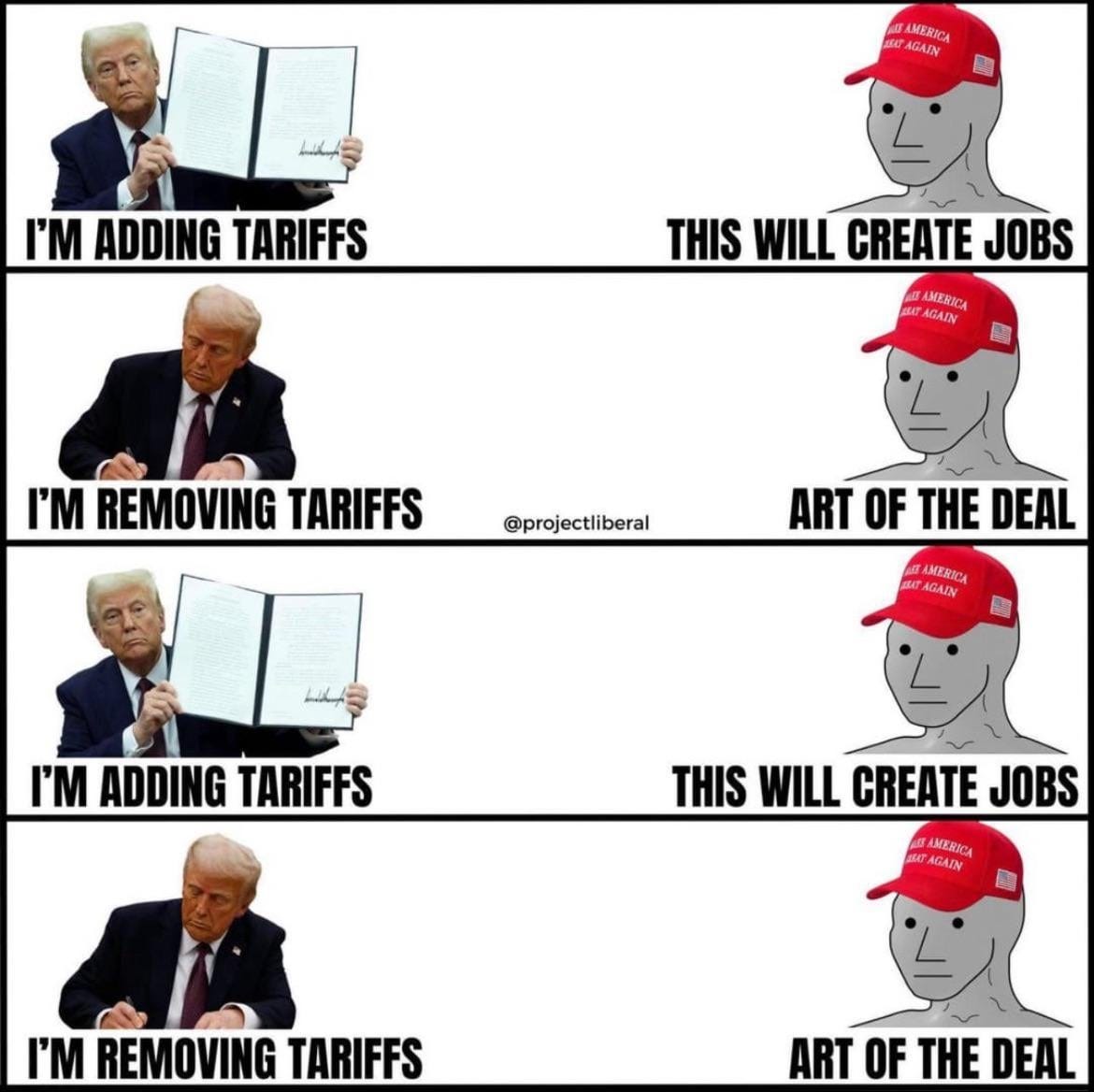
This bears some resemblance to the Trump Always Chickens Out dynamic, in that Trump will overreach and then retrench, in a manner that—on net—leaves us closer to his objectives than we were at the outset.
One gets the sense that he wishes to apply the same approach to the debacle he created in Iran. He’d clearly love to pull back enough to drive the war out of the news, at least for a while. Why else would his loyal goons threaten to revoke broadcast licenses? But he can’t TACO here. The war is different. It’s different because his targets are sovereign actors, of geopolitical significance, who can respond as they please. And it’s different because it breaks faith more fully with the ambitious zealots in his administration.
These structural differences are suddenly quite apparent on the surface. Trump’s nativist appointees and health cranks have hunkered down, waiting for backlash to quiet. But the skeptics of regime-change wars in his administration are growing restive.
On Tuesday, Trump’s top counterterrorism adviser—a bigoted extremist named Joe Kent—resigned from the administration on principle. Ambition played a role, too. But so did principle. To be clear, the principle in Kent’s mind is antisemitism—he stipulates that Trump has fallen under the manipulative spell of Israel. And his ambition is to surf a rising tide of right-wing antisemitism to a higher profile than director of the National Counterterrorism Center. Kent is not an admirable man. But the conflict in values is real. And it underlines the contrast between Trump’s misadventure in Iran and all of his other personalist flights of fancy.
George W. Bush probably sealed his fate as a failed president when he justified his invasion of Iraq on national security grounds, citing Iraq’s supposed stockpile of, and capacity to produce, weapons of mass destruction. He won re-election. But he’d committed the country to indefinite war, and war fatigue was bound to throw the WMD deception into sharp relief. How could a president who’d taken the country to war on false pretenses leave office widely admired?
By the mid aughts, this kind of thinking was already alien to Republican officials. Bush and his advisers didn’t plan around the assumption that reality would eventually assert itself. They simply changed justifications for the war, and then hoped victory—redefined as a free and democratic Iraq—would redeem him.
As a senior Bush adviser, believed to be Karl Rove, famously told the journalist Ron Suskind, “You believe that solutions emerge from your judicious study of discernible reality... We’re an empire now, and when we act, we create our own reality. While you’re studying that reality—judiciously, as you will—we’ll act again, creating other new realities, which you can study too.”
In other words, the Republican Party was pretty far down the road of postmodern politics before Donald Trump took it over. The GOP’s indifference to empirical reality surely attracted Trump. It surely also helped him recognize how ripe the party was for a takeover. But once he took over, the transformation accelerated.
It’s a testament to the GOP’s success siloing right-wing Americans into postmodern information environments that Trump has managed to fuck up so much, across two non-consecutive presidencies, without most of their voters noticing that he only ever abuses civic trust, and only to make things worse for the vast majority of citizens.
Things have become clearer to some over the past year. There’s a reason Trump’s approval has fallen. But we should assume that most of his lost support has come from marginal voters, who were never siloed, along with an accumulation of scattered, individual Trump supporters who have learned about his faithlessness the hard way. Trump voters whose family members have been deported. Trump voters whose farms or small businesses have been repossessed. Trump voters struggling with the new, Trump-imposed price of gasoline.
Trump has made a Republican comeback in blue/purple Minnesota unthinkable in the near and medium term because of his gratuitous assault on that state. If his surrogates are to be believed, he’s tested the patience of supporters in North Carolina by slow-walking FEMA aid for victims of Hurricane Helene.
But he has not been nearly as susceptible as Bush was to the verdict of consensus makers—the people who judiciously study empirical reality, and communicate it to the public. Bush could say “Brownie, you’re doing a heckuva job” thousands of times, and it wouldn’t have fooled many people. Republicans living hundreds or thousands of miles from the Louisiana coast, where Hurricane Katrina made landfall, could see that he’d botched the disaster response.
Trump simply ignores natural disasters, particularly when they impact states that voted against him, and, broadly speaking, his core supporters do not care. Not unless they live in places like the Minneapolis exurbs or Buncombe County, NC. He will lose stray voters in blue states through malign contempt and neglect. But the fact that he is failing tests of competence simply does not pierce the MAGA realm of consensus—what Jean Baudrillard would have called the hyperreal—where everything is interpretable as a show of excellence, or part of a larger plan: It’s all intentional. It’s certainly not incompetence. Trump is under no obligation to help the undeserving. The people who suffer as a result only exist on our screens, if they exist at all, and they certainly aren’t worthy of compassion. If Trump were as incapable and uncaring as his critics say, we would have felt the pinch by now… but also, if we ever feel a pinch, we must assume someone else is to blame.
By 2020 the postmodern turn was so complete that Trump could leave America stranded to a pandemic, allowing hundreds of thousands to die needlessly amid depression levels of unemployment, and still gain vote share in the subsequent election. The coronavirus was an act of god. Or China’s fault. As long as his supporters didn’t seek to hold him to any objective standard—as long as they refused to compare American carnage to the outcomes in peer nations—they could hold him harmless, and experience no cognitive dissonance.
Republicans did that by the tens of millions.
The lesson GOP elected officials drew from this experience, and Trump’s subsequent return to power, is that they could create new hyperrealities to soften the blow of every failure, every breach of public opinion. Minneapolis. Tariffs. Corruption.
But some things manifest on more than just screens.
Deportations happen to other people, in other places, filtered through screens and partisan narratives. So do measles outbreaks. But $6 per gallon gas happens to everyone, everywhere, all at once. Wars of choice that disrupt critical global supply chains don’t exist exclusively in the hyperreal.
Trump can’t fix his Iran debacle by changing what’s on people’s screens, and it’s harrowing to imagine what, apart from rapid retreat, would be required to make the cameras point elsewhere.
I don’t know what will happen to his approval ratings in the long run. Nobody knows how long the war will last, and some strategic trajectories are worse than others.
But the TACO formula, which allows his supporters to tell themselves self-soothing stories about Trump’s mastery of events, doesn’t really work here, because Trump can’t snap his fingers and restore the status quo ante.
He cannot blunt the consequences of bottlenecking a physical quantity of something almost everybody needs (oil) with sleekly cut propaganda videos and braggadocio. He can attempt any number of diversions, he can say “don’t look east!” But the material consequences are here and mounting, much as they were in February 2020.
Only this time, Trump can’t blame China or any other country. This war wasn’t necessitated by chance occurrences in Wuhan, or domestic political pressure, or anything beyond his personal judgment.
It doesn’t excuse his failures, but Bush could at least claim to be leading a country on war footing. There was a real, precipitating incident that would have left any serving president feeling pressured to do kinetic things. A truly wise leader might have tried to quiet passions. A leader wiser than Bush would have maintained singular focus on the perpetrators of the September 11 terrorist attacks. Better to capture Osama bin Laden before he could escape Afghanistan, declare victory, and become a beloved president for all time than leave the country in quagmire. But when Bush failed in that objective, the political logic of redirecting the public’s appetite for war to another country became overwhelming.
Nothing like 9/11 prefigured Trump’s Iran “excursion.” There was no national appetite for war, even a well conceived one. No appetite for larger, lengthier deployments, no appetite for higher gasoline prices—and no number of explosions caught on camera will make most people think the sacrifice has been worth it.
Again, Trump may cut and run, hang Israel out to dry, beg and bribe the Iranian regime for bygones, change the simulacrum on our screens, and recover lost standing over time. Joe Kent may ultimately decide he made the wrong bet. But who in their right mind will look back on all of this and conclude, in their hearts, “yep, that right there was art of the deal.”
It’d be nice to think Trump and the GOP would heed the lessons of this catastrophe, retreat back to the real world they abandoned decades ago. But the rest of us can take at least some solace in the reminder that reality still bites.
This is such a depressing essay on how much damage the GOP and all of its machinations have wrought on this country.
"Trump can’t blame China or any other country" - I think he can still try to blame Iran, or European Allies. The first one for mining the strait, the other one for not demining it. The narrative problem is than low information Americans don't really understand the concept of Iran. They might point it on a map sometimes, or search it on Wikipedia, but they does not know what Iran "means", in contrast to Israel, Mexico or even Cuba. This makes it hard to generate hatred against Iran. Had democrats loved Iran, it would be easier.
Also "But who in their right mind will look back on all of this and conclude, in their hearts, “yep, that right there was art of the deal.”" - I think that at least 33% of country, if not more. Not because they would really mean it, but rather in their news space it could be presented as tremendous win.