

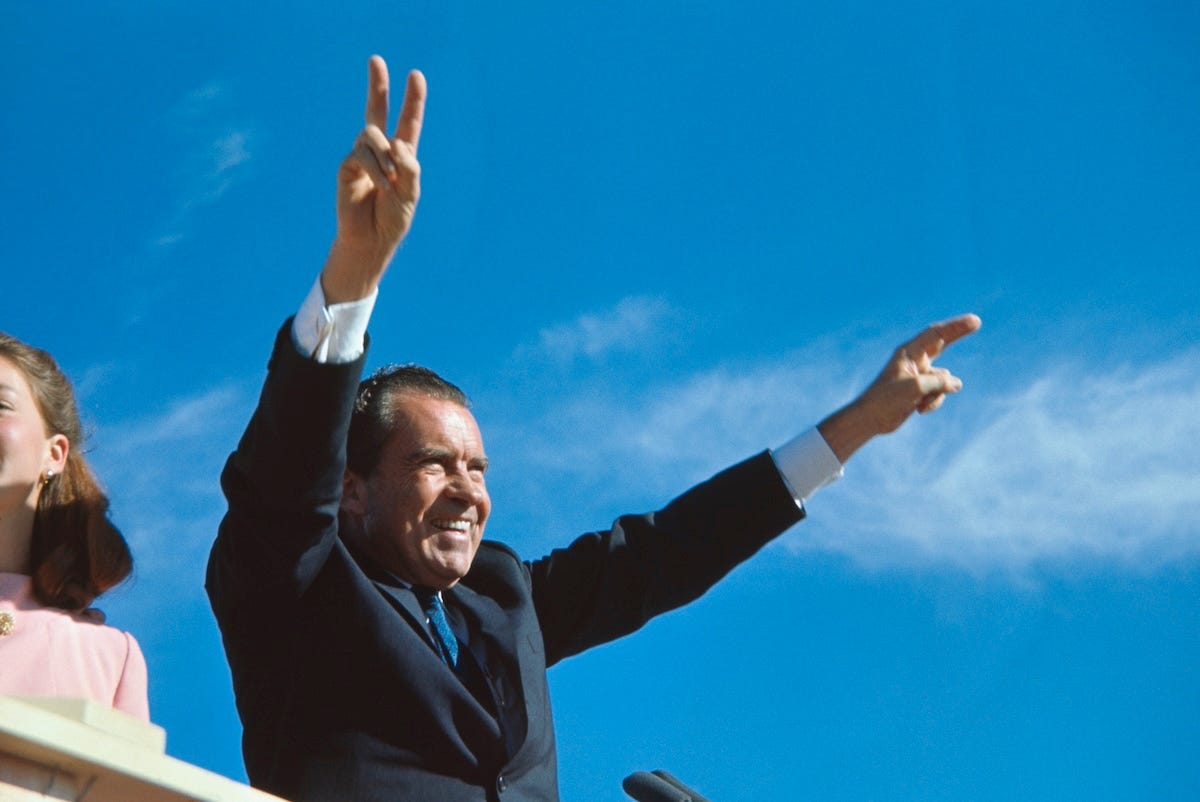
Ian: Thinking about the downfall of Cassidy in the LA primary last night, and the way he groveled for his job by voting to confirm Kennedy even after once showing the courage to vote for impeachment. And then lost anyway (as he surely should have known he would, no matter what lies the Trump people told him to keep him on side until the time came to shank him). Perhaps the mists of time have blurred my recollection (both of personal experience and academic history), but it seems there was a time when legacy mattered. That how one will be remembered by history ought to be a consideration of high import. The saga that led to the downfall of Nixon would seem to provide at least some evidence for that idea. Yet, it seems that the notion is now entirely dead, at least amongst conservatives and Republicans….
I’m left to wonder, do they believe they will somehow bend history such that they will no longer be viewed with the ignominy every rational person knows they will be viewed with? Are they in such a rush of thirst for power they cannot even consider their legacies? Do they somehow not realize how they will be viewed despite the voluminous, all-caps-on-neon-cardstock paper trail of degeneracy and malignancy they have left behind? I would be curious to hear your take on that and on whether there is any way to wrestle that particular genie back into the bottle.
I’m glad you used Nixon as a reference point, because in important ways the history we’re living through today starts with his demise.
Over a decade before Francis Fukuyama coined the term, many people in both parties seemed to operate with an end-of-history mindset. The world would evolve inexorably toward liberal democracy and open society. Dead-enders who conspired against those values might win some battles, but they’d lose the war for historical memory. They’d be remembered as villains, latter-day Jefferson Davises or Adolf Hitlers, or one of their hangers-on.
The Republicans who eventually turned on Nixon benefit from an afterglow effect, where we remember their actions as principled and heroic in order to set a moral example for future generations. But it’s usually wrong in politics to presume people are motivated primarily by principle when self-interest suffices as an explanation. Nixon was going down, and these practical men could either go down with him, or throw him under the bus1.
They didn’t fully appreciate the fanaticism of their copartisans. Many seeds of Trumpism were planted by a small number of degenerates in the post-Nixon Republican rump who believed the end-of-history consensus was wrong. That the only thing Nixon and his allies needed to prevail was greater will to power.
They built multibillion-dollar institutions to ensure Republicans never faced accountability again. Certainly not from their fellow Republicans, but ideally from anyone.
By the Trump era, their grip on the American institutional right was so tight that they barely had to pipe up for Republicans in Congress to know that trying to apply rules and laws to a Republican president would end their careers. Within days of the insurrection, they’d imposed discipline on a fully revolted Republican conference, and kept defections down to 10.
Now they openly discuss politics as a contest for all-time victory. Sam Alito, who just openly helped Trump rig the midterm, is on tape here, in what he thought was an off-the-record setting, saying the end game of American politics is one faction’s dominance over the other.
“One side or the other is going to win,” he said. “I don’t know. I mean, there can be a way of working—a way of living together peacefully, but it’s difficult, you know, because there are differences on fundamental things that really can’t be compromised. They really can’t be compromised. So it’s not like you are going to split the difference.”
It’s no mystery which side he’s on.
When Bill Barr mused to CBS News reporter Catherine Herridge about how his conduct vis a vis the Russia investigation would be remembered, he responded, “History is written by the winners, so it largely depends on who’s writing the history.”
Barr knew of what he spoke. He wrote an alternate history of Russian election interference, contradicting the Mueller report his own department produced, and it basically stuck.
All to say: Today’s Republicans have decent reason to believe that whole societies can carry on believing fictional versions of events. They think they’re winning a great clash within American civilization, and that they will fabricate the history of it.
Esang Wu: Why does the left media ecosystem treat foreign policy, especially but not only Israel, as such a strong test of ideological identification? And why does one heterodox position so often seem to pull politicians into a broader factional identity?
For example, Chris Van Hollen once opposed Medicare for All but had a more left-wing view on Palestine, shaped partly by his background as the son of diplomats. After the positive reception he received from left media over Gaza, he now seems much more fully aligned with that faction. Meanwhile, someone like Fetterman has the reverse mix: economically left but very hawkish on Israel.
Why is it so hard for politicians to sustain these cross-cutting positions? Why can’t there be durable space for a senator who opposes Medicare for All but supports conditioning aid to Israel or one who supports Medicare for All but is pro-Israel without being absorbed into one camp or another?
Let’s start with some more generalizable phenomena, then see if they apply to the specific case of Chris Van Hollen, or the broader case recently converted Israel critics.
The spoiler is: while ideological bandwaggoning is a real thing, I don’t know that the Chris Van Hollen case exemplifies it terribly well.
Anyone who’s followed politics for a long time, maybe particularly in the Trump era, has seen people break from a pack, then suddenly become ideologically transformed.
Before Arlen Specter switched parties back in 2009, he was a pretty mainline conservative. Moderate, in the sense that Pennsylvania was part of a supposed “blue wall,” so he couldn’t really get away with doctrinaire conservatism or Tea Party fanaticism. But he was grouchy and tribal like most Republicans in purple-ish territory. Think Mike Lawler, only a senator and much older.
Then one day he woke up, switched parties, and within a month he was fully in line with the Democratic mainstream. Maybe even a bit more liberal than the median Democratic senator.
Some of that was surely rank opportunism. He wanted to run again, and that meant building trust with a new voting base, and new colleagues. But some of it was also surely scales falling from his eyes. When people no longer have to hold their old tribal dogmas dear, they can cast a critical eye on them, and see all their flaws. Some people find they can’t even remember why they ever started believing that stuff.
Several years ago had a great, memorable conversation with someone who’d grown up in a religious, right-wing household. Homeschooling, quiverful ideas about sex and marriage and children, the whole deal. In their house, they believed all the worst libels about Democrats, liberals, and especially Barack Obama. They attended Tea Party protests, and even believed birther conspiracy theories, if I remember correctly. Eventually this person found their way out, rejected the whole repressive lifestyle, and worked hard to resolve anger at family members who’d held them in ideological captivity. One thing this person said to me that struck me as both funny and profound: I really cared about Obamacare. I mean I really cared. And now I can’t explain why.
That’s obviously an extreme case, but I don’t think the phenomenon is terribly rare, and it clearly isn’t limited to politicians. I gather most of us know people who crossed a gateway into MAGA, then became unapologetic Trump cultists. The handful of Democrats who’ve switched parties into the GOP since 2016 didn’t become moderate Republican squishes, they became reliable partisans. On the flipside, many (though not all) of the Never Trump Republicans are now just Democrats. And not just insofar as Democrats are the pro-democracy party. Their sensibilities are more liberal or progressive in general. They either moved left in their policy preferences, or their commitments to various policy orthodoxies weakened dramatically, to the point where they no longer particularly care if Dems come to power and pass Medicare for All—a policy they once radically opposed.
It’s tempting to ascribe it all to grift, but in many cases self-interest is a sideshow to other forces: free thinking, with fresh eyes, unburdened by reflexive tribal biases; social pressure. This is why the fascist takeover of Twitter transformed politics, and why the fascist takeover of TikTok is so alarming. It’s why one day Democrats were kneeling in dashikis and the next day they were competing with each other to establish border-security bona fides. When your milieu changes, it is very likely to change you along with it.
Which brings us back to Democrats and Chris Van Hollen.