
In Search Of A Shared Theory Of Power
The liberal establishment is not the left's biggest obstacle, and the left is not the liberal establishment's biggest obstacle. The biggest obstacle to both is a rigged political system.

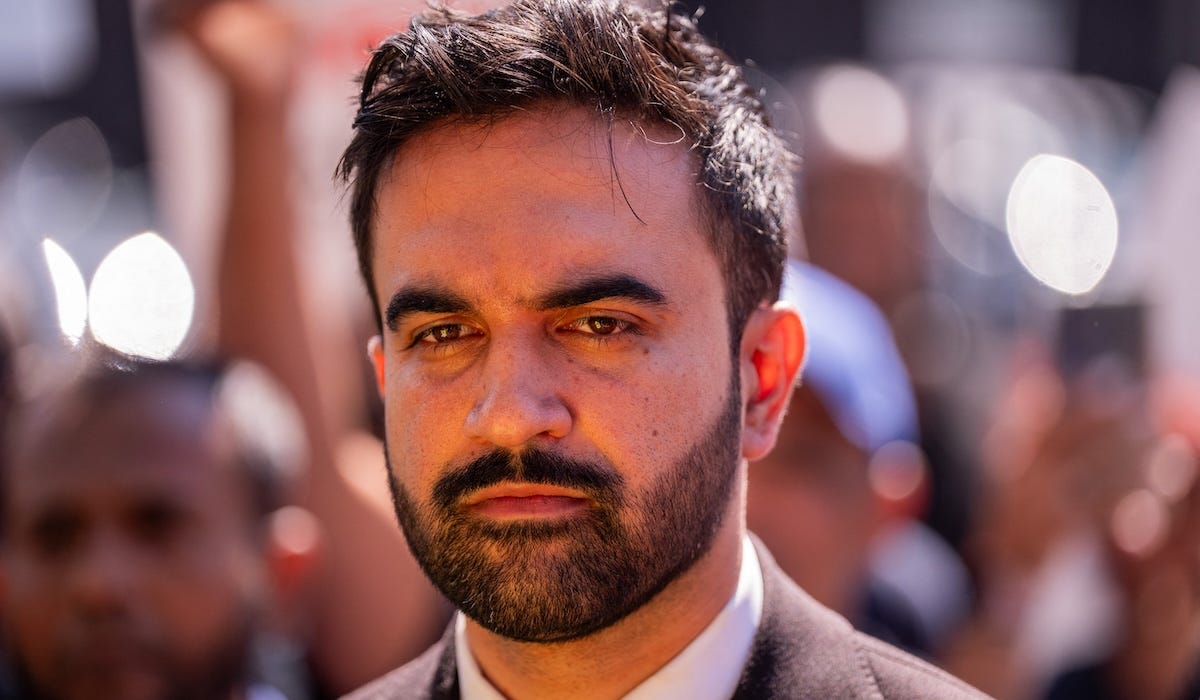
Whether you were excited by, skeptical of, or angry about Zohran Mamdani’s involvement in New York’s primaries surely turns on 1) what his ends are, 2) whether you support them, and 3) how well or poorly you think he advanced his own objectives.
Everyone agrees it was a ruthless demonstration of political power. The candidates he endorsed swept their races, ousted multiple incumbents from office, and burnt some of the bridges he’d built to other powerful New York Democrats. His critics and allies are simply arguing over whether this was wise.
So the first question is, what was the point?
Mamdani’s trying to shift the balance of power in the Democratic Party (at both the federal and state level) to make it less solicitous of Israel— at least as it exists in its unenlightened state under Benjamin Netanyahu—and more intent on redistributing income downward. He wants to do this both directly—by replacing fairly progressive New York Democrats with Democrats further to their left—and through indirect force, demonstrating to other officeholders in the state and region (including the House’s top Democrat, Hakeem Jeffries) that if they don’t change their own politics, they might lose their jobs, too.
This much is pretty obvious. But you don’t have to intuit Mamdani’s motives. He has said as much. On Wednesday, he told the MSNOW host Chris Hayes that the races he’d taken sides in, “were about clarity. They were about conscience. They were about conviction.”
“New Yorkers,” he said, “want to see people who are willing to not just stand up to the federal administration, but also stand for a vision of working people at the heart of it.”
He said he’d used his political capital “to ensure that the people who will fight hardest for that same agenda are going to be there, whether it’s in Albany or whether it’s in DC,” and that the agenda should be “much closer to what we used to see from our party in the days of FDR than what we’ve seen in a time when our only vision seems to be a responsive one to Trump as opposed to one that goes beyond that.”
I admire the confidence and the conviction. Few Democrats are willing to show, rather than say, that they’re not kidding around. He’s here to play, and everyone is on notice. I also think his objectives are worthy, at least in the abstract. What’s an FDR-like agenda for the post-Trump 21st century? Basically all of the details are TBD, but Democrats will be better served by ambition than by timidity when Trump finally departs the scene.
But as to question three: I don’t think what he did reflects a carefully calibrated theory of power. It was both front-loaded, and inward looking: A bid to make as much change as possible to the factional balance of power within the party, given an opening. The biggest possible swing he could’ve taken. But that’s a bit like entering a chess tournament and bringing your queen into game one on move two.
It might work out okay in the long run, but you’re likelier to lose early. Political fortunes turn fast. Right now Mamdani has everyone’s attention. But six months from now he, and this gambit, might look more like a cautionary tale.
The most controversial Mamdani-backed nominee is Darializa Avila Chevalier, a DSA candidate who has had some…interesting things to say over the years. Not just familiar-but-maximalist progressive views on borders or policing or Israel that stem from some raw conception of justice. Things like “Fuck Kamala Harris,” Joe Biden is a “rapist,” and COVID-19 had origins in France, not China.
Mamdani also had interesting things to say before he became a household name—none this inflammatory, but many of which he walked back for pragmatic purposes on his way to becoming mayor. Perhaps Chevalier will demonstrate similar pragmatism. Perhaps she now sees that posting every stray thought isn’t a good way to husband power. That’s what she tried to convey to MSNOW’s Ali Velshi. But it’s striking, and surely not a coincidence, that Bernie Sanders did not join Mamdani in this endorsement. Sanders endorsed Brad Lander; he endorsed Claire Valdez. But he seems to recognize that live-wire DSA shitposters aren’t worth the risk. That it’s not necessarily wise to flip every possible seat from deep blue to green. That some of his factional allies could do more damage to the Democratic Party and the cause of building left-wing power within the Democratic Party than simply leaving well enough alone.
You’ll notice that Mamdani, in explaining his theory of power, glossed over the part of the equation that pertains to defeating fascism, and skipped straight to the ultimate ends of enacting a social-democratic post-Trump agenda.
This is consistent with DSA politics in general, which tend to beg the question of how to build a national majority. You can see it in the fact that, as Sanders acolytes, they organized themselves around the term “socialism,” which, whatever they mean by it, is freighted and toxic in most of the country. This may sort itself out in the long-run—if Mamdani, and Katie Wilson, the socialist Seattle mayor, and other incoming left-wing leaders govern well, they might prove preconceived notions wrong. But they’ve put the cart before the horse. They stand in contrast to America’s fascists who don’t call themselves fascists or national socialists—they instead adopt monikers like Tea Party or America First, that, textually, are meant to assuage rather than repel the center, while winking at their fellow travelers.
Racing ahead to the policy revolution is also putting the cart before the horse. Those steps Mamdani skipped are actually the most important ones: How to fight Trump in the here and now, how to impose accountability on him and his coconspirators after he’s defeated, and how to reform the political system to make it responsive to the anti-Trump majority. Whiff on these, and the rest of the theory won’t matter. A Democratic supermajority, dominated by democratic socialists, can sweep to power in 2029, but without a well-developed theory of power, their agenda will die. If not by billionaire and trillionaire propaganda, then by filibuster; if not by filibuster then by juristocracy; if not by juristocracy then by nullification and tyranny of the minority.
This faction of the Democratic Party has fairly well-developed views on how wealth transmutes into intolerable political power inequalities: they believe that this excess wealth must be taxed, and the political influence it’s meant to purchase must be regulated.
They are not wrong. But this facet of our political-economy isn’t the only or even the greatest impediment to policy change. It is usually a safe assumption that a democratic socialist will be a more committed fighter than a moderate, because their policy ambition is sincere, and when they encounter obstacles, they will be inclined to surmount them. But they often seem to be charging forward without a map.
I’m focused principally on DSA and DSA-aligned factional Democrats here because they’re having a moment. But the liberal establishment still runs the Democratic Party and their theory is, if anything, worse.
In the mainline, you’ll see influential figures who decline to endorse nominees to their left, or even threaten to leave the party when primary voters make choices they don’t like.
You see a strategic approach to building power and checking Trump that begins and ends with winning elections and padding margins. Winning is obviously the predicate of all political power building—but it is also table stakes. And in the establishment, the approach is rote and reductive: It’s to support primary candidates who poll best head-to-head against Republicans, which typically means throwing support to the most moderate, most change-averse candidate in every primary field.
But to what end? When a party selects for wallflowers, the ambition for reform of any kind—procedural or substantive—will be shallow. It will build a big majority that makes peace with the post-Trump status quo; that hopes people can be hypnotized—with antiseptic policy ideas and promises of normalcy—into treating Trump-era wreckage as a new baseline.
Don't Call It Project 2029 If It's Not A Fighting Document

When Donald Trump took office, dusted off Project 2025—the governing playbook he’d disclaimed throughout the election—and handed implementation to Elon Musk, et al., it became clear to me Democrats would need an analog. Before the next election, someone or some entity would have to assemble a plan, with…
The Democratic elite is biased toward candidates who are struggling in many primaries not because the Democratic base across the country is unified behind a specific foreign policy or anti-oligarchy agenda, but because these candidates do not behave as though we’re all living through the same traumatic episode. The Venn diagram of authenticity and fighting is a circle at the moment, because every Democrat in America sees what the Trump regime has done to the country and feels, authentically, in their guts: “fuck these horrible monsters.” But they rarely see that sentiment reflected in Democratic officialdom, which is guided by the assumption that manifesting outrage at the GOP loses the center.
At best, we’re stuck with a party that can sometimes be counted on to react when Trump and the GOP seize more power, but never disproportionately, and certainly not proactively. It is better than not that Gavin Newsom canceled out Trump’s Texas power grab by gerrymandering California in equal measure. But this is not deterrence. Deterrence is achieved when an adversary believes a bad act will backfire. The Dem proposition was to match Republicans seat for seat, which, from the GOP perspective, was a green light: Worst case scenario, we preserve some version of the status quo. But if Dems come up short anywhere in the country, then we win.
Sure enough, a partisan state Supreme Court majority in Virginia threw out a retributive gerrymander, and state Democrats folded. Republicans won.
If Democratic leaders had a better-developed theory of power, they would have gerrymaxxed. This isn’t just hindsight speaking. It’s what Beto O’Rourke advocated when I asked him last summer. There are some Democrats, though precious few, who get it.
The Democratic presidential primary field is undeveloped, but there is little indication that any clear contenders have theories of power that are better calibrated than Mamdani’s.
The glimmer of hope I’ll leave you with comes from somewhere unexpected.
It’s from Pete Buttigieg, who told the reporter Alex Roarty that his experience as Joe Biden’s transportation secretary “radicalized” him in favor of institutional change.
I’m an ideological moderate, but when it comes to our institutions, I think that what I saw was just how hard it was to get even common-sense things done. How many layers of bureaucracy delayed the delivery of a new bridge or airport?
…
I believe that there needs to be a more restrained executive branch, but I think we’re asking the wrong question if we’re just saying, “Should the executive branch do more or do less?
To me, the executive branch needs to become both more and less powerful. It needs to become more capable when it comes to things like confronting inequality and standing up for the little guy and addressing fraud and misbehavior by powerful organizations and corporations. And it needs to become less powerful when it comes to things like surveillance and intimidation and monitoring and restricting speech.
This is admittedly not much to go on, just as gesturing to FDR is not much to go on. But what he’s saying here makes no sense unless he’s made peace with the need for significant democratic reform. Including court expansion. Because what he’s describing here would essentially invert the current Supreme Court’s partisan and unprincipled view of executive power.
The Republican justices have saddled the country with a unitary and immune executive, but largely stripped the executive branch of the power to promulgate rules, and erected myriad other governing obstacles—to progressive reforms, uniquely. Buttigieg is describing something like the opposite: an accountable and checked president, but who oversees a much nimbler and more muscular bureaucracy.
The key inference here is that no leader could advance this vision without first disempowering the court’s Republican justices. Under their recent precedents a huge range of activity that liberals and progressives expect of government—from business regulation to democracy promotion—is illegal; but it’s perfectly kosher for the president to instruct federal agents and prosecutors to intimidate executives and state-government officials into adopting the same policies envisioned under the “illegal” federal action.
It should obviously be the other way around. The courts should be weaker; the president, as a person, should be constrained, and the people supreme—but the state apparatus should be stronger.
If someone like Buttigieg leads Democrats to victory and realigns state power in this way, but in pursuit of moderate policies, leftists may howl. They may call him a sellout. They may regret not waging factional warfare more aggressively. But they will be missing the point. Because a reformer like that will leave behind a system that allows people to govern themselves; that gives them a fair shot at finally, one day, building the social democracy of their dreams.
I'd suggest three steps are necessary to create enduring Democratic power: 1) Redirect grievance from immigrants and minorities to the "economic royalists" (borrowed from FDR) in power who are skewing the political system toward the rich and leaving everybody else fighting over the scraps that are left; 2) impose actual accountability on these royalists, many of whom were also a part of this administration involved in looting American society (my model here is the Pecora Commission from FDR's time); and 3) use the energy developed by bringing accountability to create new, big things that benefit the working class.
All three of these steps are exactly what FDR used during the Depression. The Pecora Commission brought accountability to Wall Street and gave FDR the political capital to create the Securities and Exchange Commission and the National Labor Relations Board. The latter caused a boom in union membership that was essential for giving the Democratic coalition a durable base. The destruction of the FDR coalition was precisely the goal that Republicans implemented when they went after unions.
Contrast this with Obama: none of the people responsible for the 2008 crash were ever held accountable. Because of that, the energy demanding accountability was able to be captured by the Republican Party through scapegoating immigrants and minorities.
I had a comment over on SB the other day where I’m trying to come to a similar detente in this factional war.
Because I simply don’t see it as a war that either side can actually “win”. We need to embrace liberalism and pluralism within our own party, dammit! And that should be one of the biggest DUH things out there.
https://substack.com/@thebattleline/note/c-282278161?r=e9tr3&utm_medium=ios&utm_source=notes-share-action