
Republicans Wage War As Politics
...and politics as war.

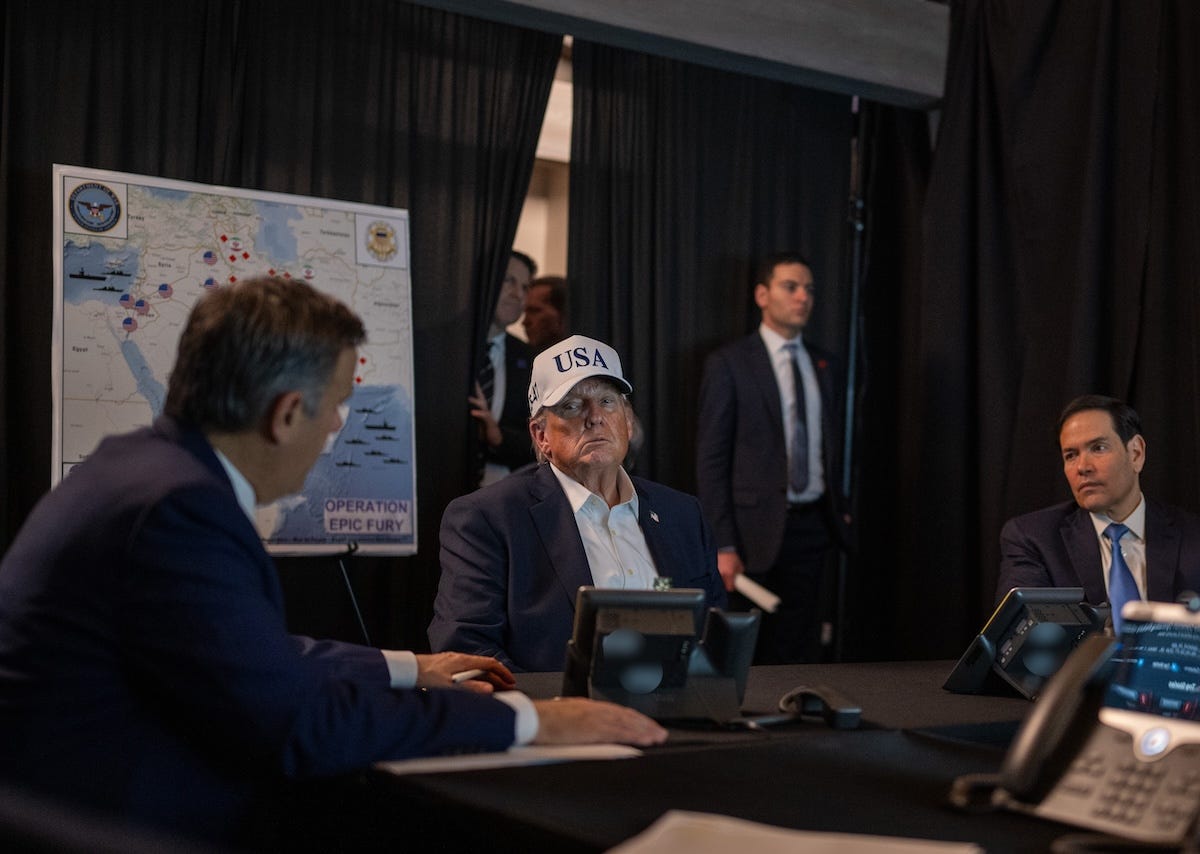
As the saying goes, Donald Trump’s latest illegal war against Iran is politics by other means
But the politics aren’t really between our countries. They’re within this country.
Trump wages war abroad in service of his domestic politics. And he views domestic politics as a proxy for civil war—gambits and stratagems designed to arrogate power at the expense of any principle, in pursuit of victory for all time.
This is consistent with his oft-stated view (and oft-demonstrated fact) that he despises Americans who oppose him much more than any adversarial regime. That America’s true enemies are from “within.”
Trump says these things out loud, but Republicans have been engaged in this kind of politics-as-war since well before he took over their party: abusing judgeships to steal elections, then abusing political power to further pack the judiciary, and to tilt the playing field of future elections in the hope of establishing quasi-permanent majorities. The modifier “quasi” is important. Before Trump, even the most shameless Republicans understood their antics wouldn’t bring about the end of history. Their testing grounds for anti-democratic politics were North Carolina and Wisconsin—closely divided states where, once in office, Republicans maneuvered relentlessly to lock Democrats and their voters out of contention. They gerrymandered and dismantled unions and limited the franchise… and then, when they lost elections anyhow, used residual authority as lame ducks to strip incoming statewide officeholders of power.
It’s been 16 years since the 2010 midterms, and Wisconsin Democrats are only just positioned to overcome this illegitimate handicap. North Carolina Democrats are a bit further behind.
Trump wants to take the “quasi” out of it. He fantasizes openly about actions he might take, or laws congressional Republicans might pass, that would preclude Democrats from winning elections. At his most perversely dishonest, he claims that Democrats already would be a permanent minority if they didn’t cheat—a lie he knows is a lie; a lie that is very nearly the inverse of the truth. Trump has never run for office without at least attempting to cheat, and without simultaneously accusing his opponents of cheating.
Democrats have nevertheless spent most of the past decade and a half in rearguard mode, struggling for viability on a tilted playing field. They had one opportunity in 2021 and 2022 to reset things—to make the whole country more democratic—but were thwarted in their efforts by Kyrsten Sinema and Joe Manchin.
Today, it should be clear to everyone opposed to MAGA that a) this is how Republicans view the game of politics, and b) principle and self-preservation point in the same direction. We should presume Republican antics to be cynically partisan, and oppose them as such.
A regime change war in the Middle East is probably not how Trump would have preferred to angle for partisan advantage in the U.S. Not because he opposes war in any principled sense, but because he has strong self-preservation instincts of his own, and he knows how thoroughly a war-quagmire can drain a president’s domestic power.
It may overstate things to say war with Iran divides his coalition. But at the outset, it polls terribly. And it clearly alienates his marginal supporters—the ones who voted for him because he claimed he opposed war; the ones his party hoped to groom into lifelong Republicans.
Still, this is all at least potentially better politics for him than the status quo ante.