
Their Lies Must Be Their Undoing
Running against the GOP culture of lying opens the door to every Republican vulnerability.

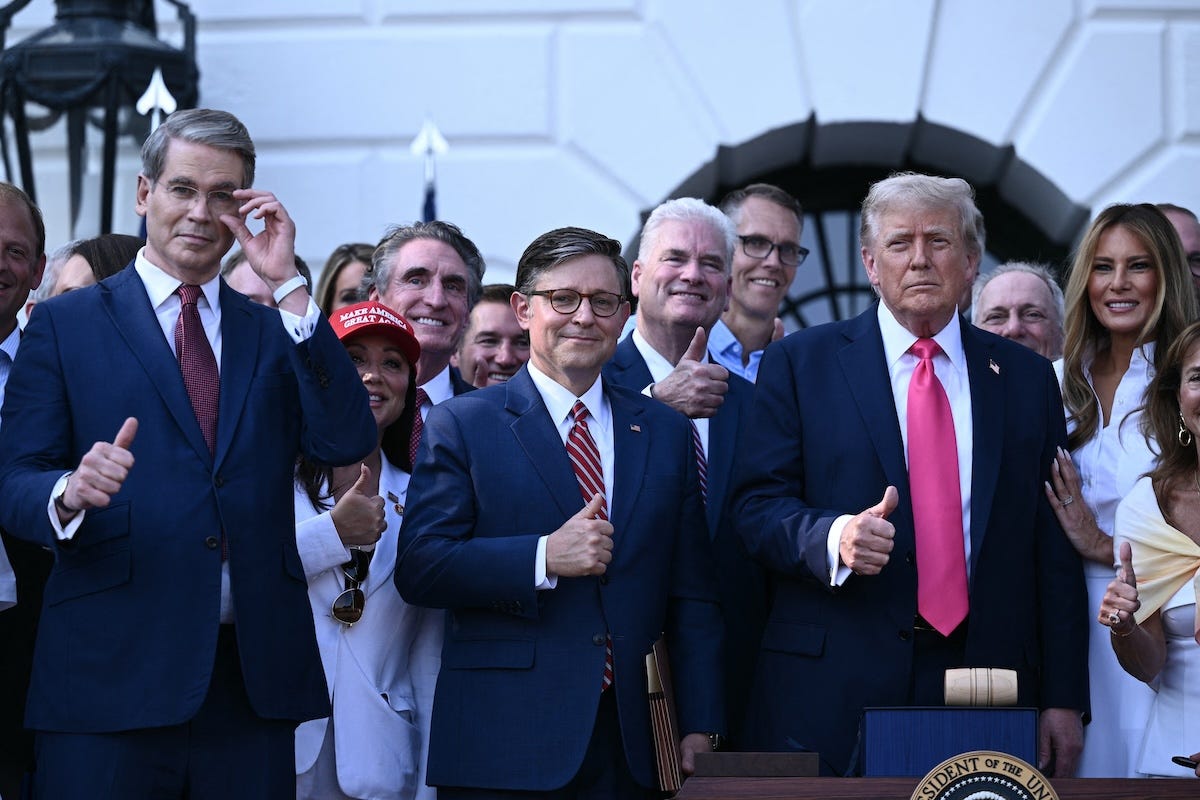
Liberals perked up last week when House Speaker Mike Johnson let slip that Republicans plan to slash Social Security and Medicare if they manage to hold Congress1.
These programs, "have to be adjusted and fixed,” Johnson said, adding, “we have a plan to do that next year, and it's critical."
Liberals always get excited when Republicans remind the public, in unguarded moments, that the raison d’etre of GOP politics is to funnel money up the income ladder, then use budgetary pressures as an excuse to cut and privatize entitlements.
It hits every sweet spot: The Republican view on these issues is terribly unpopular. Democratic views—ranging from protecting health and retirement safety nets to expanding them—are very popular. Anchoring discourse around distributive policy is politically advantageous relative to culture wars, and frees Democrats from the task of using power against Republicans. Much better and more pleasant to deploy political capital toward advancing forward-looking ideas than imposing direct political accountability on the GOP.
Once upon a time I believed this to be true, and even now I wish it were. In the past, politics has centered around this higher-minded stuff, and it seemed to benefit Democrats. Thus, the thinking goes, if we could yoke politics back to New Deal issues—where it was from the financial crisis through Barack Obama’s first term—Democrats could rebroaden their appeal and win elections the old fashioned way: with superior arguments about values and ideas.
All things equal, it’s better that Johnson said this than that he didn’t. That much is trivially true. But with the benefit of hindsight, I’d argue the advantage lies less in the fact that the Republican fiscal agenda is unpopular, than that it’s often hidden, and Republicans usually lie about it.
A campaign anchored around the putrid Republican culture of lying (about policy, and elections, and everything else) presents the public a character critique with windows into every one of the GOP’s constituent liabilities: that its agenda is unpopular, that its leaders are corrupt, that its appeals are bigoted. By contrast, a campaign that brushes most of that stuff aside in order to present a simple contrast of policy proposals is likelier to fail.
The Black Mold Of Republican Lies

Let’s assess how Republicans are running against Democrats, to the extent that they’re trying to influence voter decisions and win more votes.
I feel comfortable making this argument, because we have a substantial record to consult, and it isn’t especially impressive.
Republicans have been more or less transparent about this same agenda every election cycle for decades now, and it hasn’t provided Democrats a cheat code to victory.
The GOP war on the New Deal consensus began a long time ago, but for a brief stretch under Obama, Republicans really owned it… and it scarcely rendered them unelectable.
In 2009, at their lowest ebb in decades, Republicans needed a tidier image, so they handed policy over to congressman Paul Ryan, their top budget guy in the House. Ryan was an acolyte of Jack Kemp and Ayn Rand. He would later admit he’d dreamed of cutting Medicaid since he was “drinking out of kegs,” and it showed! He quickly produced the first in a series of lengthy policy documents tying Republicans to plans to privatize and cut Medicare; gut Medicaid, and (in some versions) Social Security as well. Democrats weren’t oblivious to this. They made it the centerpiece of their opposition.

Democrats make no apologies about relying on Social Security as a closing campaign issue — especially in midterms, when the senior vote is expected to be more reliable than the youth vote that turned out in 2008 for Barack Obama. It “fires up our base,” and Republican alternatives “turn off independents,” a DCCC spokesman said.
They made Paul Ryan’s fiscal “roadmap” famous. Republicans won the 2010 midterms in a historic landslide.
The story doesn’t end there, obviously. Obama won re-election against Mitt Romney, who put Ryan on the ticket and ran on a version of his agenda. But there was no landslide, no national rising against the idea of entitlement reform. Paradoxically, the extremism of the Romney-Ryan agenda made it difficult for Democrats to attack, because voters had a hard time believing Republicans would propose anything as outrageous as slashing taxes for the rich and paying for it by raiding Medicare.
In the end the campaign settled on something a bit more narrative-driven than a contrast of visions. They transformed Romney, the former private equity baron, into an avatar for the entire GOP, and ran against his cold indifference to working people. His desire to cut wealthy people’s taxes and working people’s benefits slotted nicely into that story—and it worked. But it’s not as though Obama won with FDR or LBJ-size margins.
In 2014, unchastened Republicans elected Paul Ryan as speaker of the House. They went on to win another landslide midterm.
Then along came Donald Trump, who ran aggressively against Obamacare, but whose main innovation was lying about his unwillingness to cut Medicare, Medicaid, and Social Security. Democrats warned that tens of millions of people stood to lose their health insurance. They repurposed all their old lines of attack. Trump did not do exceptionally well in 2016, but he did win. It was only after he operationalized his campaign promise and came within one vote of repealing the Affordable Care Act that the public really turned on the GOP and its terrible health care agenda.
The lessons here are two-fold: First, it is much harder to animate voters by warning them about what Republicans plan to do than it is to mobilize them to oppose bad legislation after Republicans have already won. Second, making policy a political albatross for the GOP probably requires tying it to some overarching character flaw. In 2012, it was callous indifference to working people. In 2026, and for as long as Trump is president, it should be rank dishonesty.
If and as Democrats try to tag Republicans with Johnson’s comments, I suspect Republicans will resume lying. Trump will insist Medicare and Social Security are off limits. Republicans in frontline districts will pretend they aren’t rubber stamps for Trump. We’ll be right back to he-said/she-said.
Here’s where a campaign pitting normal politics against a culture of lying can help break the deadlock. And the best thing about it is the approach works even in races where policy isn’t particularly salient.