
The Progressive Succession Gap
Maybe moderates are freaking out for no reason?

Donald Trump makes it hard to imagine the future of Republican politics, because he’s such an inimitable figure. Before he was a politician, he was a celebrity real-estate developer—an inheritance he plied into hosting a hit reality television show premised on the notion that he was a decisive board-room executive.
His pathological shamelessness feeds a kind of charisma. Without charisma he wouldn’t have become a celebrity; without celebrity, he wouldn’t have become understood in the culture (wrongly, it happens) as a talented deal maker. His gift for building and maintaining a fandom made him a natural demagogue; his unearned reputation lent him credibility among voters who expect competence from their leaders. Then, of course, he became president, and normalized himself. He became self-perpetuating.
But he’s terribly unpopular on the whole, and will eventually die.
So we’re left to wonder: Will his successor have to replicate most or all of these traits, and (if so) can anyone in Republican politics actually do it? Conventional wisdom leans respectively toward the answers “yes” and “no.” He won’t allow his insurgency to be reversed by a person with more rectitude. Yet candidates who try to mimic Trump underperform in their elections, and lose in the swing states he’s won twice. Nobody’s got the same aura. Not his sons, not his allies in Congress, not his loyalists (or erstwhile allies) in right-wing media, and certainly not his vice president. The Republican Party is now wired to follow the example he’s set, but the example he’s set is a loser when followed by a typical charlatan or fanatic.
Democrats don’t really have this problem. They have a different problem, in that their party’s brand is toxic. Their own supporters want new leaders to emerge. But waiting in the wings, even within the party mainline, are plenty of elected officials who overperform in their races, and raise a lot of money. They just aren’t closely associated with the congressional leadership, or the Biden administration.
But progressives, mounting an insurgency of their own, might have this problem. It’s something they should take seriously, insofar as they want to enhance their own political viability, gain power within the Democratic Party, or even elect a president. And it’s something frustrated moderates should keep in mind as they lick their wounds from a bruising primary season. What seems ascendant now can always shed its wings.
The analogy isn’t perfect. But it’s good enough! At least for the purposes of looking ahead literally one cycle. The future is much murkier.
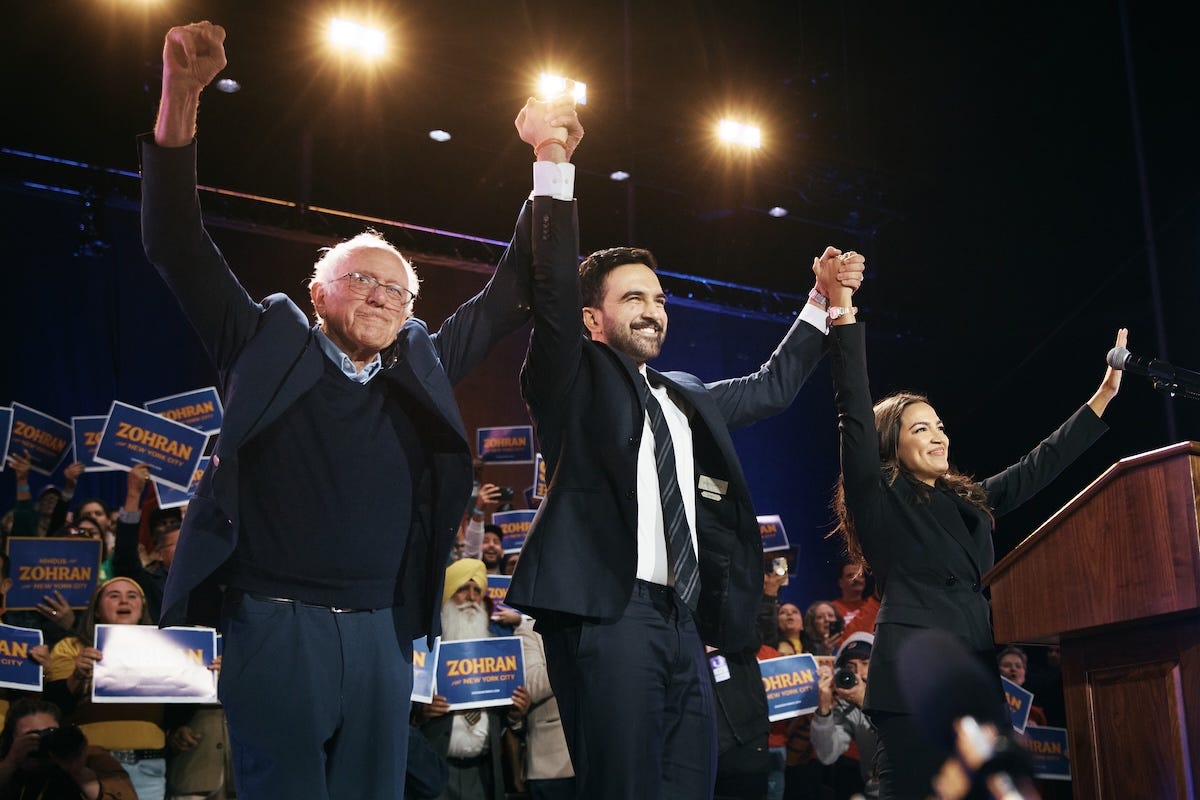
The progressive ascendancy that began (depending when you want to start the clock) in the Occupy movement, or the 2016 election, owes a lot of its political durability to Bernie Sanders.
Sanders was not exactly a pop-culture icon before the 2010s, and certainly wasn’t a billionaire. But in-the-know progressives have viewed Sanders as a role model for a long, long time. This is perhaps a bit overdetermined, because I attended college at U.C. Berkeley, but I’d heard of Bernie Sanders before I had any kind of developed politics. After the September 11 terrorist attacks, campus activists were proud that our representative, Barbara Lee, was the only member of Congress to oppose a military response, but it was a small scandal and disappointment that the only self-described socialist in federal office didn’t join her. At least that’s how I remember it 25 years later.
In any event, Sanders capitalized on that cult following in Barack Obama’s first term, when he spoke for eight hours on the Senate floor, protesting a measure to temporarily extend George W. Bush’s regressive tax cuts. That speech snowballed in real time, building an audience large enough to crash the Senate’s livestream. It resonated widely enough that he repurposed the text into a book called The Speech: A Historic Filibuster on Corporate Greed and the Decline of Our Middle Class.
Sanders threatened to primary Obama, in the manner that he would eventually challenge Hillary Clinton’s coronation, in order to channel progressive frustration with Obama’s economic policies. Obama advisers, including Senate Majority Leader Harry Reid, talked him out of it. They were, perhaps, less surprised than most when his 2016 campaign didn’t flame out as many pundits expected it would.
This made him the undisputed leader of the new new left, the most important socialist in America since Eugene Debs, a distinction he maintains to this day.
He is also 84 years old. He is almost certainly not going to run for president again. He has endorsed a number of House and Senate candidates this cycle, including candidates who challenged incumbent Democrats. Some of them have won their primaries. But this cycle will be over soon, confronting his movement with a pivotal question: And Then What?
Here’s where the similarities between MAGA and the Sanders Revolution begin to break down. The MAGA movement is composed of weird and nasty reprobates, almost to a person. Trump is more mentally ill and corrupt than most of them, but (somehow) also among the most likable. The left comprises a hodgepodge of eccentrics, dirtbags, young radicals… and genuinely inspiring people. Most of Sanders’s acolytes could not fill his shoes. But Alexandria Ocasio-Cortez could. So could Zohran Mamdani.
MAGA has little content beyond Trump and reactionary hatred of pluralism. It won’t likely have a new leader with cross-cutting appeal and an inspiring vision. But the left will! The ugly firmament of Trumpist institutions will persist, but if MAGA flames out with JD Vance or Tucker Carlson at the helm, they’ll decay into zombie organizations or simply die off. The left, by contrast, has real ideas—some more popular than others—and its organizing hubs will benefit from the charismatic leadership of Sanders’s best disciples. At least in the medium term.
But what about the near term?
Mamdani was born in Zimbabwe; he’s a naturalized citizen. The Constitution—one provision of it, at least1—says he is ineligible for the presidency.
I believe AOC will eventually run for president. And you can see in the way that she’s drawn down her involvement in factional fights2 that she’s eyeing higher office. But she’s not preparing a presidential candidacy right now, at least not as conspicuously as many other household-name Democrats.
From there, the bench begins to thin.
I wouldn’t count out Ro Khanna (though he represents Silicon Valley) and there’s a real if somewhat slender chance that Abdul El-Sayed will win his Michigan Senate race and situate himself to take the baton from Sanders.
But this may just as easily be the first open Democratic presidential primary since 2016 without a marquee progressive on the ballot—someone who can count on receiving a third or more of the vote by default. What happens then?
My guess is Normal Politics.
To hear factional moderates tell this story, you’d think they were on the verge of extinction, unwilling or perhaps unable to stand up for themselves as leftists mount a merciless takeover of the party. Progressives organize and prop up candidates while ostensible moderates like Josh Shapiro sit on their hands.
But as the AOC example suggests, it’s in the nature of an aspiring party leader not to wage factional war. It is inapt to draw a contrast between Sanders (or Mamdani) and Shapiro; the correct comparison is to the handful of moderate factional figures who have endorsed Seth Moulton in his primary challenge to Ed Markey from the right. It just feels like a weak comparison because moderates don’t have (perhaps can’t have) a leader figure like Sanders. They could try! They might feel less despondent if they tried to build movement-style popular support. But they shouldn’t despair about the fact that mainline presidential hopefuls are opting out of the factional war.
It will fall to whoever emerges as the Democratic Party’s true leader late next year or early in 2028 to forge a peace between the factions. To reconstitute the truce that allowed Joe Biden to run for president without confronting a large population of dead-enders, the way Hillary Clinton did.
That person will be less interested in vindicating any particular policy idea or vision than in pulling factional leaders together and asking questions like “what can we do, together, about the 30 million uninsured people?” Unless Democrats win majorities so large that Blue Dog-types become irrelevant, moderates will have a say in the answer to questions like that.
Fifteen years ago, when the far right in America insisted that Republicans repeal the Affordable Care Act, some “moderate” Republican members of Congress were not on board. They hated Obamacare, but they couldn’t abide zeroing out every provision of the law. Reimposing discrimination against sick people; kicking 25-year-olds off their parents’ health plans. Leadership bridged the gap with a promise to “repeal and replace” Obamacare. They eventually came within one vote of pulling it off.
The Republican opposition to the ACA was ignorant and aggrieved. But parties and political leaders exist to do work like this. There will be a factional divide in the Democratic Party over what to do about ICE that can be bridged in an analogous way.
Eighteen years ago, when progressives wanted Democrats to advance their agenda without accounting for every penny, and moderates were freaking out about the debt, leaders alighted on the idea that they should front-load a lot of spending, and pay for it slowly but cumulatively in the out years.
There will be a factional divide in the Democratic Party over what to do about the tension between energy-cost politics and climate change that can be bridged in an analogous way.
Etc. Etc.
Everyone involved will find this process frustrating. And if Democrats win with thin margins, it’ll be especially frustrating for progressives, who may find themselves with the same weak hand they held in 2021, when Joe Manchin refused to meet them in the middle.
But it’ll be normal politics. And if Democrats don’t repeat the big mistakes of the past 18 years—if they abolish the filibuster and expand the court—they’ll accomplish a lot more than they did in Biden’s term, in a much more lasting way.
I personally would love to see Mamdani build a legal case that the eligibility clause conflicts with the later-adopted equal protection clause, which should thus supersede it. But he says he has no interest in amending the Constitution, and for this essay’s purposes, I’ll assume that extends to establishing new Supreme Court precedent on the matter.
AOC did not cosign Mamdani’s endorsements in New York House primaries.
Mamdani was born in Uganda, not Zimbabwe!
I agree with the premise that there isn't a clear successor to Sanders near term other than AOC. But the establishment of the party is right to freak out in that not only do voters reject them but they are also increasingly rejecting the old establishment way of politics. Maybe this does lead to new left leaders quickly?
Buttigeig and Ossoff come to mind as younger leaders who are currently threading the needle nicely between populism / reform / and establishment politics. Maybe Takarico if he wins Texas. But who else is there waiting in the wings?
None of Schumer's picks to flip red senate seats are more than caretakers of that seat for 6 years.
Everyone else either has a bad governing record, toxic political positions, or a lack of charisma. The Dem establishment hasn't fostered a new generation of leaders either.