
Insecure Right Wingers Want Conan The Barbarian To Be Real
Their "high-minded" complaints about The Odyssey movie deny the human condition.

First, the right tried to “cancel” The Odyssey (film) for the sins of allowing a black woman (Lupita Nyong'o) to portray Helen of Troy, and casting a trans man (Elliot Page) in any role whatsoever.
These reactionaries, led by Elon Musk, did not come out and say “we find these people disgusting,” but what else could they have meant? The movie hadn’t even been released yet!
When their boycott method failed, and The Odyssey began setting box-office records, they retreated to more literary-sounding critiques. If they couldn’t cause the movie to flop, perhaps they could upend the critical consensus that the movie is good. They began complaining about the many ways director Christopher Nolan departed from the text of The Odyssey (book), as though it’s per se wrong to re-interpret old art.
This rhetorical concession has brought us endless Odyssey Discourse™️, as mainline writers (most of whom have watched the right-wing freakout unfold on X) take questionable sparring partners up on a revised critique. With the bigotry now thinly concealed, good-faith debate may resume.
A little pontificating is hard to resist from time to time, but this is a mistake. By treating instrumental ideas as if they’re analytically sincere (if a bit crude), they’re allowing improvisers to sniff out the sweet spot, where their exhausting crusade against modernity will get a fair hearing.
So let’s go meta instead. A worthier task is to examine what this whole deranged discourse says about them. What kind of person experiences an allergic reaction to any art that doesn’t serve as a trick mirror, reflecting back to them whatever they believe they and the world should look like?
To make the claims they’ve fallen back on, and stick to them, you’d have to believe very childish things about human nature. At some level, you’d have to believe there is no human nature at all, apart from what culture forces upon people. You have to believe that frailty is a choice; that He-Man would be possible, if only the right people were in charge.
Different haters have different nits to pick, but they’re all now upset about liberties Nolan took with the story (rather than with the gender and racial identities of his actors). Some of them characterize this as a preoccupation with “historical accuracy” (a complaint that conveniently allows them to smuggle the black-Helen freakout back into their critique) while others quibble more carefully: Nolan stripped the text of its intended cultural and moral lessons, and this is sacrilege.
“This isn’t something like having Denzel Washington play Macbeth,” complained one writer. “‘Macbeth’ is not specifically about Scottish culture the way ‘The Odyssey’ is about ancient Hellenics.”
(When Denzel Washington portrayed MacBeth, National Review maligned it as a “woke, Oscar-ready Shakespeare update.”)
To back up the notion that this is really just about the insult to long-dead “ancient Hellenics,” these critics bemoan that “Odysseus, as portrayed by a crusty Matt Damon… is torn and tormented about pretty much everything, often in contradictory ways, but certainly about his cunning plan to win the war against Troy. OK, there are a lot of things to say about the ancient Greeks, but being sad about winning a war is not one of them.”
"The main struggle for Nolan and his producer wife is that they can't make the ancient Greeks too heroic, masculine, iconic because that would uphold the Euro-supremacist roots of all Western Civilization. So you cast a woke manlet as the King."
That’s from the fanatical right-wing commentator Peachy Keenan, who may or may not have clacked out the words “Euro-supremacist roots of all Western Civilization” letter by letter, with two fingers marching across her keyboard in goosestep.
They’re right about this much: Nolan does not portray Odysseus as a remorseless conqueror, but rather an exhausted, regretful, traumatized elder, who bears little resemblance to Homer’s protagonist.
Ergo, something something, the movie does not deserve acclaim.
Sharper critics were quick to point out that The Odyssey isn’t a work of non-fiction. The Mediterranean has never been a funhouse of monsters or a gateway to the underworld. Homer wasn’t Herodotus. Poetry isn’t history. Odysseus wasn’t a real person. Helen probably wasn’t either, and the mythology isn’t even consistent on the question of whether she went to Troy.
But there were kings and elites and warriors and wars in Ancient Greece. It is thus practically certain that real people witnessed and committed real acts of heroism and brutality. Faithful recreations of these incidents are lost to time, but they form the basis of an oral tradition. They’re myths not just because they invoke supernatural beings and forces, but because they’re meant to impart lessons so that descendants would have archetypes to emulate, temptations to resist, sins to hate.
And if that is the case, then, as a modern and mature person, you should believe that someone like Odysseus—perhaps a composite of real-but-forgotten warriors—would fare in “real life” more like Nolan’s Odysseus than like Homer’s. Not only that, but (no one post this to X.com, and certainly don’t @ Elon) some ancient fighters and adventurers probably had vaginas, even if they didn’t really seem like it outwardly!
We don’t need the classics to understand how myths grow untamed from underlying kernels of truth, and then persist in the popular imagination.
Our modern myths are less fantastical than the classics, because we have better historical practices, and better foundations of knowledge—about the human condition, but really the entire natural world.
There’s no reason to believe a man named Odysseus ever existed, let alone that gods beset him with mortal perils as he fought his way home from war. But it’s totally reasonable to believe that lost warriors, feared dead, returned home telling heart-rending tales of peril and deprivation.
Scanning through the right-wing Odyssey laments, I was reminded of the differences between Audie Murphy, the combat hero I learned about from popular culture, and Audie Murphy as depicted in Don Graham’s definitive biography No Name On The Bullet.
To the extent an American selected at random in 2026 knows anything at all about Audie Murphy, it probably has something to do with his courage and lethality on the frontlines of World War II. Some surely remember or know that his heroic service made him famous, prefiguring a successful Hollywood acting career. Perhaps they recall these scenes from the autobiographical film To Hell And Back, in which he portrayed himself.
In reality, the war shredded Murphy’s psyche, and he lived out his days addled, intemperate, and vulnerable. He suffered flashbacks. He picked fist fights with strangers. He slept with a gun under his pillow. Here’s a characteristic passage from Graham’s book.
Compounding his problems was insomnia, the old affliction from right after the war that had come back to ravage his nights from, he said, 1959 to 1966. He moved into his garage, made over into a bedroom, so that he could be farther away from noises. Hypersensitive to sound, he was bothered by any kind of noise. That, too, he traced back to combat: “In combat, you see, your hearing gets so acute you can interpret any noise. But now, there all kinds of noises that I couldn’t interpret.” Sometimes when he did sleep, the old nightmare returned. He was on a hilltop and faceless people were charging at him. He had his Garand rifle, but every time he shot one of these people a part of his rifle fell off. Finally all he had left was the trigger guard. Then he’d wake up. He kept the lights on so that when he woke up from the dream, he’d know where he was. Then, to cure the insomnia, he started taking a prescription drug, Placidyl. One pill would buy him three or four hours’ sleep; not enough but better than nothing. Before he knew it, he was hooked….
He started taking more pills and he began to lose weight. By now, he said, “I was a zombie. I dissipated all my money. I gave it away. I was not interested in anything. If a bus got in my way while I was driving on the freeway, I’d just force it to the side of the road....” His friend Al Jank, a wrangler and animal manager at Universal, was riding with Audie to the racetrack one day when a guy cut them off on the freeway. Audie threw his new Olds into high gear and raced after the guy at 100 miles an hour…. “I’m gonna catch that son of a bitch and run over him and shoot him.”
If you’re 12 years old, or a writer for Townhall.com you can lash out at Graham for puncturing the mythology. Or you can choose to be a grownup about it. Murphy did! He knew why he had a hard time functioning after the war. He was not shy about it. He even lobbied the government to study the effect of modern combat on the human psyche.
We valorize warriors by recounting their daring escapes from captivity. If you’re interested in an underheralded, truly Odyssean story, find yourself a copy of Prisoner Of The U-90, the autobiography of World War I hero Edouard V.M. Izac, who was taken captive after a German U-boat sank his transport ship. As a prisoner and fluent German speaker, he eavesdropped on his captors, and committed the intelligence to memory, hoping to escape and debrief allied commanders. He once attempted escape by jumping from a moving train, but was recaptured with terrible injuries and held in solitary confinement. He eventually helped organize a jailbreak and trekked with an American compatriot over 100 haunting miles through mountainous terrain and across the Rhine into Switzerland.
“Often we were startled by sentinel-like trees standing alone in the fields: in the gloom they so closely resembled the guards, who we knew were by this time searching for us,” he later wrote. “When we spoke, which was seldom, it was always in whispers; and we never coughed from the moment we left the camp until we were safely in Switzerland.”
He received the Medal of Honor for his heroism, and eventually became a member of Congress, but his physical and psychological injuries forced his retirement from the military, and he grew to hate war.
It’s not that there’d be anything wrong per se with purely mythological treatment of any of our great war stories. Civic mythology is propaganda, but it can be useful for promoting social virtue.
Part of the problem they perceive is that we—the culture—produce too much of the wrong type of propaganda. We valorize selfless heroes, but there will never be an acclaimed film or biography celebrating a marauder like Eddie Gallagher. Indeed, the modern right has less and less time these days for any cultural production that depicts the allies as the heroes of World War II.
But it’s also weird and revealing to get mad about truer depictions. Their response, as if experiencing the effects of poison, is bizarre to witness. It’s indicative of contempt, and not just for nuance or authority or different kinds of people, but for themselves. That were it not for our acknowledgement of and concern for human frailty—particularly male frailty—rightists would not need to be haunted by their own torments or feelings of inadequacy. They would not feel under siege because they could lay waste, mightily and without consequence, to whomever or whatever they perceived as a challenge to their divine excellence.
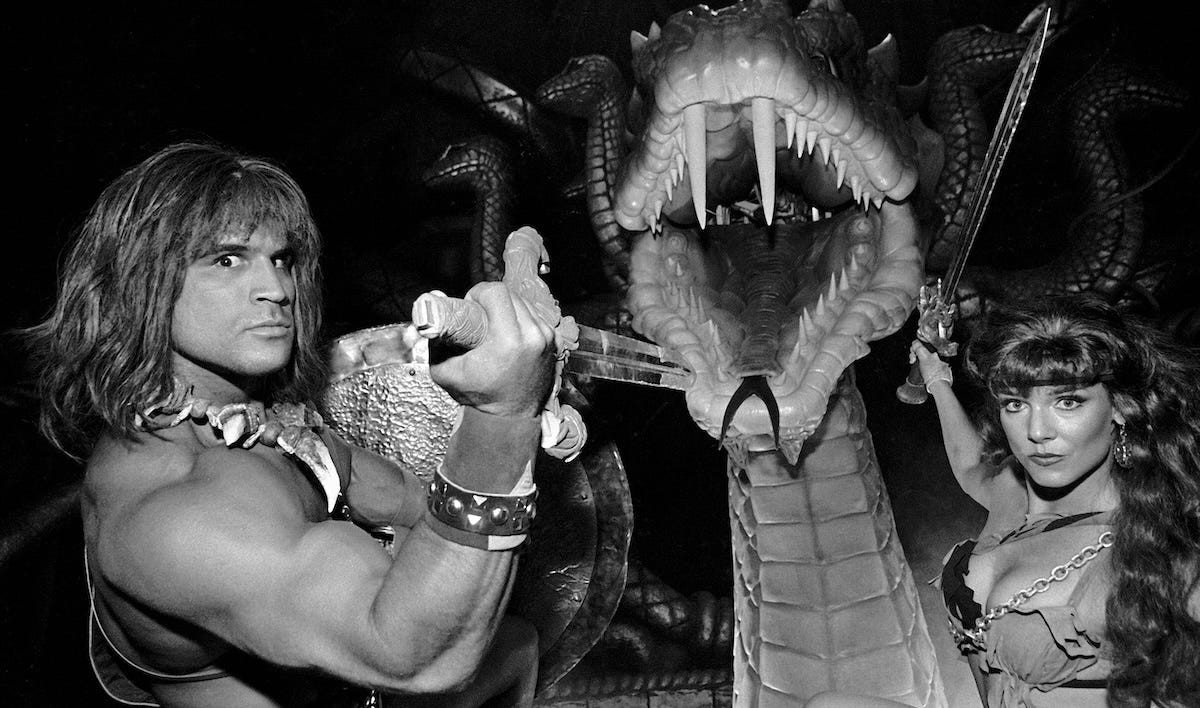
If it weren’t for the wokes, I could be Conan the Barbarian!
They direct their anger at Nolan and Nyong’o and Page, but their true beef is with reality. The human condition, and its durability across time and culture. The persistence of vulnerabilities and variabilities they'd prefer to deny. Until they can accept those things, discourse will be futile. PTSD wasn’t conjured into existence by psychiatrists intent on emasculating modern men. Men weren’t free from suffering until scholars identified common symptoms and triggers of trauma. Likewise, the coinage of the clinical term “transgender” did not cause people to become transgender. Gird your loins, Musk, but transgender people have always been with us. They were more real 3,000 years ago than Odysseus himself.
Could it be that the common language and consensus we’ve developed around conditions and identities we didn’t understand until recently drive what we might describe (in a collective sense) as “false positives”? People who, say, claim PTSD to explain different psychological symptoms, or even to pathologize what’s ultimately just flair for the dramatic? Absolutely. But people like that have always been with us, too. What it means to be human hasn’t changed, only how we regard the many manifestations of human existence. We don’t need to play along with child-minded chauvinists who’d drag us backward, to a time when it was easier to disown, sequester, or kill off the inconvenient ones.
This piece has been updated for clarity.
What a fantastic read - insight into our desire to be comic book heroes instead of humans. Loved it.
Denzel Washington did play Macbeth!