
MAGA Squandered Young Men's Trust; Making Them Stay Democrats Is The Hard Part
The right discredited itself. The left can't win them back with beards and podcast appearances alone.

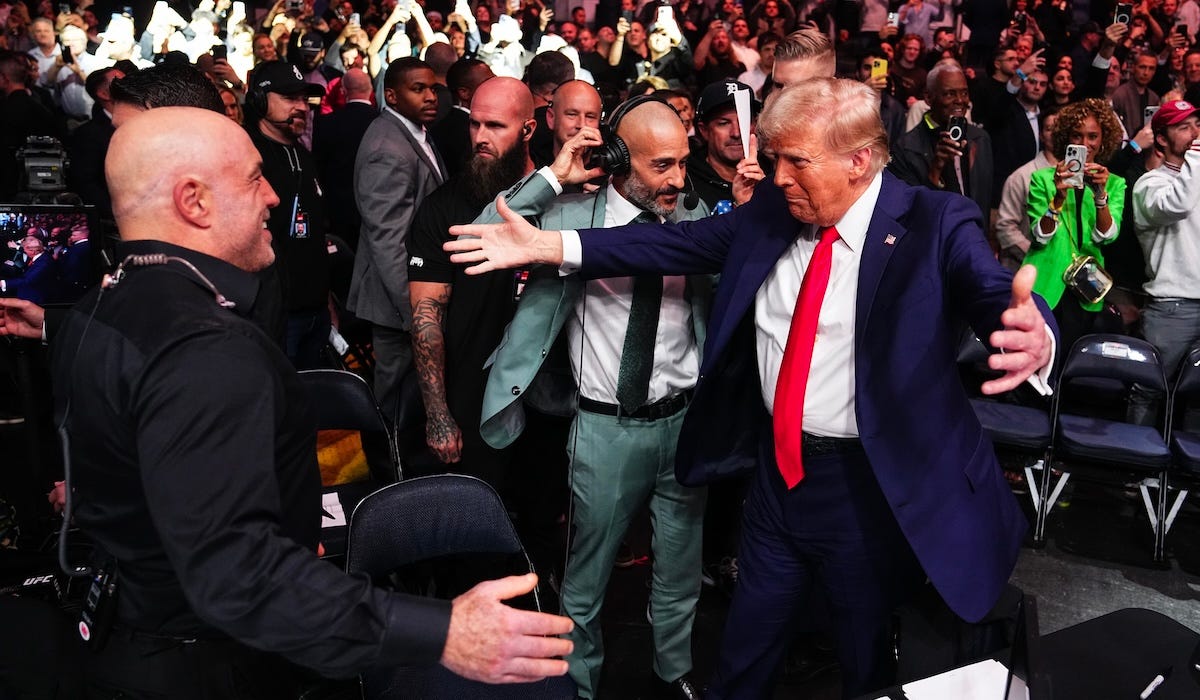
We’ve come a long way since the post-2024 freakout. When Donald Trump won a second term, Democrats quickly gave in to fear of permanent realignment, and durable Republican political and cultural dominance, driven by young men—as if the election had been a choosing moment for them, for all time, and they’d chosen chauvinism.
The swing back has been head-spinning. Trump’s support among young men has collapsed. Survey data provides some clues about what caused these voters to sour on him, but for the most part we’re left to draw hypotheses with common sense.
Most obviously: Trump’s presidency has been a failure. Whatever about him appealed to young men—or made him less unappealing than Kamala Harris—proved illusory. The policy appeals were lies; the cultural ones didn’t pay for gas and groceries, and in any case they came with more baggage than they were worth.
Harris and her aides aides cite the influence of the Tate brothers as a critical factor in her defeat; casual misogyny apparently sold well as a fad, and helped sour young men on progressive feminism. But there’s no way to join a mass movement of “masculinists” without aligning yourself with thieves and rapists.
Young men, some surely oblivious, joined a movement and party of blamers and whiners—a political formation that covered up the Epstein files, where men who abuse their wives and partners are shielded from consequences.
The contrast between the parties on this score has thus grown stark. In the span of just a few weeks, Democrats evicted two leading candidates for important offices (California governor and Maine senator) from their party over credible accusations of predatory behavior toward women. Meanwhile, it is essentially a capital crime in Republican politics to even acknowledge that Trump himself is a predator. That, in turn, makes it impossible for Republicans to uphold any standards at all, lest they be applied to Trump. Republicans and the overwhelming majority of conservative elites continue to hang together with Congressman Max Miller, who has been credibly accused of physically abusing multiple women—including his ex-wife, who happens to the daughter of Republican Senator Bernie Moreno. (After laying low for weeks, Moreno finally called on Miller to resign.)
The ur-hypothesis, then, is that a large subset of young men were willing to try Republicans on for size, and Republicans squandered their trust. It’s a compelling theory. But it’s conspicuously a theory about the right wing discrediting itself. Nobody fools themselves into believing the broad left somehow won young men back, let alone that progressives and Democrats have grappled rigorously with the question of how to do that.
In this insightful episode of the New Republic’s Daily Blast podcast, Greg Sargent and Moira Donegan assess these developments methodically—starting with why the 2024 election turned out the way it did, through the clumsy ways Democrats responded, to the crumbling of the second Trump coalition. But a big question mark still hangs over the matter of what Democrats should do that might actually generate higher sustained levels of young-male support.
As Donegan notes, “You see people from the left, right, and center of the Democratic Party all trying to make the party a little more masculine, trying to recruit more manly men, trying to court male voters. But there is this sort of over-identification, I think, with the Republicans’ theory of the case.” Trump lost these voters, she notes, because “they’re not actually being elevated in their own status by this hyper-masculine style in governance.”
But the episode ends without a positive prescription. Sargent asks, “What would you like to hear Democrats saying to young men that will kind of create a sense that they represent a better vision of masculinity than the one Donald Trump has tried to foist on the country?” And it goes unanswered.
For the purposes of the next election or two, the problem may have taken care of itself. But I don’t think it’s been solved for the medium or long run.
Democrats and liberals, analytical as they tend to be, tried to solve it as though it were a game. Go on Rogan. Recruit burly candidates. Swear more. Add chips to the “masculine” side of the scale.
And for a freewheeling kind of Democrat, going on Rogan is fine. If his gut-driven, manipulable, factually challenged style of broadcasting can’t be discredited and outcompeted in the marketplace, reasoned people are better off engaging with it than allowing it to pollute the information ecosystem unchallenged.
Likewise, burly male candidates are good if they’re good—but they’re bad if they’re bad. And in any case, none of these superficial concessions is really responsive to the question of why young men looked at Biden-Harris-era Democrats and decided: No thanks. Nobody thinks America’s only liberal party would’ve better appealed to impressionable young men with a dozen more Rogan appearances and a ten percent increase in bearded senators, absent any change in substance or values.
This is an approach to winning over men that’s roughly akin to competing in a high-school popularity contest by collecting and responding to survey data. Its superficiality, its robotic touch, make it almost self-discrediting.
To take the problem seriously, you first have to imagine and inhabit the mind of a fairly typical young male, someone without political sophistication, let alone fixed ideological commitments. He’s awash in memes and influencers and celebrities and political operators standing as avatars for communities he may choose to join. And then you have to ask yourself: How did the left-wing community come across, and how did the right-wing community come across?
In our flawed political system, this kind of young adult has two choices. Blue or red. We know what he chose last time. What we want going forward, ideally, is for him to look left and find a community that seems fun and welcoming, generous and forgiving, to him as a man.
Of course not all young men will make voting decisions on the basis of male identity alone. Men, like all people, hold varied identities and commitments, some that run into conflict with one another. I know a number of gay Democrats who aren’t particularly fond of how progressive culture regards the male condition (or, at least, how they perceive progressive culture to regard the male condition) but who will never vote Republican because they correctly assess the GOP as the more intolerant party. Jewish men and black men are much less Republican than white men for similar reasons.
But a year and a half ago, this entire cohort looked left and right—and then drifted right. We interpreted that collective decision through the lens of right-wing appeals. Republicans welcomed young men to be “based.” To gamble. To be unabashed. And so Democrats thought, we should be more based-curious. More tolerant of ribaldry and more fluent in sports, more open-minded about crypto and Kalshi, and their lobbyists.
I don’t think that approach works in the long run. The new right turned out to be a scam—in some ways literally scamming young men out of their money. But fundamentally the broad left hasn’t modeled an attractive alternative; they’ve mostly just repackaged the same stuff with edgier tweets. Democrats didn’t actually become ballsier, and the broad progressive world didn’t really change posture or affect.
Rather than check more boxes next to categories that code male, the solution lies in presentation and manner. Step one isn’t appealing to men for their votes, but demonstrating an interest in their fellowship. They should look left and see a place that would esteem an appealing version of themselves.
The conundrum has at least two major roots.