
Jasmine Crockett's Partisanship Was Not The Problem
Her liabilities were real, but by November, anti-Trump partisanship might be a winning play across all Senate battlegrounds.

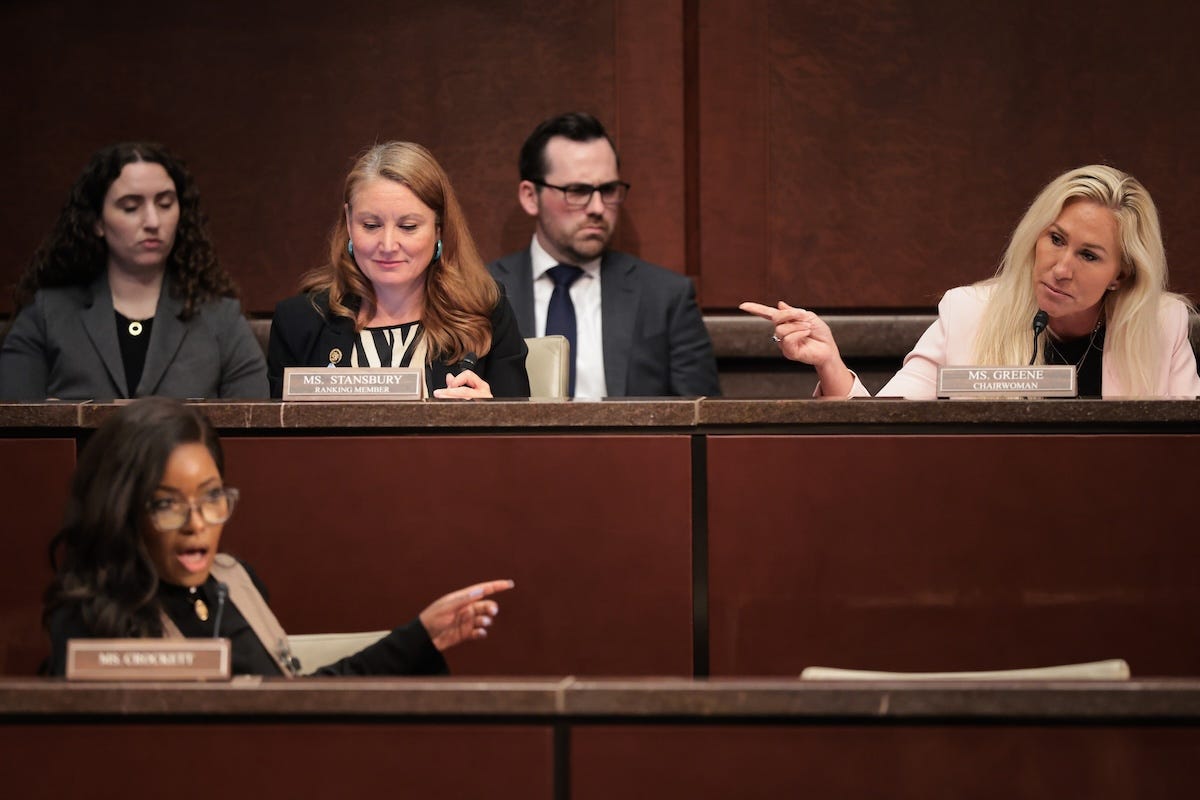
It came as a relief to Democratic Party elites and activists watching from the sidelines that James Talarico defeated Jasmine Crockett for the Texas Democratic Senate nomination.
After tracking that race, also from the sidelines, I mostly feel the same way. Crockett entered the primary dogged by reporting that depicted her as undisciplined and self-absorbed, flaws that overwhelmed her raw talent. She could have shaken off this reputation by running a disciplined campaign. But she didn’t. On balance, Talarico won the grace-under-pressure primary, and, thus, the nomination
But I don’t think I came to my view the same way most liberal politicos did.
When Crockett entered the race, most Washington Democrats freaked out before they’d had time to reason. They knew Crockett had a large, dedicated fan base, and (they stipulated) no chance of winning statewide in Texas.
This was a tell, because most of the time, political moneyballers weigh ideology more heavily than anything else, and deem moderate candidates the most electable. But not in this case. If anything, Talarico was the more conventionally progressive of the two.
And so they cast about for alternative analyses, mostly (I think) because they were reluctant to acknowledge their true animating concern: Crockett is a black woman who doesn’t try to make herself seem like “one of the good ones” to marginal white voters. The most successful black politicians with national name recognition all do this to some degree, but Crockett doesn’t really. Not in her fashion choices, not in her vernacular, and not in the way she talks about her Republican colleagues.
I want to be clear that I don’t think these doubters were racist or even necessarily wrong. They imputed a level of racism to the Texas electorate, and assessed Crockett’s viability under that constraint. Republicans could barely contain their excitement at the thought of running against her, and we know what their attacks would look like.
But it would’ve been impolite and impolitic to cite all of this as the basis for supporting Talarico. So they alit on another justification: that Crockett was too partisan. She’s a good attack dog. Her contempt for Donald Trump is deeply felt. But in a state like Texas, Democrats need to win over people who voted for Trump, not antagonize them. Moderate or not, they can’t make being anti-Republican central to their identity.
It’s hard to dispute this analysis in the abstract. And at the end of the day, we all reached the same conclusion, so what’d be the point of nitpicking other people’s public arguments? Mostly it’s to remind everyone in the punditry game that politics is weird and events are unpredictable. But it’s also because we’re living through a period of unsettling turmoil, which makes pat assumptions that might be true today even less valuable than they usually are.
For instance: The general election will likely pit Talarico, a seminarian, against Ken Paxton, a philandering crook. In Texas-adjusted terms, I like Talarico’s odds. But a known scumbag has no reputation to maintain, whereas the shine can come off a golden boy in one news cycle. This is a risk that polling can’t capture.
By contrast, if Crockett’s defining quality is partisanship, what really matters is Trump’s popularity, and the trajectory of his polling. Those make a bull case for candidates like her. Indeed, the Democratic Party’s broad aversion to outright partisanship has become harder and harder to justify every day. Trump is already underwater in Texas. His trajectory, for a hundred different lies and failures, is downward. As time goes on, the broad public—including many Trump voters—might well come to appreciate Democrats who had Trump’s number from the jump, and never minced words about it.
Historians can speak with greater certainty, but I can’t think of a president who ran for office on universally false pretenses, only to reveal a secret agenda very few people voted for knowingly. It happened to be a recipe for victory, it could easily be a recipe for historic collapse.
What might that look like in practice?