

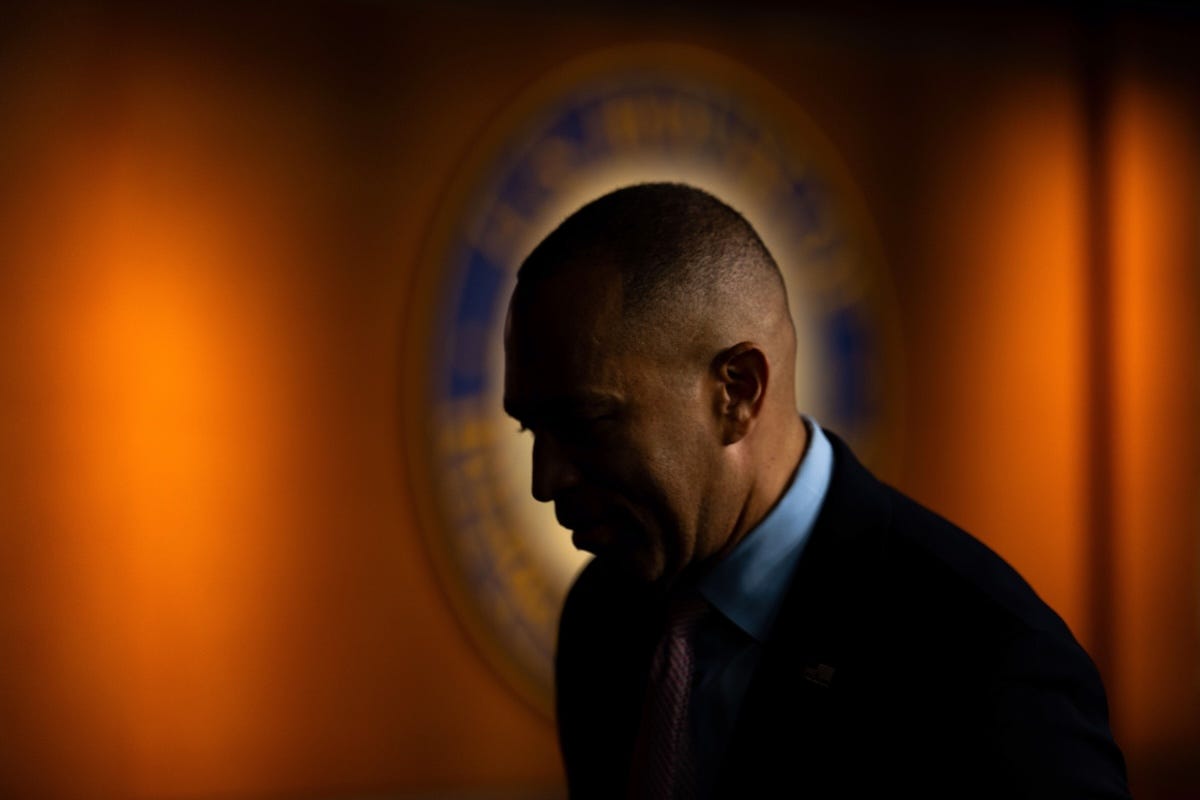
With the House of Representatives back in session this week, I think Hakeem Jeffries should force a vote on a privileged resolution to impeach Donald Trump as a first order of business.
Trump affirmed once again this Easter weekend that he’s a menace to the country and a threat to world peace. And at the risk of boring readers with the rules of parliamentary procedure, Jeffries alone among Democrats is entitled to an immediate vote when he raises a privileged question on the House floor.
Republicans could and likely would vote to table any such resolution, but that would represent a de facto endorsement of whatever war crimes Trump chooses to commit against Iran in the coming days, and of the global economic fallout for Trump’s humiliating forfeiture of the Strait of Hormuz.
The least-worst way forward for both the U.S. and the world is for the war to end immediately. That almost certainly can’t happen with an erratic president in office, buffeted by improper ego and personal-wealth considerations. Ergo the least-worst way forward for both the U.S. and the world is for Trump to be removed from power abruptly.
That obviously can’t happen without Republicans. And most Republicans will fall over themselves to protect Trump from any form of accountability, to say nothing of removal. Perhaps particularly to the extent that removal is presented as a Democratic Party demand. Their raison d’etre since at least the Gingrich era has been: anything goes so long as you’re all in against Democrats.
But, paradoxically, removal won’t become a live question unless Democrats raise it. That militates for an impeachment debate. The only legitimate ways to remove Trump from office are through the 25th amendment—which must be initiated by the vice president and members of the cabinet—and the impeachment process, which would require significant Republican support, but can at least in theory be initiated by the out party.
It is not certain that either approach would result in removal quickly enough to prevent Trump from committing war crimes against the citizens of Iran. But it might! It might also deter Trump. Either way, it would signal to the country and the world that the atrocities he has in mind do not have the blessing of the U.S. government or the American people.
And it would represent the Democratic Party’s first unmistakable attempt to end this war; to define themselves in the public mind as a party that’s wholly opposed, and is trying in earnest to stop it. Instead of squabbling internally over whether they’re antiwar, or how to be antiwar, or which antiwar public figures they should welcome into the tent, they would simply become the representatives of the country’s antiwar supermajority.
Let’s talk about the Republicans first. They bear primary and ultimate responsibility for all of this. But from where they sit, it seems as though enabling Trump, submitting to his threats, and justifying it all as the price of lib-owning has become so frictionless that they don’t realize Trump threatens to squander their inheritance along with liberals’ and everyone else’s. The U.S. is a mighty democratic republic, but there’s only one of it, and wrecking it for liberals wrecks it for the right-wing, too.
If any argument will convince these Republicans to end their complicity it’s this one—an appeal to their selfishness, cloaked in the language of patriotic fervor. So let’s spell it out.