
Exploit The GOP's Nazi Meltdown
Are we really going to accept the conceit that the central issue in politics is whether DEMOCRATS are too extreme?

It’s likely though not certain that Abigail Spanberger, Mikie Sherrill, and Zohran Mamdani will all be elected to important offices on Tuesday.
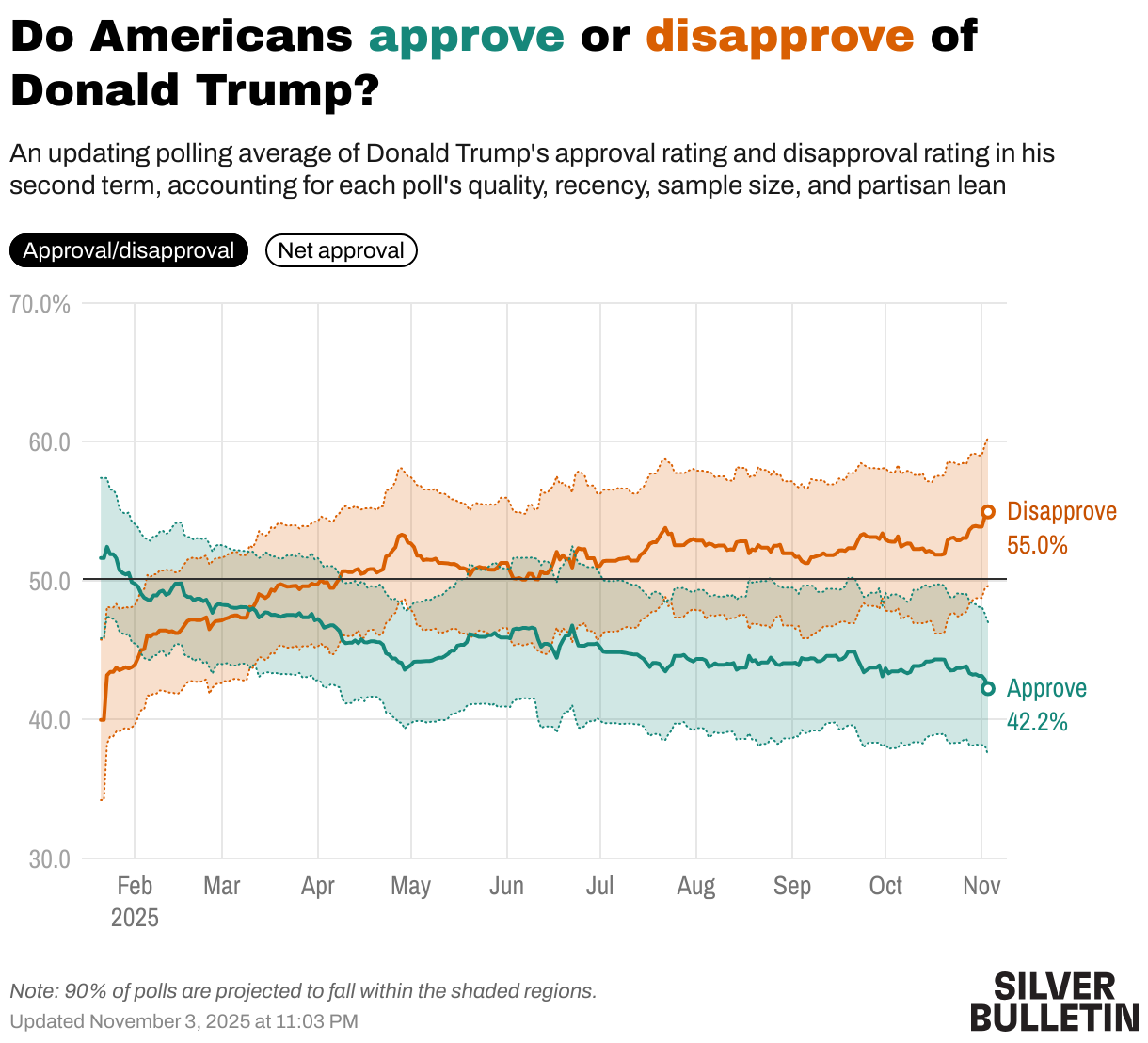
As long as we’re all knocking on wood together, this should serve to improve Democratic Party morale. Donald Trump has grown significantly more unpopular since the federal government shut down a month ago. Republicans badly underestimated Democratic resolve—at long last—to wield power. And recent survey data suggests Dems might finally be building a real lead in the generic ballot for control of Congress.
Whatever the margins of Democratic victories this week, though, the fact of them will drive predictable and insipid discourse aimed at fanning the party’s insecurities.
Is Mamdani the future of the Democratic Party, or are Spanberger and Sherrill?
Does the Democratic Party have a socialism problem?
Isn’t Mamdani’s rise yet another indication that Democrats have Decided Not To Win nationally?
For our collective sanity, we should anticipate and head off all of these sources of self-doubt, then contemplate why, after a Democratic electoral sweep, amid a huge national backlash to Republican extremism, political professionals will be inclined to muse over why Democrats winning might create problems…for Democrats.
Why do elites assume hinterland swing voters are carefully attuned to the voting decisions of progressives in New York City, but uninterested in genuinely disturbing trends unfolding on the right?
This is a big and complicated problem, but an important aspect of it is self-inflicted.
TUCK SOUP
Let’s go bullet point by bullet point:
The answer to the first question is simply, “yes.” For as long as the American right is in thrall to fascism, the Democratic Party must span the left and center, and even a bit beyond.
The answer to the second question is simply to scoff and observe that the Trump regime is strong-arming major industries into giving or selling the U.S. government ownership stakes in the means of production.
The answer to the third question is to ask why political elites are so fixated on left-of-center infighting, or the ideological perception of Democrats, given that the right is currently embroiled in a civil war over whether the GOP should be one- or zero-degrees removed from Nazis.
There’s no hyperbole at work there.
For years now, Democrats have been arguing in circles over the import of their issue positions while on the split screen, Republicans accommodated unapologetic extremists without compunction.
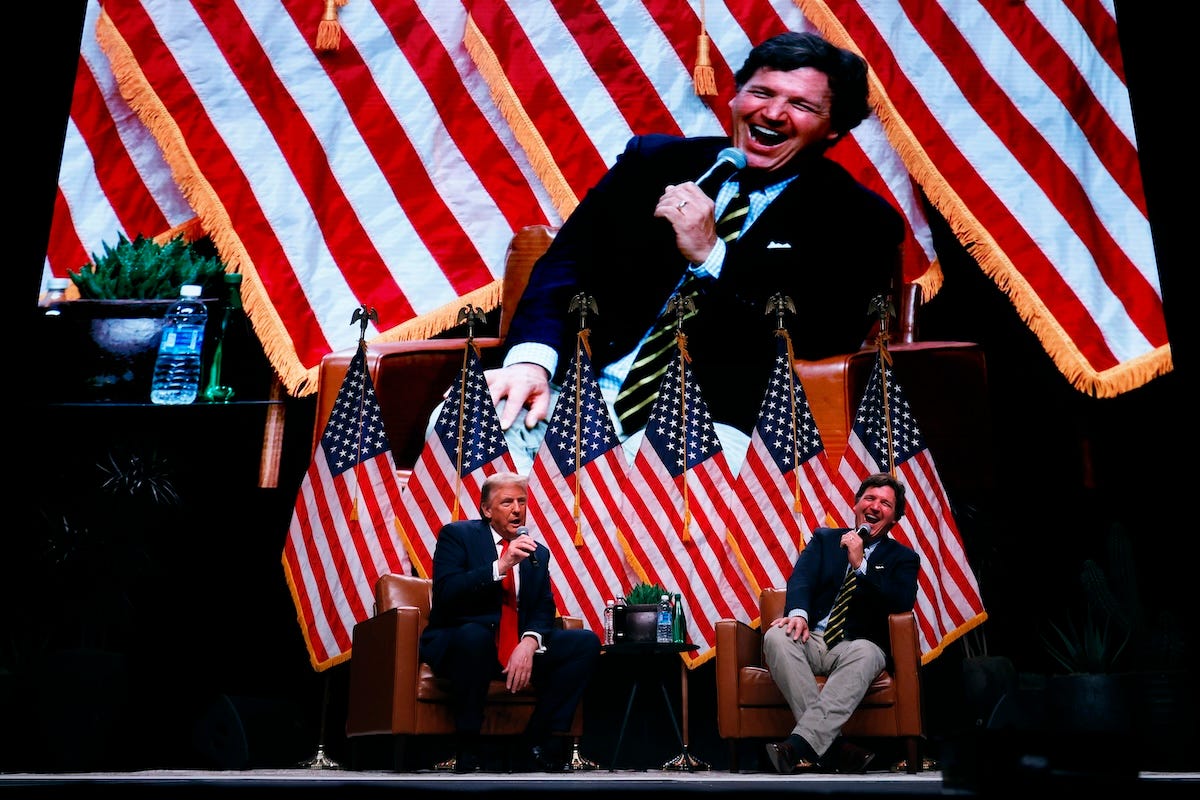
Some of those Republicans claim to have reached a breaking point last week when Tucker Carlson, the country’s most prominent right-wing media figure, feted Nick Fuentes, the country’s most prominent Nazi—and major MAGA institutions decided that they were A-OK with it!
The Heritage Foundation has been at the center of these recriminations. Its CEO Kevin Roberts absolved Carlson for trying to bring Nazis into the mainstream. Other Trump-aligned elites balked, including Heritage Foundation employees, plunging the whole conservative movement into crisis. These rebels aren’t the most sympathetic bunch. They chose to ride the tiger of MAGA and all of its bigotries for a decade. But they really do seem draw the line at remorseless Nazism.
And yet… this huge and fraught question of how the Republican Party defines itself, and who it opens its doors to, remains a sideshow in our discourse to the apparently more pressing question of whether the Democratic Party’s platform uses the words “trans” and “climate change” too much. Republicans crack up over the question of whether they should be more fascist or most fascist, and yet the question dominating U.S. politics is whether Democrats have become too left wing to win.
These warped discourse priorities are symptoms of the broad left’s biggest liability, which is a deformed information environment. Nearly all media channels blare reminders, in one form or another, that the Democratic Party is weak, lame, and out of touch. Meanwhile, it requires specialized knowledge and curiosity to learn that the Republican Party is in the process of affirming that its mantra “no enemies to the right” includes Hitler admirers.
THROW MAMDA FROM THE TRAIN?
Rebalancing the information environment will require years of effort and a lot of money. But even now liberals have some sway over political discourse, and it’s worth noting that the discourse reflects the decisions they have made about what to focus on.
Liberal elites and Democratic strategists have chosen to rend their garments over issue positions and rhetorical tropes. They are unusually sensitive to the social-media output of progressive activists relative to elected officials within the party. They claim Democrats have been punished predictably for views they either never held or abandoned years ago. They proceed as if politics follows the rules of Calvinball, where Democrats have to theatrically purge unpopular ideas and flagellate themselves in order to win the trust of swing voters, but all it takes for Republicans to maintain an image of moderation is for Trump to lie unconvincingly about his governing agenda once or twice.
In waging this factional war, liberals have aligned themselves with Republican pundits—Patrick Ruffini, Ross Douthat, Ramesh Ponnuru, Steve Bannon—who, whatever their talents and whatever their real views of how politics works in modern America, are happy to sic centrists and progressives at each others’ throats.
What if liberal elites were similarly interested in fanning right-wing infighting?
Republican leaders are eager to make Mamdani famous. They treat it as a foregone conclusion that the national public will hate him. They assume, because they’re keen observers, that the Democratic Party will destroy itself over the question of whether to defend Mamdani from smears and abuses or leave him to fend for himself.
Democratic leaders by and large do not reciproacate (though Chuck Schumer gets an honorable mention here). It is a distraction, in their minds, from the poll-tested issues their internal critics scold them for not making “salient.” Better to talk about health care than Beltway drama. They try to live out the old maxim that it’s best not to interrupt an enemy who is destroying himself. They have mostly failed to adjust to a fractured information environment, where the best move against a self-destructing enemy is to egg him on.
Most prominent Democrats have avoided mention of the Carlson-Fuentes alliance and the various Republican elites on either side of the ensuing controversy. They have not noted the obvious: That Trump is ultimately responsible for his movement’s openness to Nazism, and only he can really write Carlson, Fuentes, and their ilk out of the movement. He must either purge his government of Groypers or admit to the world that they are welcome to wield power in his regime.
A more fitting discourse to accompany a big-tent Democratic election sweep amid a Republican civil war would more or less invert the one we’re likely to get:
Is the future of the GOP Jack Ciattarelli or Winsome Sears or Tucker Carlson or Nick Fuentes?
Does the Republican Party have a Nazism problem?
Isn’t their aversion to gatekeeping yet another indication that they’d rather lose and steal elections than moderate?
It's perhaps a bit too telling that my initial reaction to the headline was, "Which Nazi problem? The texts? Heritage and Fuentes? The salutes? The race-based gestapo? Reserving refugee status for apartheid perpetrators?
The Republican Party has a Nazism problem and, therefore, so does the rest of America.