
The De-Trumpification Process Begins Now
We are already in a battle for historical memory. Proceed accordingly

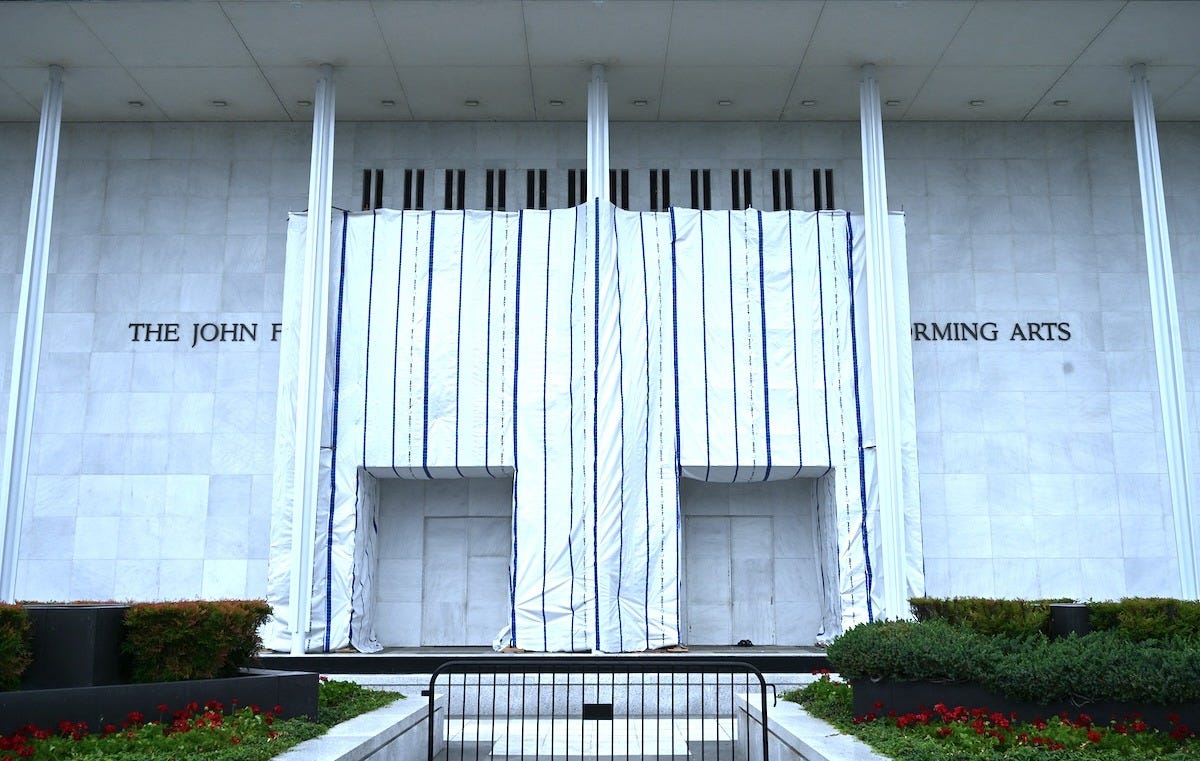
My wife and I went to see Disclosure Day1 Friday evening. Earlier in the day I’d checked in on one of the feeds set up to livestream the facade of the Kennedy Center. The center’s board (but really the executive branch of the United States government) was under court order to remove Donald Trump’s name from the building’s exterior wall, which Trump’s lackeys had welded up there in violation of the law dedicating it to honor John F. Kennedy.
Thunderstorms forced the construction crew to take shelter, which meant that for a time the feeds would depict half-erected scaffolding rendered out of focus by falling rain.
But when the storms passed, the construction did not resume. Trump et al had raced to the DC Circuit Court of Appeals in a desperate attempt to get the order lifted. To qualify for emergency relief, the litigants would have to show that the Kennedy Center would suffer harm if the order were allowed to stand. The harm, they argued, was that the board would throw a hissy fit and defund the institution, unless it remained “THE DONALD J. TRUMP AND THE JOHN F. KENNEDY CENTER FOR THE PERFORMING ARTS”—at least through the pendency of litigation.
This delay cost hours, and left the order for removal in a state of limbo at showtime. By the time the movie ended, an appeals court panel, including one Trump appointee, had denied the request, and the crew was back at work assembling the scaffolding.
So we started walking. On the off chance that there was enough time left in the day to comply with the order, we wanted to be there for it.
As we were en route, I mused that, even if we got there in time—and even if the work was completable by midnight—Trump would likely arrange for the letters to be pried off the building behind a curtain, to deny onlookers the satisfaction, and spare himself the humiliation. Ten years in, we should all have enough experience inhabiting Trump’s diseased mind to have suspected this.
Sure enough, shortly after we arrived, the scaffolding reached the height required to remove the characters “THE DONALD J. TRUMP AND” from the building. But the workers kept climbing. And in the header art for this newsletter you can see why.
Trump’s name is gone. But my strong hunch is that, unless he’s once again compelled by a court to remove the tarp and scaffolding, the Kennedy Center will look like this through the remainder of his presidency. Either things will bear his name, or they will be turned into eyesores.
This is the best we can hope for until Trump leaves office. Trump will build monuments to himself, unless he is stopped. He will slap his name on things that aren’t his, and getting it removed will be a fight. His name still adorns the Institute of Peace. It may take litigation and citizens engaged in civil disobedience to delay or prevent groundbreaking on a triumphal arch that would stand as a semi-permanent photobomb along the line connecting the Capitol, Washington Monument, Lincoln Memorial, and Arlington National Cemetery.
It’s worth noting, then, that Trump’s name only came off the Kennedy Center because a single ex-officio member of the board—an Ohio congresswoman named Joyce Beatty—decided to file suit. There are other Democratic officeholders who serve ex-officio on the board. Hakeem Jeffries is on it. Washington, DC’s mayor, Muriel Bowser is on the board. Rep. Rick Larsen (D-WA) is on the board. But only Beatty sued.
The weird giant trousers hiding Trump’s shame at the Kennedy Center may not come down until 2029. But that’s Trump’s humiliation, not ours. Beatty won; she should become a role model for the rest of her party.
Those other members reflect a more accommodationist mindset that has aged poorly. Before Trump’s second inauguration, and into his first term, the prevalent view was that Trump was too ineffective to leave a durable legacy. Yes, he was a danger to democracy and the rule of law, but he was also bad at the kinds of things that earn presidents more than passing mention in high-school history textbooks.
And so the task at hand was to find some high ground and hunker down.
If you were anything like me growing up, your awareness of U.S. history tracked the republic’s great traumas, triumphs, and conflagrations, and so the presidents whose accomplishments you could recite probably went something like: Washington, Adams, Jefferson yada yada yada Jackson yada yada, Lincoln, yada yada Teddy Roosevelt yada yada, FDR, JFK, which brought us to the living memory of our teachers.
Trump, by the conventional wisdom, didn’t have the substance or commitment required to join them. He’d be remembered as a lesser president, if not a failed one. Someone like Herbert Hoover, who we only really understood in relation to FDR, as the author of the Great Depression. Or George W. Bush—who entered political seclusion after his presidency ended in failure; and was rewarded for it by the political establishment, which agreed to sweep most of it under the rug.
This thinking has held up poorly—not because credible people with real historical memory now think Trump is a great president, but because he’s been too consequential to fade into obscurity. Indeed, so consequential that he may end up being the last legitimately elected president of the United States for some time.
By now it should be clear that we are not going to exit the Trump era, brush ourselves off, sweep our feet across the doormat, and stride into a brighter new era. It is still possible that Trump will become unpopular enough that Republican elites pretend they never heard of the guy. But without accountability and concerted de-Trumpification, his Democratic successors will struggle to explain why “normal” hasn’t returned, and the public will turn on them.
Democrats will shoulder the anger if recovering from the Trump era requires austerity. They will not be able to govern if the crooks in Trump world fall back into the periphery of the political system and resume efforts to sabotage liberal government.
When the next president has a hard time re-establishing alliances and U.S. cooperation—if the world moves on from America and some of the conveniences that we derive from U.S. hegemony disappear—the public will blame whoever is in charge. Permanently higher borrowing costs; permanently more expensive safety nets; less freedom of movement internationally.
It will be much easier to arrest the normal process of forgetting if Democrats embrace the goal of Trump humiliation now. If peeling Trump’s name off the Kennedy Center is just a taste of what’s to come.
Democrats and liberals are currently wrestling with the question of which way the ethic of responsibility cuts: Should we hang his defeat and surrender in his war of aggression against Iran around his neck, or should we show restraint, lest he lash out narcissistically and resume hostilities?
It is a shame that this question comes to a head when the underlying stakes are war or peace, and the whole world is collateral damage. But my considered view is that while there’s a compelling logic to protecting Trump from ego injury on a case by case basis, the practice of letting him play hero after putting out his own fires has insulated him from real political accountability and brought the United States to the brink of collapse.
We should not make arguments that suggest resuming the war is better than surrendering, but we shouldn’t spare him the taunting either.
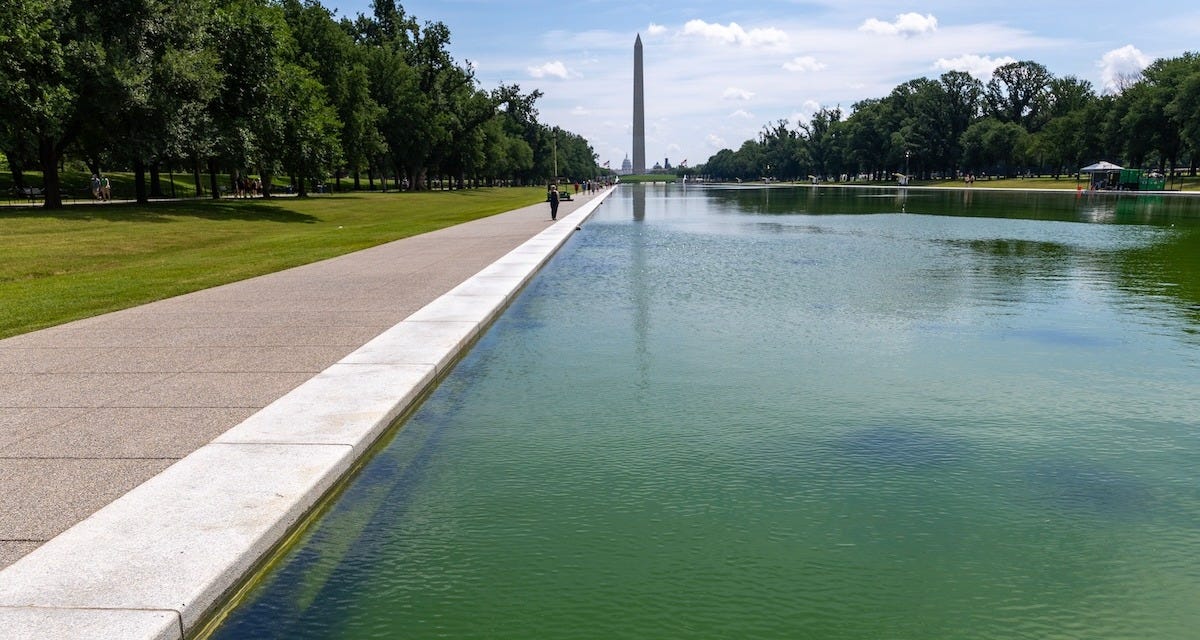
Fortunately, there are many lower-stakes ways to play this game, too. Trump handed an unqualified ally $14 million to make the reflecting pool on the mall look like a swimming pool, and within days of completion it was already opaque and green with algae.
It turns out the palace ballroom Trump intends to build on White House grounds has cost taxpayers hundreds of millions of dollars already, and Trump knew it when he told the public it would be fully paid for by private donations—bribe money. This is outrageous, but it’s also grist. It strengthens the case that Congress should stop him, even claw back the public funds, leaving him unable to complete the project such that his term ends with a giant hole in the ground where the East Wing used to be. A monument to his greed and incompetence.
So congratulations to Trump, he’ll make it into the history books after all. If the republic endures another hundred years, that generation’s wayward young high school students will learn about him in the same osmotic way I learned about the other Big Deal Presidents. But the world Trump is trying to build is one where the writers of those books have to lie about the 2020 election, and where schools and parks and public buildings bear his name even in parts of the country where he was most reviled.
We have to aim for something like the opposite, where even dead-enders know that their loyalties are embarrassing. Something about themselves that they either conceal, or broadcast like nuisance neighbors, who festoon their homes in vile iconography to upset people in their own communities.
Trump’s properties will either be seized, sold, and stripped of their branding, or they’ll become for-profit museums underwritten by federal subsidy. The Trumps and the people who’ve foisted him on us can see the two endgames with perfect clarity: triumph or eternal disgrace. The question is: Can we?
The less said about this the better.
A quick search on Amazon shows me results for 24ft telescoping arms + adapters for spray cans -- I can easily foresee a near future where some brave soul takes it upon themselves to desecrate Donald's humiliation shroud in front of the Kennedy Center.
A bold, high-viz paint saying something like "Trump is in the Epstein Files" and that tarp will come down real quick -- at least long enough for the pictures to be posted in every corner of the internet.
Nothing the current Lead Weenies™️are doing should give any of us confidence that they understand, let alone have the stomach for, the necessary decontamination and systemic disinfection the country will require following the end of the soon-to-be-former Trump Super Fund Administration™️. It's frankly disqualifying. Thanks to Rep. Beatty, and Pritzker, and Ossoff, and a handful of others (even Newsom, God help us), we know a few of our electeds aren't completely flaccid and feckless. I personally think it's too late for the USofA, but I would love to be proved wrong. (I don't think I will be.)