
Court Expansion Is The Linchpin Of American Renewal
Inside the mailbag: Abdul el-Sayed ... Climate Change ... Deplorables

Casey: Why does the progressive wing of the party seem so much more comfortable fighting the centrists than MAGA? Especially now that they have clearly won many, many arguments within the party. Once you win inside, you gotta start fighting outside. Not seeing much of that.
Assuming that by progressives, you specifically mean insurgents who rose through DSA or Justice Dems, or who are aligned with the squad, and not just typical members of the Congressional Progressive Caucus… I would aver that progressives have won some arguments, but not others, and while their footprint in the party has grown, it’s still quite small, and the leadership is still quite hostile to them.
Progressives have gained enough power in the party to move the policy needle to the left, but not to win ideological fights outright. And so they mount more challenges.
Here, at the exhausting conclusion of primary season, this creates the impression that they’re “much more comfortable fighting the centrists than MAGA.” Because that’s where the action has been, that’s what the news is about. Moreover, for a few contingent reasons, we can’t easily hark back to a time when a leading new-progressive really stuck it to Donald Trump or the GOP. Zohran Mamdani won a Democratic primary, and then one of the Democrats he beat became an independent and ran against him in the general election, so we got more Dem-on-Dem violence. AOC defeated Joe Crowley, then waltzed into office because her district is not competitive. Most insurgent progressives have won in deep. blue territory.
But I don’t think it follows that they’re uncomfortable fighting MAGA, or that they don’t do it.
Here’s the peroration of Zohran Mamdani’s victory speech, after he defeated Andrew Cuomo and Curtis Sliwa:
As I write this, Abdul el-Sayed is viral on the internet making a hard pivot to attacking Mike Rogers.
We’re going to see a lot more in this vein, because Abdul el-Sayed is really the first high-profile Bernie Sanders ally who’s become a Democratic Party nominee in a high-profile, competitive race.
AOC fights Republicans on Capitol Hill almost exclusively.
There are surely some wreckers on the radical side of the DSA that really do want (or think they want) to chew the Democratic Party up and spit it out before turning to the pursuit of national power. There are accelerationists on the right, too.
But the entryists—Mamdani, Ocasio-Cortez, Sanders, el-Sayed—aren’t really like that.
Republicans are all in for Trump and all knives out for Democrats all the time now. I think they’re about to learn that the enforced unity that marks their personalist politics has some pretty severe downsides. But as recently as last decade they were very fractious. They and their propaganda outlets devoted tons of resources to lib owning, no doubt. But the party endured a years-long insurgency at the same time. This was very uncomfortable for them; it cost them a bunch of winnable races. And if you followed that insurgency closely, you would’ve walked away with the impression that the far-right was particularly obsessed with defeating RINOs.
It would be a big bummer if the progressive insurgency costs Democrats winnable seats in the same way. But the right-wing fanatics who came to power became Republican incumbents, and are now full-time, lib-owning partisans.
Mark Adler: Why expand the Supreme Court? I don’t like how they’ve ruled, but it’s just a temporary solution and the Republicans could do the same and add their own people. It’s just a race to the bottom, without a principled goal. DC and PR should be states and the filibuster is stupid, so adding more states and eliminating the filibuster are principled. But do you really think 9 is not the right number of justices and is the only goal just to overwhelm the conservatives?
I think nine is a mostly arbitrary number, but to the extent that there’s any logic to it at all, it’s that nine is 1) an odd number, and 2) the number of circuit courts that existed over 150 years ago when the Judiciary Act of 1869 became law.
Today there are 13 circuit courts, and 13 is also an odd number.
But your game theory point is real, as is your implication that adding seats to the Supreme Court doesn’t contain the same internal, small-d democratic logic that statehood or filibuster reform do. And the counterpoints are important for Democrats to internalize, and then to impress upon others. Because they’re going to need norms-minded and risk-averse liberals to come around to the case for expansion.
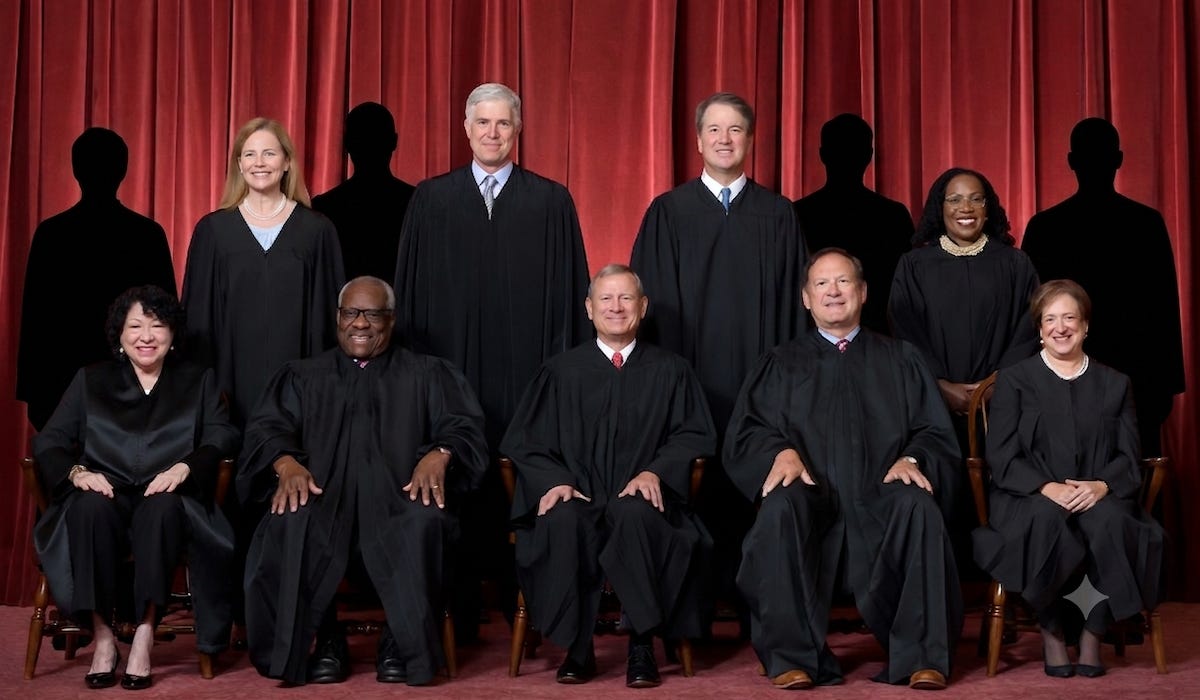
The gist is that the Supreme Court is institutionally unlike the political branches, where ideally the people choose their representatives, and everyone’s vote counts the same. But there is supposed to be a tether between the public will and the jurisprudence of the day, in that people elect presidents and senators, and then they establish the composition of the courts. Republicans have severed that tether. The court they have built now stands as a corrupt obstacle to making our system more truly democratic. And so it must be checked and balanced in a way that allows popular majorities to govern. Almost invariably, that starts with changing the composition on the court by law, rather than by waiting around for the right justices to die at the right time.
Start with your observations about statehood.