
Confront Trump's California Election Lies
Let's not just roll our eyes and hope for the best again.

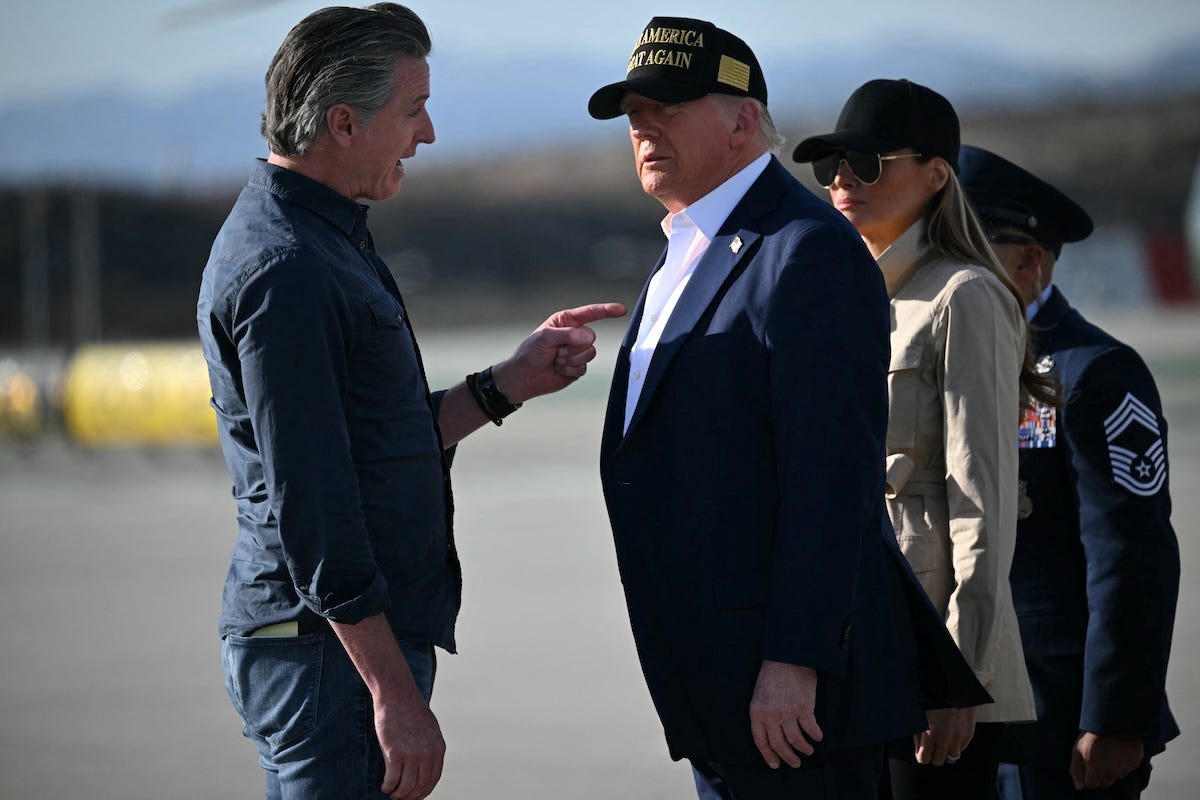
Donald Trump stormed off the set of Meet the Press Sunday because Kristen Welker had the temerity to note he has “no evidence” that Democrats steal elections.
Trump was mostly fixated on the 2020 election, because that’s the one he lost. But this time he did something that could help us beat back his election lies more thoroughly: He alleged fraud in an election that’s underway right now—while he is president, and, crucially, after he has toppled the firewall separating the White House and Justice Department.
PRES. DONALD TRUMP: You play right into their hands with this stuff. You know that these elections are rigged. Your network knows that they’re rigged. Do you know that I won an election in a landslide and I got 94% bad press.
KRISTEN WELKER: But Mr. President –
PRES. DONALD TRUMP: You know why I got that?
KRISTEN WELKER: – you’ve never presented –
PRES. DONALD TRUMP: Because you have no credibility.
KRISTEN WELKER: -evidence. But you’ve never presented evidence it was rigged. Let’s keep talking about, I want to talk about Todd Blanche.
PRES. DONALD TRUMP: You have more evidence, there’s more evidence than ever presented.
KRISTEN WELKER: Let’s talk about–
PRES. DONALD TRUMP: Your elections in this country –
KRISTEN WELKER: – you went to court.
PRES. DONALD TRUMP: We’re like a third world country.
KRISTEN WELKER: But sir –
PRES. DONALD TRUMP: Your elections are crooked and you’re crooked, and Meet the Press is crooked.
KRISTEN WELKER: But Mr. President–
PRES. DONALD TRUMP: And so is ABC and CBS and CNN.
KRISTEN WELKER: But Mr. President–
PRES. DONALD TRUMP: You’re a one-sided crooked network. Sorry. Let’s call it quits because I’ve had enough. Thank you, darling. Have a good time.
This is no less repugnant than any of his earlier election lies. But it could be of more use. The lie rests incongruously alongside federal inaction. If there were evidence of fraud, this Justice Department would collect it aggressively and bandy it about for the whole world to see. It would raid counting facilities and seize ballots and air allegations at press conferences.
The fact that nothing of the sort has happened is a tell. It confirms widespread awareness, even in Trump’s orbit, that his lies are just what they appear to be. And it should mark a change in how the political establishment grapples with Trump’s addiction to promoting election conspiracy theories. Alas, in all likelihood, the opportunity will slip away and we’ll continue as we have for the past decade, treating these poisonous lies as a fact of life we must tolerate.
Welker’s choice of the word “evidence” here is worth dwelling on—though we should note that she didn’t coin this phrasing; she’s just the one who drew the Trump interview this week. The word “evidence” is the crutch basically everyone in the mainstream news business uses when dealing with Trump, in order to flag his false claims without calling him a liar or asserting the truth with certainty.
She’s of course correct that Trump has presented no evidence of election theft, because he just made it up. It’s not just that he has no evidence—it’s that the election was not stolen.
One could in theory defend this phrasing on proving-a-negative grounds. Maybe—just maybe—someone pulled off the perfect heist and covered their tracks meticulously. Wouldn’t it be irresponsible of a reporter to claim certainty about things unseen? Even low-probability events?
As a rhetorical move, this is a copout—indeed, it should be a source of embarrassment to the news industry. On one hand, there is “no evidence” of Democratic election theft. On the other hand, there is no “proof” that the election wasn’t stolen—because proving a negative is impossible. But that shouldn’t be the end of the inquiry: There is, after all, substantial evidence that Trump knows his claims aren’t true.
January 6 investigators discovered that many of Trump’s most trusted aides told him that his claims of election theft were false. They also discovered that he would privately acknowledge his defeat to them. “Can you believe I lost to this effing guy?" he said.
“I don’t want people to know we lost, Mark. This is embarrassing. Figure it out,” he instructed his White House chief of staff. At one point he told his family, "It doesn't matter if you won or lost the election. You still have to fight like hell.”
If evidence is the standard for making a controversial assertion on television, then the right response to Trump claiming any election is stolen is: A thorough investigation established that you know you lost and are being dishonest about it.
But let’s be exceedingly generous and allow that Trump’s mental illness may have weakened his grasp on reality. Perhaps he once knew he lost the election, but over time his brain convinced him that he actually won, to protect him from ego injury. Maybe in that sense he isn’t lying the way he lies about other things, because his comments lack deceptive intention.
This is why it’s useful, in a perverse way, to see him tell the same lie about the Los Angeles mayor’s race, in which the Republican candidate, Spencer Pratt, failed to qualify for the general election ballot.