
Obama, Trump, And The Outmoded Politics Of Indirection
We can say what we mean about the bad guys; it might work better.

Right-wing consciousness of guilt is one of few amusing phenomena of the Trump era. It is so pitched, and conservatives so self-aware, that any nod to virtue strikes them as an accusation, and they lash out angrily.
Observe in a campaign speech or on social media that lying is bad; produce a film or write a book in which the antagonist is immoral; praise a politician for keeping his word or serving all of the public; and they will interpret it as a partisan political attack, skipping the step where anyone actually has to say anything explicitly negative about Donald Trump.
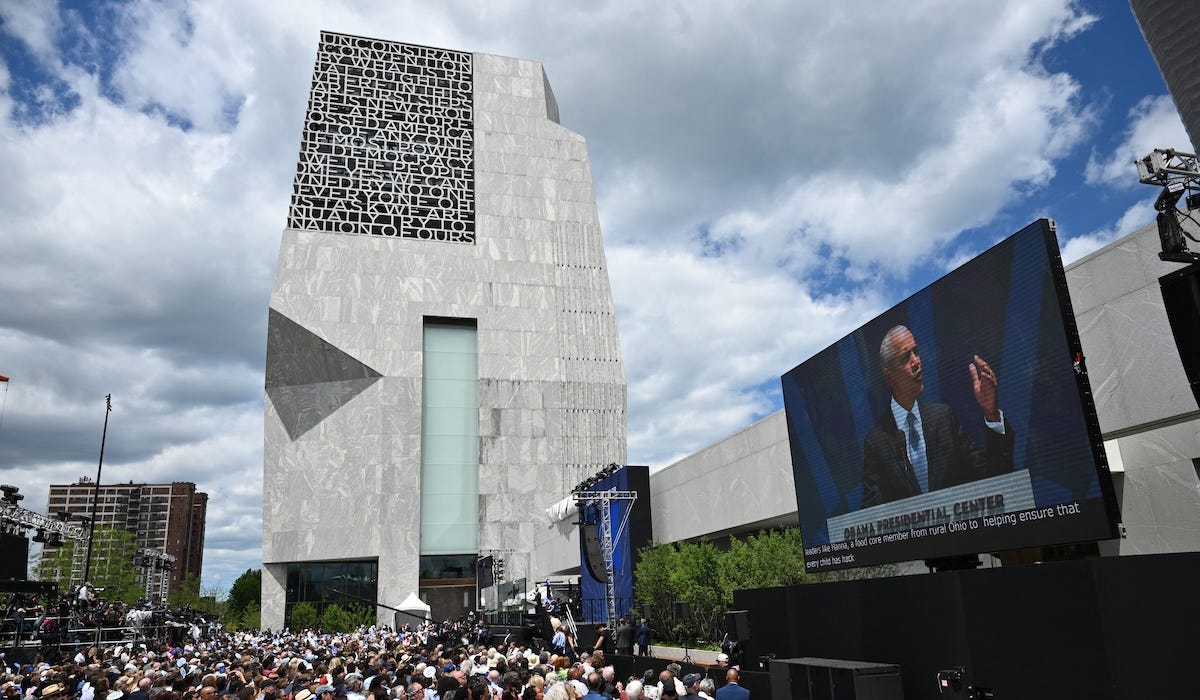
This is why they interpreted Barack Obama’s speech at the dedication of his presidential library last week as a partisan attack, while many of the rest of us were struck by how oblique it was.
Fox News called Obama “classless” for taking “partisan shots” at Donald Trump, whose name went unmentioned all day. Others took it personally—as a “cheap shot”—that Obama gestured at the importance of the peaceful transfer of power. Obama’s admirers and members of his inner circle, meanwhile, were quick and proud to note that Trump’s name went unuttered.
Obama’s politics have always been indirect in this way. Rarely—and almost exclusively in the heat of campaigns against Donald Trump—has he expressed exactly what he means about the people he opposes.
This has been a bit of a sore spot in Democratic politics—especially now after most politically engaged Democrats have concluded that Michelle Obama’s famous mantra—“when they go low, we go high”—was well-intentioned but bad political advice.
There is a small but vocal (and by some measures ascendant) faction of progressives who believe or claim to believe Obama was actually a bad president. Not incompetent, not woefully naive, but a villain.
Abutting them, are another set who deem him a failure almost by definition—after all, if his politics and leadership were so successful, why did the country reject his anointed successor and elect Trump?
I think these arguments are essentially ludicrous. At the most extreme, they echo the committed communists who view FDR as an enemy for rescuing capitalism from the just verdict of history. They’re almost ludicrous by definition, insofar as Obama left office popular and has only grown more so in the afterglow of his post-presidency. But they’re ludicrous on other terms, too, such as: compared to whom?! Most of our presidents have been mediocre to terrible. Even the best ones have checkered records, because humans are flawed, politics is hard, and governing (particularly in a two-party democracy) is impure.
Our best president was followed by arguably our worst—not by some minority-rule glitch in the electoral system, but because Abraham Lincoln dumped his abolitionist vice president, and replaced him on his re-election ticket with a southern bigot who sabotaged what might have been an even more impressive legacy.
A large majority of American liberals admire Obama. But there is a rift—between those who believe he did the best he could, and thus floats largely above reproach, and a more malcontented bunch (including me) who really wish he’d gone about some things differently, and would change some things going forward.
Looking back, we wish Obama had devoted less political capital to negotiating with himself as a means of seizing the center, and been more clear-eyed about the rot in Republican culture.
But one of these complaints pertains to Obama’s post-presidency. He has been a reserved partisan fighter for most of the Trump era—more engaged than most of his predecessors, but more called upon than any of them ever were. There is, notionally, a norm that former presidents don’t offer color commentary on their successors. But we live in a post-norms world. We at least live in a world where we must question the value of ancient norms, rather than apply them blindly. This one is clearly obsolete, and in any case, it’s not clear it was ever doing much work.
George W. Bush forswore partisan politics after his two terms, not out of politeness, but because he left office a huge liability to his party. Same Jimmy Carter. Same George H.W. Bush, who was also a WASP’s WASP and would have deemed backseat driving Bill Clinton to be ungentlemanly. Ronald Reagan left office old and demented, and in any case he was succeeded by his own vice president. Clinton might have made an exception, but he passed the baton to his wife, whose presidential ambitions turned on navigating Bush-era politics, and by September of her first year as senator, Bush held a 90 percent approval rating.
So the shoe really only fits Obama. Yet he’s often carried himself in his post-presidency as though he’d given way to a Democratic successor in 2016, and could leave politics behind. In reality, the post-Obama era has been a bareknuckle fight for democracy—to demonstrate, in a collective sense, that liberalism is morally superior to authoritarianism and fascism. It’s called on avatars of liberalism the world over to conduct themselves with both strength and humility, if not Carteresque asceticism. Obama’s chosen to spend much of it demurring, or relaxing with celebrities.
And when he has spoken up—not just for democracy, but against Trump—it’s often been in his vintage, elliptical way.
The library opening is an admittedly poor object lesson, because it was a dignified, nonpartisan event, and a joyous occasion. Under no circumstances would any sane person want Donald Trump’s name or stench to fill the air of a gathering like that.
But Obama’s speech was fairly emblematic of his oratory over the years, and reading through the text I began to wonder afresh whether the days of politics by implication have become outmoded, replaced by an uglier, blunter era of telling rather than showing. An unfortunate development for writers, but politicians don’t get to choose their time.
I could quote from several sections to make the point, but I think this excerpt does it best:
[T]he exhibits here focus not just on policies but on the shared values that make democracy possible, a belief in the intrinsic dignity and worth of all people, and that no one is above the law or beneath its protection, a belief in checks and balances in our government and an accountability that comes with an independent judiciary and a robust, free press.
A belief that our military and law enforcement owe allegiance not to any president or political party but to the people and our Constitution.
A belief in the peaceful transfer of power after the people have spoken in fair and free elections, recognizing that in a large, complicated society like ours, no group or faction gets its way 100% of the time.
And a belief that qualities of character, honesty, integrity, kindness, compassion, a sense of duty and honor, those things matter in our public dealings, just as they do in our private lives.
These are the values and traditions I believe in, and they are not Republican or Democratic values. They’re American values we can all share, regardless of party, values every president here today, as different as we are, has tried our best to uphold, values that John McCain and Mitt Romney believed in, no less than I did.
This is an extremely roundabout way of saying Donald Trump is un-American and worthy of exclusion from polite society—even by comparison to the era’s next-worst Republicans. But that’s what the passage means.
Trump supporters hear it as an insult, because, in this case, it is intended as one. They know as well as we do that Trump is the only president of the modern era who openly rejects the idea that people have equal dignity; or who’d enlist security services in attacks on Americans or our system of government. They know Trump’s the only president who transferred power violently, and that he’s bereft of character, honesty, integrity, kindness, compassion, duty, and honor.
He’s also the only living president who was not formally invited to, and who didn’t attend, the dedication.
Obama surely knows it is controversial on the left to draw this distinction between Bush and Trump. To emphasize Bush’s politeness, rather than his record on the merits, in order to underscore Trump’s malice. The distinction is important and correct. But it is difficult to draw without explication or caveat. This is why Obama made a point (again implicitly) to note that he and Bush are quite unalike—that he was elected in many ways as Bush’s antithesis—but that only Trump is aberrant enough to be excluded. And rightly so.
I suppose my question is: How much work is this kind of euphemistic language doing in the current era? Why not just turn subtext into text, if not at the library dedication, then in less hallowed contexts? Would we not be better off just hearing the explicit claim—hearing explicit calls for a united front to expunge Trumpism?
I can’t help but suspect that the answer is yes, even if I have a hard time making a satisfyingly confident case. If I had to write with unearned certainty, the case would be something like this: Trump supporters get the messages he wants them to get—in fact everyone does. But less-engaged voters—the ones who might actually move—don't read or listen to presidential library dedication speeches with their radars tuned to subtext.
The counterpoint is that Obama speaks in polite idiom, he won the presidency twice, and remains a beloved and influential figure—while Trump is widely loathed.
But Trump also won the presidency twice. And he simply comes out and says what he wants people to believe. That the “Barack Hussein Obama” library is a “total disaster,” and so on.
Trump bears much of the blame for coarsening American politics. But I suspect the rapid evolution was structural, too. Politics is hyper-polarized, which inflates the stakes of every election, and thus draws candidates to hyperbole. We’ve given ourselves over to social media, which feeds addiction with incitement. The angrier and less subtextual, the greater the engagement. If Obama intends to restore the appeal of elevated politics, he’s got years of work ahead of him, because defeating Trump, even resoundingly, won’t accomplish that goal on its own.
It might also make defeating Trump resoundingly more difficult.
Gavin Newsom’s case for the presidency will turn heavily on the fact that he gave Trump as good as he got on social media. Jon Ossoff’s star is on the rise, in large part because he’s started talking like this. (And not just in staged set pieces.)
This is not particularly high minded stuff. And yet it’s totally accurate and refreshing to hear! There are people out there who don’t know, but need to know, what Ossoff knows.
Trump reduces politics to a simple morality play, draining it of nuance and subtlety. Allowing Trump’s vulgarity to speak for itself has worked wonders for Obama, but I suspect it’s contributed significantly to Trump’s ability to fight to a draw over his greatest liabilities—his corruption; his contempt for democracy. He’s not popular, but neither are the crazed radical left Democrats or the Biden crime family or…
Trump’s elite enablers are conscious of their guilt; when Obama speaks they hear all the undertones. But what about all the people out there who, against all evidence and reason, still aren’t sure what to think?
I like the Osoff approach. Unfortunately, a lot of Dems don't like it because they are 'above it'. They don't understand that 'getting dirty' is the way the world works right now. A bunch of people drinking shitty coffee in Brooklyn ain't gonna get a President elected.
Right now messaging has to be simple and striking. Trump is an incompetent crook stealing all he can get. All he wants is your money.
Or Trump started this war because he's so stupid. Dumber than dirt! But he'll use it to steal more from us, just watch.
Have graphics with him grabbing cash from the hands of dead soldiers. Or kids.
Gotta use stuff that tells the story and makes it stick.