
Barack Obama And The Lost Art Of Broad Empathy
Democrats want to seem authentic; they also want to land on the right side of public opinion; when they mishandle the dilemma they fail on both counts.

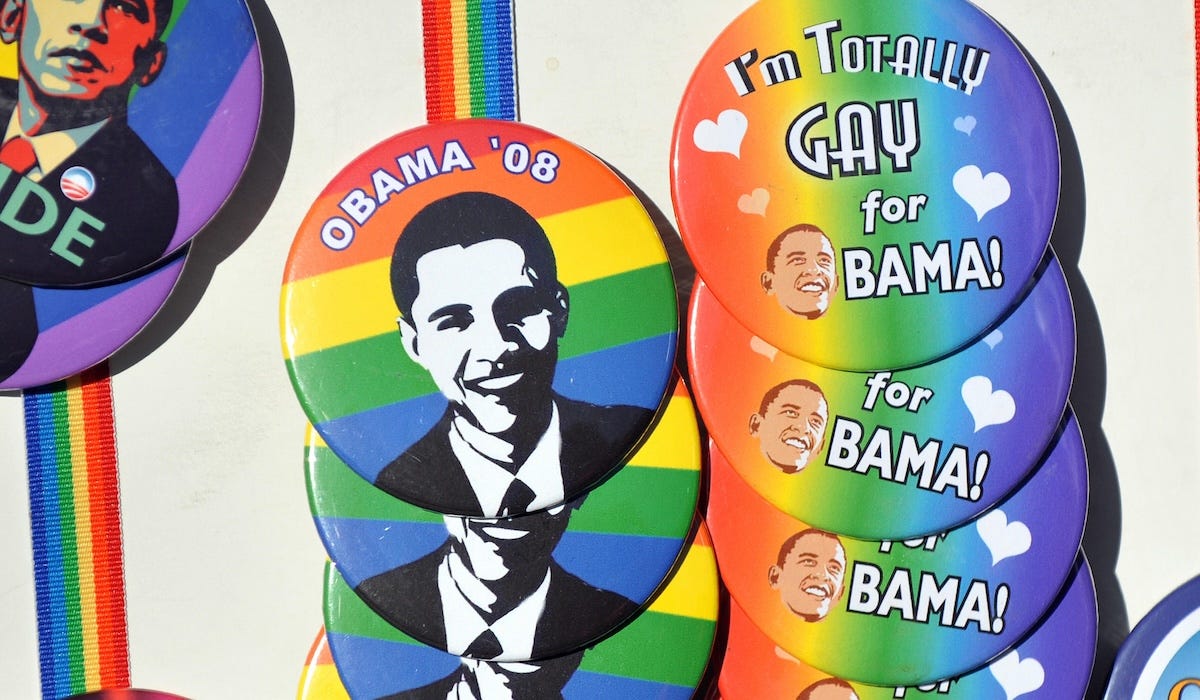
How did Barack Obama manage to win over “traditional values” voters? Or, at least, enough of them to carry states like Indiana?
A few theories, not mutually exclusive:
Obama was incredibly charismatic, which made people predisposed to liking him, sight unseen. Even people with, let’s say, strong unconscious bias against black people identified him as “one of the good ones.” This is what Joe Biden alluded to so clumsily in 2008, when he told the New York Observer, “I mean, you got the first mainstream African-American who is articulate and bright and clean and a nice-looking guy. I mean, that's a storybook, man.”
Obama was right from the outset, where most Democrats and all Republicans were wrong, on the central issue of the day: The war in Iraq was stupid.
Obama was obviously more culturally progressive than just about anyone in Republican politics (cf. abortion) but did not front-run public opinion on most cultural issues, particularly pertaining to race, sexuality, and the nuclear family.
This is what made the Jeremiah Wright controversy such a threat to his political viability, and why he delivered a famous speech on race at the National Constitution Center in Philadelphia in March 2008. But it’s also why he had to get dragged (or acted like he had to get dragged) into supporting same-sex marriage. He ran for president, and for much of his re-election campaign, as an opponent of same-sex marriage.
He invited Rick Warren, an avowed opponent of LGBT equality, to deliver the opening prayer at his first inauguration.
This was vexing to those of us who already understood “marriage is between one man and one woman” as an assertion right-wingers coined to draw mainstream support for discrimination against gay and lesbian couples.
Obama said it, too! How could he do that?! And how could it not run afoul of gay and lesbian voters, to say nothing of LGBT advocacy groups?
The answer, I think, is: That’s not all he said.
Here’s a representative comment, offered as an answer to a question from Jake Tapper. “I believe that marriage is between a man and a woman, but I also think that same-sex partners should be able to visit each other in hospitals, they should be able to transfer property, they should be able to get the same federal rights and benefits that are conferred onto married couples. And so, you know, as president, my job is to make sure that the federal government is not discriminating and that we maintain the federal government’s historic role in not meddling with what states are doing when it comes to marriage law. That’s what I’ll do as president.”
Or, here, just watch:
Charismatic as Obama was, though, I recall thinking this was all terribly inauthentic. (Turns out I was right.) I did not believe, even as an impressionable young person, that Obama sincerely opposed same-sex marriage. Perception is subjective, but he did not seem to be giving voice to his conscience. He seemed rather to be sheltering on the safe side of public opinion. This was frustrating—even to me, as a heterosexual person whose dignity wasn’t being treated as a political chit. But in a weird way, it was also reassuring: Better someone who’ll let the wind carry him than a regressive ideologue who’ll stand his ground. And maybe better someone whose heart is in the right place—who cares about all people—but who’ll fake traditionalism as a hedge against losing an election to someone who’d set back progress on all fronts.
This is all relevant in today’s discourse, as Democrats find themselves whipsawed between public demands for “authentic” politicians, and public opinion on certain cultural issues, where progressive Americans and activists are well to the left of median.
Many of them experience cognitive dissonance, and, thus, appear inauthentic, when discourse alights on issues like race preferences, or language inclusivity, or (in edge cases) trans rights. Wherever their hearts lie, most of them can’t land the politics.
The latter is probably GOP’s preferred wedge issue. If 18 years ago, Republicans shrieked “one man, one woman” to place Democrats in a bind, today they shout “girl’s sports!” They say a variety of other, nastier things, too. But youth sports is the issue they cooked up in a lab to wrong foot Democrats. When they treat trans people as mentally ill or inherently violent, their cruelty is evident; but when they say “boys shouldn’t be allowed to play on girl’s sports teams,” they at least appear—in text if not intent—to be standing up for one set of children over another, on the basis of fairness.
In truth, they don’t care about children’s sports, or women’s sports, or even the main, professional, male-dominated sports, unless they’re useful for tribal recruitment. They care about political cudgels. Their views on NFL football and NBA basketball bounce around depending upon whether star players are obedient or free-thinking, or whether owners are willing to discipline players who speak out of turn. Athletic excellence is beside the point.
But they have made this a capital-I Issue. And while their cynicism is an essential part of the story, and a potential liability, Democrats can’t get away with refusing to weigh in on the controversy, no matter how frustrated they are that it’s ginned up in bad faith.
And this gives rise to a question at the heart of Democratic disarray, but that nobody can quite articulate in our soundbite-dominated politics: If the public today gravitates to authentic politicians, but a prominent Democrat authentically holds an unpopular view, what’s the right thing to do? Should they stick to their guns? Or should they do what Barack Obama did?
Frustratingly, I don’t believe there’s a correct, generalizable answer to this question.
But there are useful heuristics. And they point to the ways factional warriors on both sides of the Democratic Party tend to harm their own causes and the collective cause of defeating fascism by fighting each other rather than Republicans.
Progressives and moderates have conflicting theories of victory. The former believe conviction in defense of the little guy sells—if it doesn’t persuade, it at least earns respect; the latter believe public opinion comes first, and is more or less the whole ballgame. They view each other as existential obstacles to national power. But in their stridency and zero-sum attitude toward one another, they each lapse into inauthenticity.
What is authenticity?
As I mentioned to Nicholas Grossman a couple weeks ago, I think it’s reasonable to define authenticity as the synthesis of self-knowledge and comfort in one’s own skin. Not necessarily charisma, but confidence and fearlessness. A person is authentic if they know what they believe, why they believe it, and can defend it without wilting or lashing out.
This can be faked, politicians try to fake it all the time. But only a really talented, intelligent, cynical actor can pull off the performance of authenticity without the sincere belief that’s supposed to reside at the heart of it. Even Obama struggled. His poker face was poor. And this is why factional fighting over questions like what to do about trans sports tends to leave most Democrats looking like caricatures of themselves. Progressives, like people pandering to interest groups; moderates, like people striving to impress the masses by triangulating against their own coalition partners. Hippie punching.
The right-wing wedge is a federal ban on trans participation in girl’s sports.
The left-wing counter is civil-rights protection for trans athletes.
From there the position-taking race is on, but few seem to really believe what they say. They lead with their inauthenticity. Emphasis on the word “few.” There are, in particular, progressives who hold the maximalist line fearlessly, without flinching, even at the risk of losing elections. Even at the risk of losing primary elections. They are authentic.
But there is a reason so many Democrats and progressives get tripped up on debate stages or as witnesses at congressional hearings. They are conflicted internally, and it spills out into the public. They know they’ve been cornered into a position that requires them to either grapple with an uncomfortable tradeoff or deny it. Their well-developed, well-intentioned reflex to side with the little guy comes into tension with the reasonable concerns of other little guys.
Centrists fall into a mirror-image trap. They are, ostensibly, members of a pluralist and tolerant party. When they echo Republican talking points without qualification, they seem out of place; like they know they’re stepping on vulnerable people demonstratively, as a branding exercise. They’re angling, or seem like they’re angling, for the sweet-spot of public opinion, rather than expressing sincere belief. They believe that politics is a game that can be solved by seizing the center on salient issues, and they validate their alignment with the majority by demeaning leftists who stand on unpopular principles.
It’s a hash. And it’s all before we get to the fact that the Republican position—an enforceable ban on trans participation in opposite-sex sports—would be a civil-liberties nightmare.
The Republican view on same-sex marriage in 2008 was also a nightmare: It was not just that the state should refuse to recognize same-sex couples, but that it should deny them rights reserved only for heterosexual couples. From tax benefits to hospital visitation.
Obama may have been inauthentic in his traditionalism on this issue. But he wasn’t doctrinaire about his position-taking, either, and he did not try to showcase his independence by attacking progressives and (through them) gay people.
It’s infuriating that in our warped discourse, every right-wing culture provocation requires an answer, and that the right answer is so often presumed to be: find a vulnerable person and kick them in the teeth.
But I also don’t understand why Obama-like answers that maximize empathy across the population have fallen out of favor across the factional divide.
There’s a soccer field near my house, and at least once a week I walk past with my dog as boys and girls play soccer together. Everyone’s always having a great time. And since there is obviously no problem with this arrangement, it just as obviously wouldn’t matter if one of the girls was trans.
But as they age, things will change. Most of the boys will grow taller, stronger, and faster than the girls. I can’t imagine ever feeling compelled, then, to call in the government like a meddling tattletale. But I can imagine a near future when playing those same kids against each other would seem or simply become unfair.
That is the mass intuition Republicans exploit. It’s their cudgel. It’s why those debate-stage Democrats get tripped up on the question to this day. They want to be kind to the trans girl who’s bigger and stronger than the cis girls, but desperately wants to fit in and play with her peers. And so they struggle to acknowledge differences that would be uncontroversial to them if the trans girl were a cis boy.
Does this make them radical? No. It means they’re acting on a lovely, humane impulse. And since the dilemma arises so infrequently, they ask themselves, subconsciously, “what’s the harm in a little hand waving.” But lovely and humane as the impulse is, even a hint of confused thinking can strike an equally kind-hearted person as uncanny. Insensible. Perhaps even “inauthentic.”
That’s the bind. But in no sense does political expediency requires Democrats to flip all the way around to the Republican view. This is too many words to fit on a bumper sticker, but it’s not too many words for some candidate on a debate stage: The trans-sports controversy reflects a rare but heart-breaking dilemma. One kid who wants to play with her friends and peers; another who feels they can no longer compete on a level playing field. However the dilemma gets resolved, someone will feel like they got a raw deal. And sometimes, it will be a trans child. But when these situations arise, we need mature adults—teachers and parents and coaches and principals and league officials to decide what’s fair under what circumstances and resolve the conflict. And whatever they decide, they need to do it in a way that’s kind to children; to not bully them or make them feel like they don’t belong. By the same token, anyone who raises this issue angling for political advantage through cruelty to children is beneath contempt. Leave that vileness to Republicans.
This more or less encapsulates my authentic belief. I suspect it’s Obama’s, too. But unlike in 2008, when he feigned opposition to true civil equality for same-sex couples, the middle position here isn’t just a calculated hedge against the risk of blowback and backsliding. I tend to doubt the maximalist position on this issue will ever become the popular consensus1. Because in this case, there’s actually a dilemma. Hard as aughts conservatives pretended that same-sex marriage would cause marriage itself to dissolve as an institution, no interests were actually butting up against one another. The dilemma was fake. This dilemma is rare—but it’s real. And so we’re going to just have to figure out how to accommodate one another, and be neighborly about it.
I’m not a talking points writer. But I think this view would carry with the broad public, its conflicting opinions, and its apparent hunger for authentic leaders.
I think it’s likelier that we’ll some day end sex-segregated sports all together, and assign people to teams and competition based on bespoke measures of height, weight, and strength, than that majorities will eventually support civil-rights protection for trans athletes.
There is literally no scenario where a President will be on the hook to make a determination about ‘men in women’s sports’. Why accept a challenge to argue this stuff?
Being willing to be drawn on your opponents fake issue *is the loss*. The issue is secondary. In fact it doesn’t really exist.
Change the subject to the best, latest hit your oppo research has come with about your opponent.
In this comment, I attempt to display my Solomonic wisdom in resolving the thorny issue of transgender women participating in women's sports. Let the brickbats fly!
1. The issue the GOP has manufactured here is 99% bullshit. Can they name a single person who, as a man, couldn't cut the mustard in men's sports, and so decided to undergo gender-changing therapy to increase their odds in high-level sports? Of course not. Most young men in such a position would simply give up their dreams of high-level sports glory and find something else to do with their lives.
2. Cis-gendered girls who have trained for years to attain a high level of competence in high-level women's sports do nonetheless have a point when they complain about transgendered women who haven't trained as heavily as they have, competing against them, relying in part on innate biological differences. This is the other 1% referred to in #1 above. This is rare but it is real.
3. There are many things that men transitioning to women can't do. They can't, obviously, give birth. I guess I don't have a huge problem in adding high-level sports participation to that list. It might best be thought of as part of the deal.
4. Nothing I've said above applies to free-play of sports between boys and girls, cis- or trans-. That should be allowed in all circumstances. It applies only to high-level college, olympic, and professional athletics.