
A Requiem For The Old MSM
Time to go back to basics.

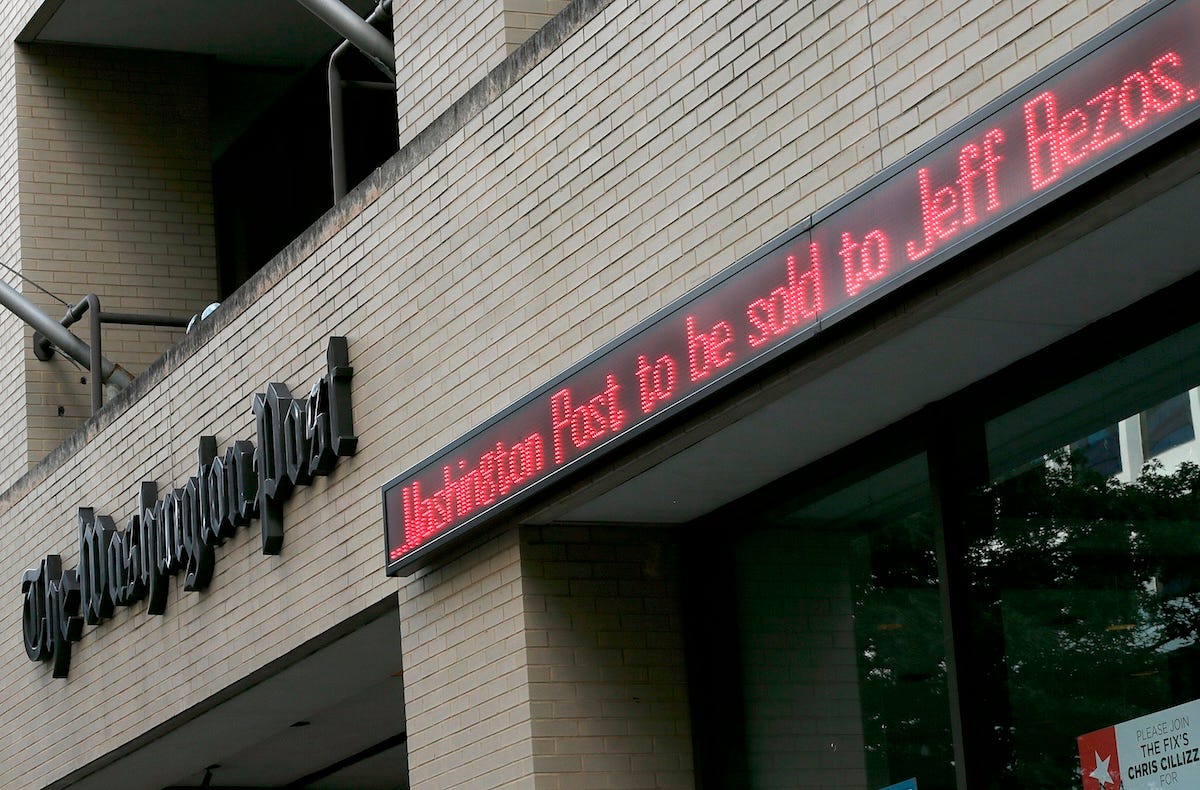
Why did Jeff Bezos do what he did to the Washington Post?
How did he end up becoming the face of such an unredeemed act of destruction, haphazard and wanton in equal measure?
To me, it can only be explained as an act of malice carried out incompetently. If deep in his heart, Bezos wanted to restore the Post to the greatness of its past golden ages, then we’ve witnessed a cascade of pure incompetence. If, for sheer greed, Bezos wanted to transform the Post into a right-wing mouthpiece, there were surely ways to do it competently.
From his submarining of the Post’s presidential endorsement, to the bribes he directed at the Trump family, and his naked panhandling for billion-dollar federal contracts, we know that Bezos’s motives aren’t pure. It follows that he fumbled the execution.
I’d argue further that he and the hired hands left such a long trail of failure in their wake because they would not cop to their ulterior motive. Bezos was willing to commandeer and repurpose the Post’s opinion section, concealing his intentions in the euphemisms of “free markets” and “individual freedom.” But he could not bring himself to own the dishonor of defanging the newsroom, or (worse) transforming it into a right-wing propaganda broadsheet reminiscent of the old Washington Times.
So he blamed the staff.
It should go without saying that if a major newsroom was profitable in recent memory, the abrupt dismissal and attrition of half of its journalists must be a failure of management or the consequence of an unanticipated catastrophe, rather than any kind of comment on the quality of the workers who lost their jobs. There is a lot of turnover in journalism, but not that much. The Post became adrift after Trump’s first term, but it was only after Bezos made management changes aimed at placating Trump that it hemorrhaged subscribers and drove staff to the exits. Every large organization has dead weight, but this is on Bezos and the people he hired to run his newspaper.
Hints of what was to come began mounting in 2023. In 2024, Bezos henchman Will Lewis told the newsroom, “People are not reading your stuff.” But in hindsight, this small bit of color, buried in a prescient 2025 New Yorker investigation, looms larger. Amid severe turbulence in 2024, when Bezos spiked the Post’s endorsement of Kamala Harris, he reportedly told Post management he “wanted the paper to ‘widen its aperture.’”
“Jeff apparently started pulling up the Atlantic app and was saying, ‘Why don’t we do these stories?’ It was almost like someone who descended from another world.” Bezos had said that he wanted the Post to broaden its appeal, but he was pointing to a magazine with a targeted audience. Bezos also mentioned that he thought more firefighters from Nebraska should be reading the Post.
Here is the telltale dodge of essentially all media executives commandeering news outlets on behalf of Donald Trump: Right-wing audiences don’t like you, ergo you must be biased, ergo we must “restructure.”
To a person, they all know that this is a form of victim blaming. That right-wing audiences have been trained over generations to dismiss real journalism categorically, and thus that—if the goal is to continue producing journalism—they can not be the target market.
Something along these lines is underway at CBS News, where the Trump-approved Bari Weiss recently told staff “not enough people trust us,” and is likely coming for more television networks and cable outlets and newspapers. They will be transformed into regime media, or they will be sacrificed on its altar, and it will all be undertaken in the name of Real Americans—like the not-at-all-imaginary Nebraska firefighters who would be loyal Washington Post subscribers if only the paper were friendlier to Republicans.
The sad irony is, many of these same newsrooms have sold themselves on a similar version of this false critique. Many reporters and editors also believe that the problem of right-wing distrust in journalism can only be remedied with more pandering, at the expense of the existing audience.
In reality, it can only be resolved through a revolution within conservative culture that places civic virtue closer to the center of things. Or through a kind of political collapse that discredits the institutional right. A man can dream. But while we await the unlikely, outlets caught in the sights of MAGA-aligned billionaires can make themselves a bit more resilient to subversion by returning to a first principle: that the purpose of journalism as a vocation isn’t to produce reportage that appeals to every sliver of the political spectrum. It’s to best inform the citizens who wish to be informed.
So stop hitting yourselves. Bad acting executives like Bezos and Lewis and Weiss are deploying your own misguided internal critique against you, to do the bidding of journalism’s most powerful enemies. Let go of the notion that fairness and accuracy in reporting requires bending to right-wing pressure tactics. Or, to provide a clearer benchmark, do the kind of journalism the Post was doing during the first Trump presidency, when Marty Baron ran the newsroom.
That version of the Post struck a pretty good balance. Many in the industry bristled at the Bezos-approved tagline “Democracy Dies In Darkness,” but it worked as a branding exercise because it simultaneously captured the main civic challenge of the Trump era, and appealed to the real, addressable market of American newspaper subscribers. It was both a guide star and a sales pitch. In the Biden years, the Post could have followed the same star and seen the story of the threat to democracy to a more fitting end. A Post that freighted January 6 with as much import as Hillary Clinton’s email scandal might have noticed before it was too late that Joe Biden’s Justice Department was keen to let Trump slide. It might have even compelled Merrick Garland to move with greater dispatch, strengthening the winds of swift justice. That would have been a huge public service and form of mission fulfillment.
Instead the paper regressed back into the kind of aimless journalism that arises when outlets don’t have a guide star. When, for instance, they fear that treating democratic backsliding as the biggest threat to the stability of the country might paint one party in worse light than the other. When they, thus, dilute their own mission by glibly inflating the importance of competing stories and narratives.
The purpose of this big-picture kind of false balance is to attract those elusive Nebraska firefighters, but the effect is to help soften the image of the party and movement that’s committed to the destruction of journalism as a vocation.
Journalists who care about journalism should want no part of it. But many are scared of what it would mean to ditch false balance. I know this because I’ve been around a while, but also because it’s been confided in me.